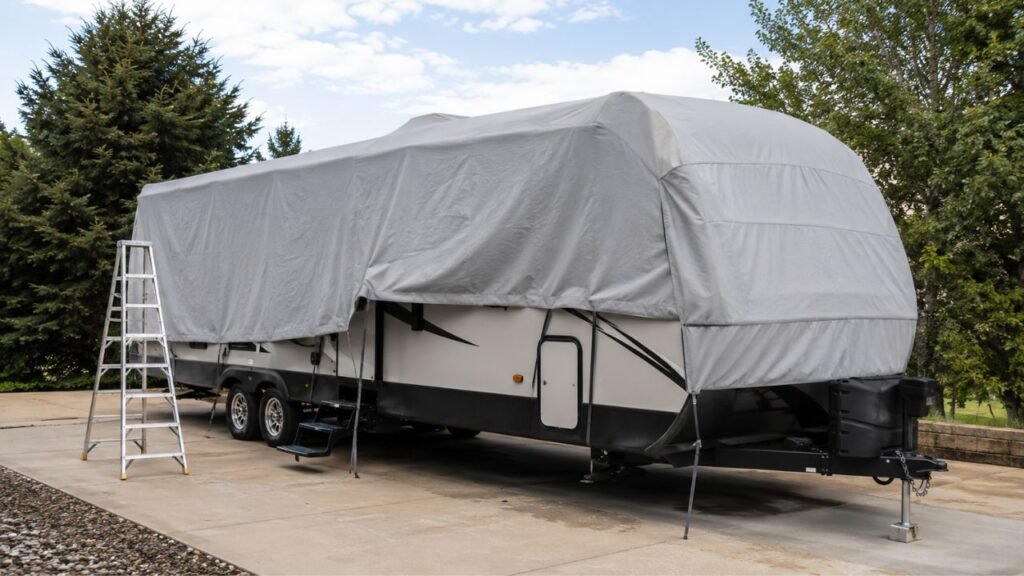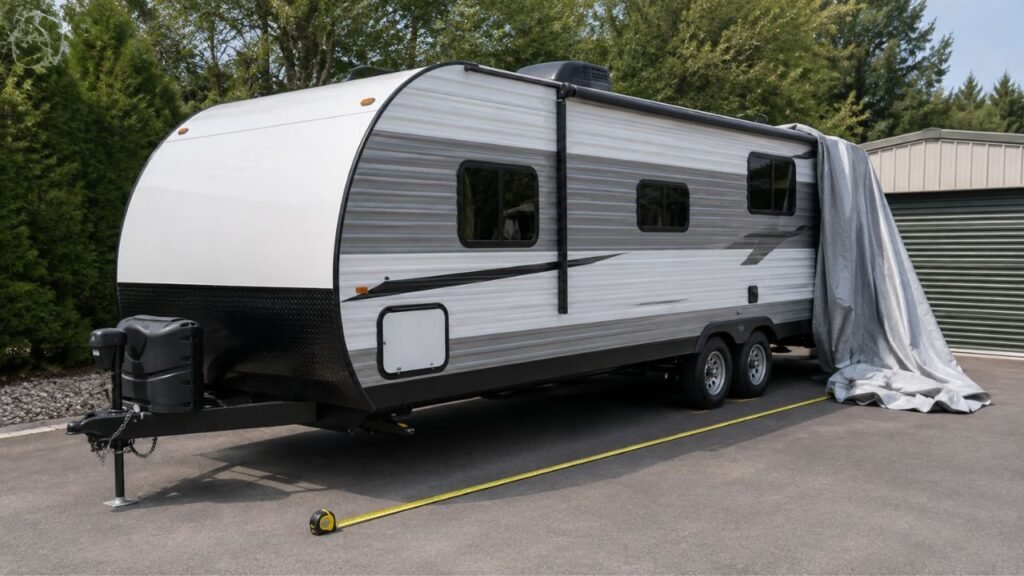
To measure an RV for a storage cover, measure its actual coverable length, width, and height while it is parked in storage configuration. For most travel trailer covers, include fixed rear items such as the bumper, spare tire, and ladder, but exclude the front hitch, tongue, and propane tanks unless the cover manufacturer says otherwise.
I’ll walk you through exactly where to place the tape, what accessories to include, how different RV types should be measured, and how to use those measurements to choose the right cover size.
Key Takeaways
- Measure the RV yourself instead of relying on its model number.
- Length is usually the most important measurement for cover sizing.
- Include fixed rear items that the cover must fit over.
- Travel trailer hitches and tongues are usually excluded.
- Keep slide-outs, awnings, and mirrors in storage position.
- Many covers already allow room for standard roof A/C units and vents.
- Cover height is not always the same as total road-clearance height.
- Follow the sizing instructions for the exact cover you plan to buy.
- Do not automatically choose a much larger cover for extra room.
What Measurements Do You Need for an RV Storage Cover?
You will normally need three measurements: length, height, and width. Even when a cover is sold mainly by length, checking all three helps prevent a poor fit.
RV Length
Length is usually the measurement that determines which cover-size range you need.
Measure the part of the RV the cover will actually protect. On many travel trailers, that means measuring from the front of the trailer body to the farthest rear covered point.
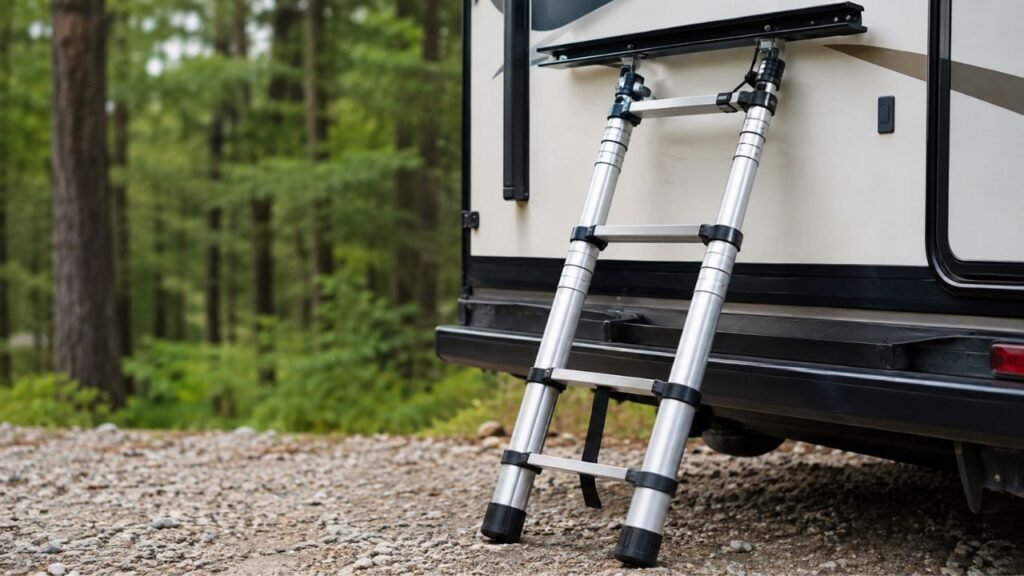
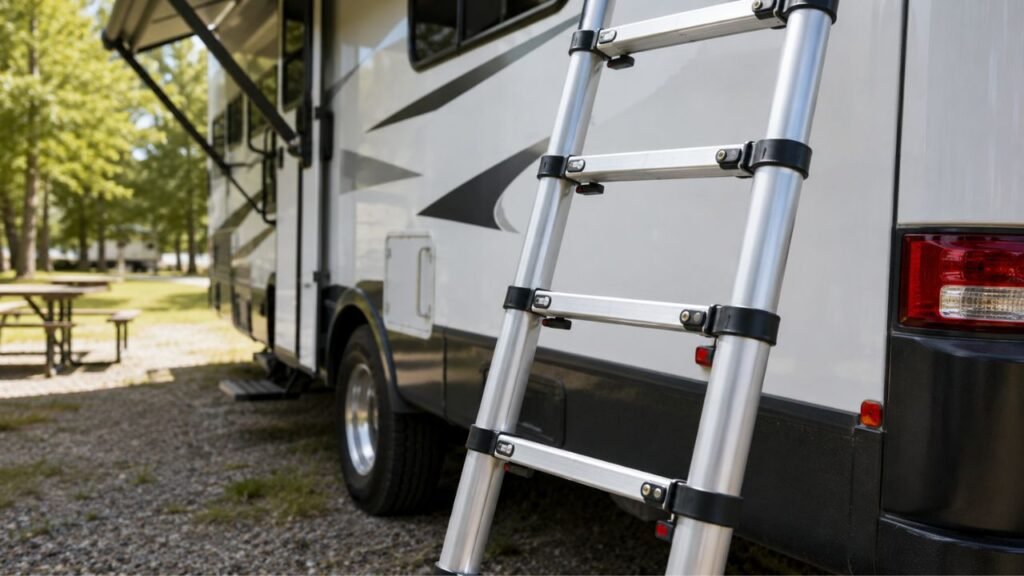
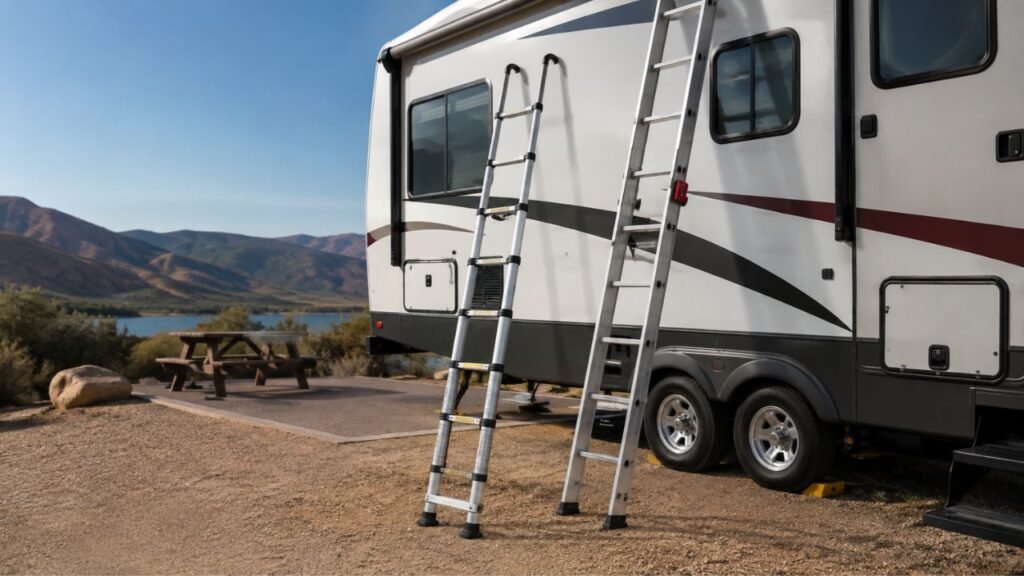
Rear bumpers, ladders, and mounted spare tires often count because the cover must stretch around them.
The trailer tongue usually does not count.
Motorhomes are slightly different because you normally measure the complete body from the farthest front point to the farthest rear point that will sit beneath the cover.
RV Height
Height can cause more confusion than any other RV cover measurement.
For road clearance, RV height is measured from the ground to the highest rooftop component.
For many fabric storage covers, however, manufacturers want the height of the RV body or sidewall rather than total ground-to-A/C clearance.
That often means measuring from the roofline down toward the bottom of the body or frame.
Always check the cover manufacturer’s diagram before ordering.
RV Width
Measure straight across the RV at its widest fixed body point.
Keep:
- Slide-outs retracted
- Awnings rolled in
- Mirrors folded when possible
You normally do not need to include temporary objects that will be removed before storage.
What Should You Include and Exclude When Measuring?
The basic rule is simple: include anything the storage cover must physically fit over, unless the cover manufacturer already builds extra space for it. Some accessories are treated differently between brands, so use this table as a starting point rather than an absolute rule.
| RV Part or Accessory | Usually Include? | What to Know |
| Front or rear bumper | Yes | Count it if the cover extends over it |
| Rear ladder | Usually | Often adds to the coverable length |
| Rear-mounted spare tire | Usually | Count it when it remains mounted |
| Fixed storage box | Usually | Include it if it remains beneath the cover |
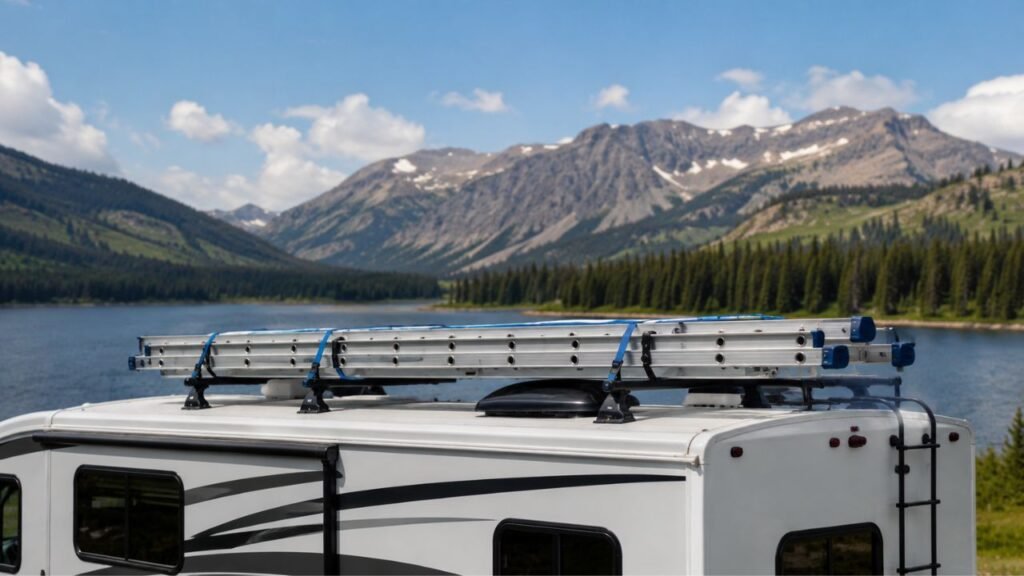
| Permanent cargo rack | Check manufacturer | Large racks can change required cover length |
| Bike rack and bikes | Usually remove | Many covers are not designed around loaded racks |
| Travel trailer hitch | Usually no | Most covers begin at the trailer body |
| Trailer tongue | Usually no | Normally remains outside the cover |
| Propane tanks | Usually no | Often sit forward of the covered trailer body |
| Tongue jack | Usually no | Generally outside the main cover |
| Roof A/C | Often no extra measurement | Many RV covers already allow for standard A/C units |
| Roof vents | Often no extra measurement | Typically accounted for in standard cover design |
| Solar panels | Check manufacturer | Large or raised installations may affect fit |
| Side mirrors | Usually no | Fold them inward before covering |
| Retracted awning | Usually no | Standard RV width usually accounts for it |
| Slide-outs | Retract | Measure the RV in storage configuration |
The important part is not memorizing every yes or no. The safest approach is to measure your actual RV first, then compare those measurements with the diagram supplied for the exact cover you want to buy.
How Do You Measure an RV for a Storage Cover Step by Step?
A few minutes spent preparing the RV correctly can prevent a measurement error that leaves you with a loose, tight, or unusable cover.
Step 1: Park the RV on Level Ground
Move the RV onto a reasonably flat surface before measuring.
You want it sitting the same way it normally will during storage.
Before you begin:
- Retract every slide-out.
- Retract the awning.
- Fold mirrors inward.
- Lower retractable antennas.
- Remove temporary cargo.
- Remove bikes if they will not stay under the cover.
- Keep permanent accessories in their normal storage position.
Do not measure while the RV is tilted on a steep driveway if you can avoid it.
A level surface makes your height and length readings more reliable.
Step 2: Measure the RV’s Length
Use a long tape measure and keep it as straight as possible.
Do not run the tape over the roof or follow the curves of the RV.
You want a straight horizontal measurement.
For a travel trailer, begin at the front of the trailer body unless the cover manufacturer tells you to start elsewhere.
Run the tape to the farthest rear point that will sit underneath the cover.
That could be:
- Rear bumper
- Spare tire
- Ladder
- Storage box
- Fixed cargo carrier
Do not automatically measure from the hitch coupler.
The hitch and tongue are commonly left outside a travel trailer cover.
For a motorhome, measure from the farthest front covered point to the farthest rear covered point.
If you can, have another person hold one end of the tape. It makes getting an accurate straight-line measurement much easier.
Here is a simple example.
Your trailer body measures 27 feet 8 inches.
The rear spare tire extends another 10 inches.
Your actual coverable length becomes:
28 feet 6 inches
That is the number you should compare with the cover manufacturer’s size chart.
Step 3: Measure the RV’s Height
This is where I would slow down and read the manufacturer’s instructions carefully.
There are two different height measurements RV owners commonly deal with.
The first is total RV height.
That runs from the ground to the highest rooftop point and is important for bridges, garages, carports, and overhead clearance.
The second is RV cover height.
Many storage cover manufacturers use the height of the RV body or sidewall instead.
That can mean measuring from the roofline down to the bottom of the body or frame while excluding ground clearance.
Standard rooftop A/C units, vents, and similar items may already be allowed for in the shape of the cover.
If your RV has unusually tall solar racks, satellite equipment, or other custom accessories, check those separately.
Do not climb onto the roof simply to get a measurement unless your RV is designed for roof access and you can do it safely.
Step 4: Measure the RV’s Width
Stand beside the RV and measure straight across the body.
Find the widest permanent part.
Make sure:
- Slide-outs are closed.
- Mirrors are folded.
- Awnings are retracted.
- Storage doors are closed.
Do not measure from a deployed awning or an open slide-out.
Those positions are not how the RV will sit beneath the storage cover.
Most RVs fall within fairly predictable widths, but checking yours helps catch unusual accessories or modifications.
Step 5: Measure Everything Again
I recommend taking every measurement twice.
It takes only a few extra minutes and can save you from ordering the wrong cover.
Write your measurements down immediately.
I also like converting the length to total inches when comparing covers online.
For example:
28 feet × 12 = 336 inches
336 + 6 = 342 inches
So:
28 feet 6 inches = 342 inches
That makes it easier to compare two close sizing ranges without mental math.
Should You Measure From the Ground to the Top of the RV?
Not always. For a storage cover, the height measurement requested by the cover manufacturer may be different from the total height you use for driving clearance.
Your overall RV height normally runs from the ground to the highest rooftop component.
That number matters when checking:
- Bridges
- Garage doors
- Storage buildings
- Carports
- Tree clearance
- Fuel station canopies
Your RV cover height may instead run from the roofline down to the bottom of the main body or frame.
That is because the storage cover hangs over the RV body rather than extending all the way to the ground.
Many covers also provide extra material around the roof area for standard rooftop accessories.
So if you are shopping for a fabric RV storage cover, do not automatically use your published overall height.
Use the measurement method shown in the cover’s sizing diagram.
Why Your RV’s Advertised Length May Give You the Wrong Cover Size
Your RV’s model name or published overall length can be useful for general reference, but it is not reliable enough for choosing a storage cover. Different measurements can include or exclude completely different parts of the RV.
Model Numbers Are Not Exact Measurements
An RV marketed as a 27-foot or 30-foot model may not measure exactly 27 or 30 feet.
Manufacturers use model numbers for product identification, floorplans, and marketing.
Those numbers are not guaranteed to match actual body length.
A trailer with “28” in the model name could require a cover several inches shorter or longer than you expect.
That is why I would always put a tape on the RV before spending money on a cover.
Official RV Length and Cover Length Are Different
Another source of confusion is the official overall vehicle length.
A travel trailer’s official overall length may include the front hitch or coupler.
At the same time, certain rear accessories can be excluded from that measurement.
A storage cover often does the opposite.
It may exclude the tongue while requiring you to include a rear spare tire or ladder.
So even a completely accurate specification sheet may not give you the number needed for your storage cover.
Aftermarket Accessories Can Change the Required Length
This becomes even more important if the RV has been modified.
Pay attention to:
- Rear spare carriers
- Cargo trays
- Storage boxes
- Bicycle racks
- Replacement bumpers
- Ladder extensions
- Generator platforms
- Custom solar equipment
If the accessory remains installed beneath the cover, it may need to be included.
How to Measure Different Types of RVs for a Cover
The basic measuring process stays the same, but the starting and ending points can change depending on your RV. Here is how I would approach the most common types.
Travel Trailer
Measure from the front of the trailer body to the farthest rear covered point.
Usually exclude:
- Hitch
- Tongue
- Coupler
- Tongue jack
- Propane tanks
Check whether the rear ladder and spare tire should be included.
They commonly are.
Fifth Wheel
Measure the fifth-wheel body rather than automatically including the pin box.
Begin at the front-most body section that will sit beneath the cover.
Measure to the farthest rear covered point.
Fifth wheels can also be taller than many travel trailers, so check the cover’s height range carefully.
Class A Motorhome
Measure from the farthest front body or bumper point to the farthest rear covered accessory.
Fold the large side mirrors inward before checking width.
Make sure rear ladders and spare tire carriers are accounted for if they remain installed.
Class B Camper Van
Class B RVs often have more aftermarket exterior equipment than their small size suggests.
Check carefully for:
- Rear spare tires
- Roof racks
- Ladders
- Storage boxes
- Raised roof equipment
- Cargo carriers
Measure anything that will remain under the cover.
Class C Motorhome
Measure from the farthest front point of the body or bumper to the farthest rear point covered.
The cab-over section normally does not change the overall length measurement, but you should still verify height and profile requirements.
Check rear ladders and spare tires carefully.
Pop-Up Camper
Measure a pop-up camper while it is completely closed.
That is the configuration it will be in under the cover.
Measure the closed camper body and usually exclude the trailer tongue unless your chosen cover is specifically designed to cover it.
Truck Camper
Measure the truck camper itself, not the pickup truck carrying it.
Pay attention to:
- Cab-over projection
- Rear overhang
- Ladder
- Roof equipment
Truck camper covers use their own sizing ranges, so compare your measurements with a truck-camper-specific chart.
How Do You Choose the Right RV Cover Size After Measuring?
Once you have accurate measurements, your next job is matching them to the manufacturer’s sizing range. This is where being precise matters because a cover that is too large can create almost as many problems as one that is too small.
Match the Actual Length to the Cover Size Range
Suppose your RV measures:
28 feet 6 inches
The manufacturer offers:
- 26’1″ to 28’6″
- 28’7″ to 31’6″
If the first cover is rated through exactly 28’6″, your RV fits that listed range.
You do not automatically need to move up one size.
Use the limits printed for the actual cover.
What If Your RV Falls Between Two Cover Sizes?
If your measurement is longer than one size range but shorter than the next range’s maximum, move to the next appropriate size according to the manufacturer’s instructions.
For example:
Your RV measures 28’8″.
The smaller cover ends at 28’6″.
That cover is too short.
You would move to the next range.
Do not round the RV down just to make it fit a cheaper or smaller cover.
Why You Shouldn’t Buy an Oversized Cover Just to Be Safe
It can be tempting to order several extra feet of cover.
That usually is not a good idea.
An excessively loose cover may:
- Flap in the wind
- Rub against paint
- Rub against decals
- Wear through around corners
- Create more strain on straps
- Collect water in loose areas
- Become harder to secure
You want enough material for the cover to fit properly, not enough to hang loosely around the RV.
When a Semi-Custom or Custom Cover Makes More Sense
A standard universal RV cover works for many rigs.
A more specialized fit may be worthwhile if your RV has unusual dimensions or equipment.
Consider it when you have:
- Large permanent rear cargo platforms
- Unusually tall roof equipment
- Raised solar panel racks
- Nonstandard body width
- Oversized storage boxes
- Custom roof conversions
- Unusual RV body shapes
Paying for a better fit can make more sense than forcing a standard cover around equipment it was never designed to accommodate.
RV Cover Measurement Example
Seeing all three measurements together makes the process easier. Here is a typical travel trailer example.
| Measurement | Example |
| Trailer body length | 27’9″ |
| Rear spare tire projection | 9″ |
| Coverable length | 28’6″ |
| Sidewall height | 8’5″ |
| Width | 8’0″ |
| Trailer tongue | Excluded |
| Roof A/C | Not added unless cover instructions require it |
In this example, the owner should shop according to a coverable length of 28 feet 6 inches, not simply the 27-foot body measurement.
The owner would then check whether the selected cover also accepts the trailer’s width and sidewall height.
Notice that the trailer tongue is not added.
Also notice that the A/C is not automatically stacked on top of the sidewall measurement.
Those details depend on how the particular cover is designed.
Common RV Cover Measuring Mistakes
Most cover-sizing problems come from a few predictable mistakes. Avoiding these is often more important than measuring to the nearest fraction of an inch.
- Buying a cover based only on the RV model number
- Using the advertised RV length without measuring
- Including the travel trailer tongue when the cover excludes it
- Forgetting a rear-mounted spare tire
- Forgetting a rear ladder
- Measuring along the curved roof or side
- Using ground-to-A/C height when the manufacturer wants sidewall height
- Adding roof A/C height even when the cover already allows for it
- Measuring with slide-outs open
- Measuring with the awning extended
- Leaving mirrors unfolded during width measurement
- Rounding the RV length down
- Buying several extra feet of cover unnecessarily
- Assuming every RV cover brand uses identical measuring rules
The last mistake is especially common.
One manufacturer may tell you to include an accessory while another already builds space for it into the cover.
That is why your measurements and the exact cover sizing chart need to be used together.
How Tight Should an RV Storage Cover Fit?
An RV storage cover should fit securely without being stretched tightly across every surface.
If the cover is too small, you may struggle to pull it over the RV.
The fabric can also place unnecessary stress on:
- Seams
- Corners
- Zippers
- Straps
- Roof edges
If the cover is much too large, wind can get underneath it.
That causes fabric movement and rubbing against the RV’s finish.
The ideal fit gives the cover enough room to follow the RV’s shape while still allowing the straps and adjustment panels to hold it securely.
A snug, adjustable fit is better than either extreme.
Quick RV Cover Measuring Checklist
Use this checklist before you order your cover.
- Park the RV on level ground.
- Retract all slide-outs.
- Retract the awning.
- Fold side mirrors inward.
- Remove temporary cargo.
- Remove bikes if they will not stay covered.
- Measure the coverable RV length.
- Check rear spare tire projection.
- Check rear ladder projection.
- Measure the RV body width.
- Measure the height requested by the cover manufacturer.
- Check unusually tall roof equipment.
- Exclude the hitch or tongue when instructed.
- Record measurements in feet and inches.
- Measure everything a second time.
- Compare your measurements with the exact cover size chart.
Final Words
Measuring an RV for a storage cover is fairly simple once you know which dimensions actually matter. The biggest mistake is assuming the advertised RV length tells you everything you need to know.
Measure the actual portion of the RV the cover will protect. Include permanent projections the cover must fit over, keep the RV in storage configuration, and pay close attention to how the cover manufacturer defines height.
Most importantly, measure first and choose the cover second.
That extra effort can help you avoid a cover that is too tight, too loose, or simply the wrong shape for your RV.
Related FAQs
Do You Include the Hitch When Measuring an RV for a Cover?
Usually no. Most travel trailer covers begin at the front of the trailer body and leave the hitch, tongue, coupler, and propane area uncovered, but you should still follow the instructions for your specific cover.
Do You Include the Spare Tire When Measuring an RV Cover?
Usually yes if the spare tire remains mounted at the rear and the cover needs to extend over it. Measure to the farthest point of the spare rather than stopping at the trailer body.
Do You Include the Ladder When Measuring for an RV Cover?
Many RV cover manufacturers want a permanently mounted rear ladder included in the overall coverable length. However, some cover designs already allow room for standard ladders, so check the sizing diagram first.
Do You Include the Air Conditioner When Measuring an RV Cover?
Often you do not need to add the A/C height because many standard RV covers are designed with enough roof space for common rooftop units. Unusually tall equipment should still be checked against the cover specifications.
Should You Measure RV Height From the Ground?
Not always. Ground-to-roof height is useful for driving clearance, garages, and carports, but many fabric cover manufacturers use roofline-to-body or roofline-to-frame height for cover sizing.
Do You Measure an RV With the Slide-Outs Open or Closed?
Measure with the slide-outs fully closed. RV storage covers are normally designed to fit the RV in its travel and storage configuration rather than with the slides extended.
Should You Include the Awning When Measuring RV Width?
Keep the awning completely retracted when measuring. You normally measure the permanent RV body width rather than the width created by an extended awning.
How Much Bigger Should an RV Cover Be Than the RV?
You should not add an arbitrary number of feet. Choose the manufacturer’s size range that contains your actual measurement and follow its recommendations if your RV sits between two sizes.
What If My RV Is Exactly at the Maximum Cover Size?
If the manufacturer’s stated range includes your exact measurement, that size will normally be considered compatible. There is no need to automatically move up unless the manufacturer specifically recommends doing so.
Can I Use My RV’s Model Number to Choose a Cover?
You should not rely on the model number alone. RV model names do not always match the actual exterior body length, and accessories such as spare tires or ladders can change the coverable dimensions.
Is RV Overall Length the Same as RV Cover Length?
No. Overall vehicle length and coverable length can use different measuring points. A travel trailer’s official length may include the hitch, while a storage cover may exclude the hitch but include rear accessories.

Jack Collins specializes in RV routes, trail access, and travel logistics. His how-to articles help RV and trailer owners plan smoother trips and avoid common mistakes. Every review focuses on performance, safety, and value.