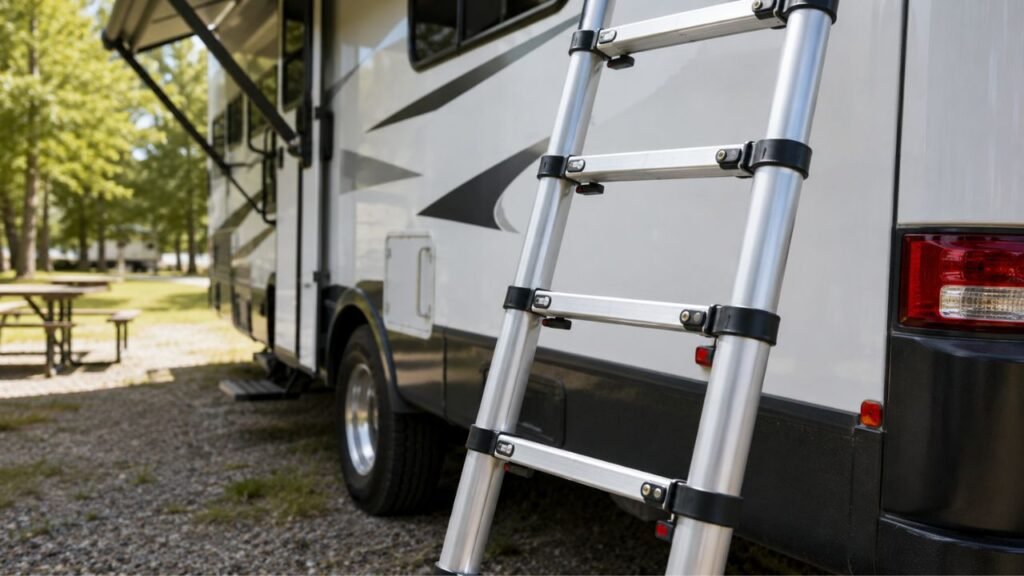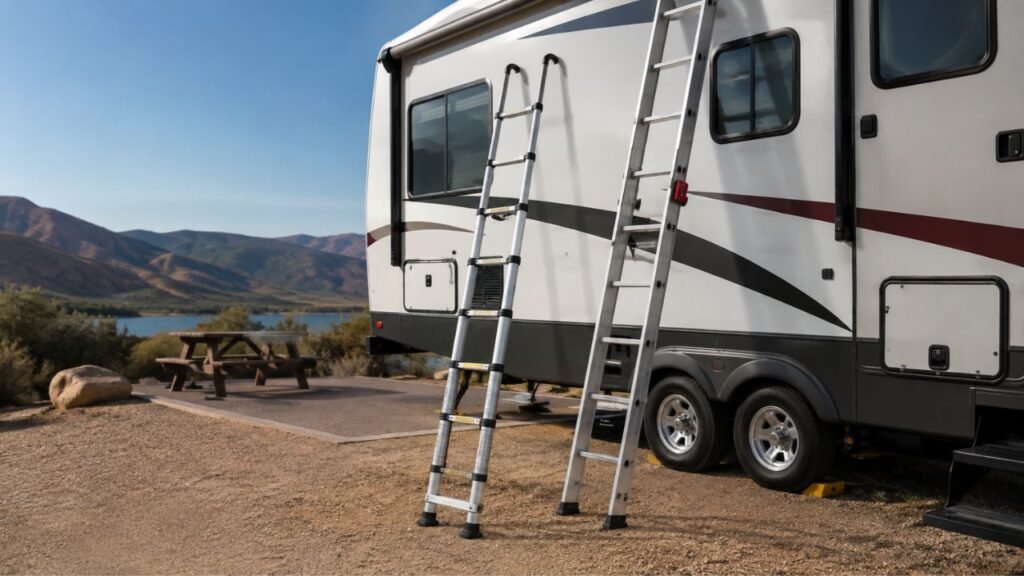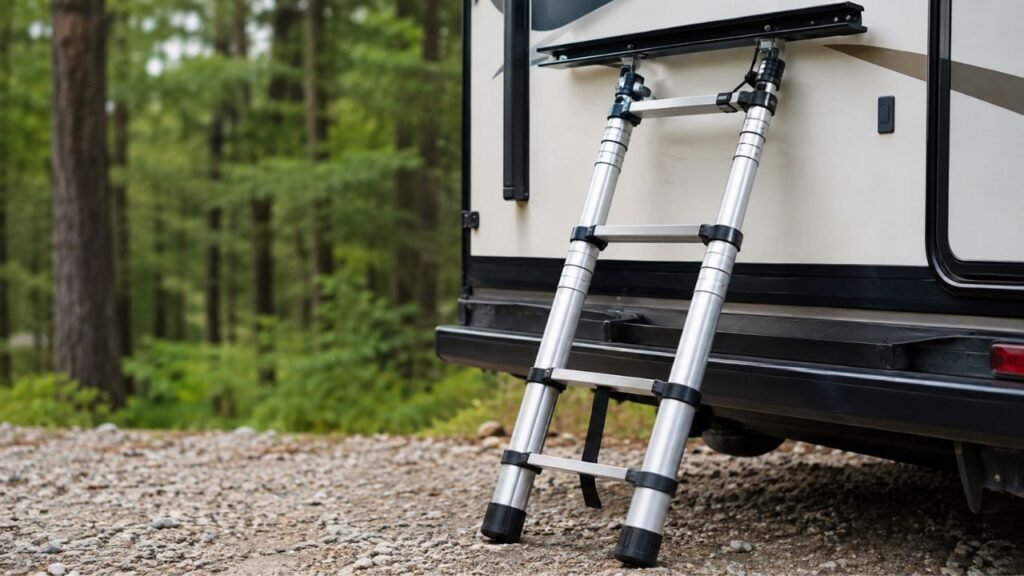
An RV telescoping ladder usually collapses unevenly because one side meets more resistance than the other. Dirt, moisture, sticky locking pins, damaged guides, incorrect release technique, or slightly bent aluminum tubes can make one rail drop before the opposite side.
In this guide, I’ll help you find the troublesome section safely. We’ll also cover cleaning, retraction, damage checks, and when replacement makes more sense.
Key Takeaways
- Uneven collapse usually means both ladder rails are not moving equally.
- Dirt and road grit commonly create friction inside telescoping sections.
- One sticking locking pin can leave a rung noticeably tilted.
- Some ladders require both release controls to operate together.
- Moisture between nested tubes can make retraction slow or inconsistent.
- Never force, twist, kick, or hammer a stuck ladder section.
- A bent rail or unreliable lock can make the ladder unsafe.
- Check your ladder manual before applying any lubricant or spray.
- Test every lock again before climbing after maintenance.
Why Does My RV Telescoping Ladder Collapse Unevenly?
When a telescoping ladder works properly, each rung should lower evenly. If one side hangs higher, something is interfering with movement or release.
Dirt or Road Grit Is Binding One Telescoping Rail
This is one of the first things I would check.
Telescoping ladders have very small clearances between their nested aluminum tubes. Dust, sand, pollen, dried mud, and road grime can enter these spaces.
Your RV lifestyle makes this especially easy to happen. You may use the ladder around dusty campsites or gravel parking areas. It may also spend weeks inside a storage compartment.
If one rail gets dirtier than the other, friction increases there. The cleaner side then slides downward while the dirty side remains higher.
You may also notice a rough or gritty feeling while retracting it.
One Locking Pin or Release Mechanism Is Sticking
Most telescoping ladders rely on locking mechanisms at individual rungs. These locks keep each extended section securely in position.
If one side releases normally and the other sticks, the rung tilts.
You may notice one release button feels harder than usual. One side may click while the other remains completely silent.
Sometimes the sticking side eventually releases after extra pressure. That does not automatically mean the problem is harmless.
A lock that behaves differently deserves closer inspection before climbing again.
The Release Buttons Are Not Operating Together
Some telescoping ladders need both sides released at nearly the same time.
Other designs use one control connected to both locks. Either way, both rails need to move as the ladder manufacturer intended.
Suppose one side releases before the other. The weight above can shift toward the still-locked side.
That extra pressure may make the remaining lock harder to release. The rung then drops diagonally instead of staying parallel.
Do not repeatedly force one side downward to correct this.
Instead, extend the section again and restart the proper retraction sequence.
A Telescoping Tube Is Bent or Dented
Even a small dent can change how nested tubes fit together.
The damage does not always look dramatic from several feet away. A slight flat spot can still create extra friction inside the ladder.
RV storage can occasionally cause this problem.
A leveling block, hitch component, tool case, or other heavy item can shift during travel. If that object hits the ladder repeatedly, a tube may become distorted.
Dropping the ladder onto pavement can create similar damage.
Look closely for dents, bowed rails, flattened areas, and abnormal scraping marks.
Moisture Is Trapped Between the Nested Sections
Rain and washing can leave water between telescoping ladder sections.
Condensation inside an RV storage compartment may create similar problems. This is especially possible after humid or rainy camping trips.
Water can increase resistance and carry dirt farther into sliding surfaces.
You may notice the problem suddenly appears after wet weather. The ladder might also feel normal again after completely drying.
Do not immediately pack a soaking ladder into a closed compartment.
Extend and dry it according to your manufacturer’s instructions first.
Plastic Guides or Internal Components Are Worn
Many telescoping ladders use guides, collars, or similar alignment parts.
These components help each tube enter the lower section straight. Over time, a worn guide may let one side move slightly off-center.
The tube may then rub instead of sliding freely.
A damaged collar can also make a particular rung repeatedly become crooked.
Internal safety parts are not ideal areas for improvised repairs. If damage is suspected, check the manufacturer’s repair recommendations.
The Slow-Close Mechanism Is Not Working Evenly
Some newer telescoping ladders use controlled or slowed retraction systems.
These mechanisms reduce sudden movement while sections collapse. They also help protect your hands from fast-moving rungs.
If one side suddenly drops much faster than before, pay attention.
A noticeable change in retraction speed can indicate mechanical trouble. Do not assume unusual movement is simply part of normal aging.
What Does Uneven Collapse Tell You About the Problem?
The exact way your ladder collapses can reveal useful clues. Watch the first section that stops moving normally.
| What You Notice | Most Likely Area to Check | What It May Mean | What to Do First |
| One side drops while the other stays up | Release controls or locking pins | Both locks are not releasing together | Stop and inspect both sides |
| One rail slides slowly throughout retraction | Telescoping tube | Dirt, moisture, or deformation | Clean and inspect the rail |
| The same rung becomes crooked every time | That rung’s lock, guide, or tube | Localized mechanical problem | Focus inspection there |
| Several sections feel gritty | Multiple nested tubes | Dirt contamination | Clean exposed sliding surfaces |
| Problems appear after rain | Telescoping tubes | Moisture may be trapped inside | Extend and dry the ladder |
| One tube scrapes at the same point | Aluminum rail | Possible dent or distortion | Stop forcing that section |
| A section suddenly drops too quickly | Retraction mechanism | Possible slow-close problem | Stop using until inspected |
| Retraction is uneven and locks feel unreliable | Locking system | Possible safety-related failure | Remove it from service |
How to Find Which Ladder Section Is Causing the Problem
You do not need to disassemble the entire ladder immediately. A careful visual test can often narrow the problem quickly.
Start With the Ladder Completely Unloaded
Never troubleshoot collapsing sections while someone stands on the ladder.
Place it on firm, level ground with enough working space. Keep children, pets, and other people away from the area.
Make sure your hands remain outside obvious pinch points.
Watch Each Rung While Retracting
Retract the ladder slowly using the correct procedure.
Watch each rung as it begins moving downward. Look for the first one that stops staying level.
That section is usually where your inspection should begin.
Do not concentrate only on the final rung that gets stuck. The original problem may start one section higher.
Compare Both Release Controls
Check how the left and right controls feel.
They should generally respond consistently for that particular ladder design.
One control may feel unusually stiff or slow. Another may not return completely after pressing.
Also check visual locking indicators if your ladder includes them.
Inspect Both Tubes Around the Problem Rung
Look closely at the aluminum surfaces.
Check for:
- Sand or dried dirt
- Sticky residue
- Deep scratches
- Dents or flat spots
- Bowed sections
- Cracked collars
- Corrosion or discoloration
- Foreign material near moving parts
Repeated scratches in one narrow area can indicate ongoing rubbing.
That may point toward a damaged or misaligned section.
Extend the Ladder Again and Check Every Lock
After identifying the troublesome area, extend the ladder again carefully.
Confirm every required lock engages properly. Use the visual indicators provided by your ladder manufacturer.
Do not rely only on hearing a click.
A lock can sound normal while still behaving differently from its opposite side.
How to Fix an RV Telescoping Ladder That Retracts Unevenly
Start with cleaning and correct operation before assuming internal failure. However, structural damage deserves a more cautious approach.
Clean the Telescoping Rails First
Begin with the ladder fully extended and unloaded.
Remove loose dust using a clean, dry cloth. Wipe each accessible sliding surface carefully.
Pay extra attention to the section that became crooked.
Remove sand, grit, and sticky residue around exposed areas. Do not push debris deeper into the mechanism.
Avoid flooding internal parts with cleaning liquid.
Once cleaned, let every section dry completely before testing retraction.
Dry the Ladder Completely if It Got Wet
A wet ladder should not go directly into storage.
Extend it in a protected, well-ventilated area. Allow moisture around the tubes and locks to dry.
Wipe visible water from the aluminum surfaces.
If your manual provides a specific drying procedure, follow that procedure.
This simple step can prevent dirt from sticking inside damp sections.
Follow the Correct Retraction Sequence
Telescoping ladders do not all collapse the same way.
Some retract section-by-section. Others use linked release controls or controlled-descent systems.
Follow the instructions printed on your ladder or provided by its manufacturer.
Keep your fingers away from spaces between descending rungs.
Avoid pressing one side repeatedly while ignoring the other.
If a section becomes crooked, stop and extend it again.
Use Lubricant Only When Your Manufacturer Allows It
This is one area where generic advice can cause trouble.
Some manufacturers permit specific dry silicone products on certain components. Others recommend cleaning without general lubrication.
Oily products can attract dust and create more buildup.
Do not spray WD-40, grease, or random household lubricant everywhere.
Check the maintenance instructions for your exact model first.
If the manufacturer recommends a product, use only the specified type.
Retest Every Section Before Using the Ladder
After cleaning and drying, extend the ladder completely again.
Then verify that each section:
- Extends smoothly
- Retracts evenly
- Remains level during movement
- Locks securely
- Shows proper lock indicators
- Does not scrape or bind
- Does not drop unexpectedly
If the same section still tilts, further use deserves caution.
Cleaning should not be used to hide obvious mechanical damage.
What You Should Never Do When a Telescoping Ladder Gets Stuck
A stubborn ladder can become more dangerous after an aggressive repair attempt.
- Do not stand on the ladder while testing release mechanisms.
- Do not stomp on a rung to force it downward.
- Do not twist the rails until they suddenly release.
- Do not hammer dents back into shape.
- Do not soak locking mechanisms with oily lubricant.
- Do not remove springs or locking pins without approved instructions.
- Do not slam a stuck section closed.
- Do not keep using a ladder with unreliable locks.
- Do not assume closing successfully means the ladder is safe.
When Does Uneven Retraction Mean the Ladder Is Unsafe?
Some retraction problems are caused by simple contamination. Others point toward damage that can affect climbing safety.
Stop Using It if a Lock Does Not Reliably Engage
The locks are among the most important components on telescoping ladders.
Each extended section depends on them remaining securely engaged.
If a lock occasionally misses, sticks, or releases unexpectedly, stop climbing.
Repeatedly pressing it until it “works” is not a reliable repair.
Stop Using It if a Rail Is Bent or Dented
Small surface scratches are usually different from structural deformation.
A dent, bow, crack, flattened area, or obvious twist deserves more concern.
The tubes need precise alignment to telescope properly.
Trying to straighten them yourself can change their strength or geometry.
If structural damage is visible, contact the manufacturer about replacement options.
Stop Using It if a Rung Moves Without Being Released
This distinction is extremely important.
Uneven movement while intentionally folding the ladder is one problem.
Unexpected movement while the ladder should remain locked is much more serious.
If a rung slips while supporting weight, stop using the ladder immediately.
Do not climb again simply because the lock appears normal afterward.
Check Whether Your Ladder Has Been Recalled
Mechanical behavior sometimes relates to a known product problem.
Locate your ladder’s brand, model number, and manufacturing information.
Then check whether that exact ladder has an active safety recall.
This is especially worthwhile if the problem appears suddenly without damage.
Can You Repair a Bent or Damaged Telescoping Ladder?
Cleaning a dirty ladder and repairing structural damage are very different jobs.
I would not recommend hammering, bending, drilling, or reshaping aluminum rails. Small dimensional changes can affect tube movement and overall strength.
The same caution applies to internal locking components.
Avoid replacing safety-critical pins with generic hardware unless specifically approved.
If a rail, rung, collar, or locking mechanism is damaged, contact the manufacturer. In many cases, replacing the ladder is safer than improvising a repair.
Why RV Telescoping Ladders Need Extra Attention
An RV ladder can experience conditions that household ladders rarely encounter. Travel, outdoor storage, and campsite contamination create additional maintenance concerns.
Storage Compartments Can Contaminate the Rails
RV storage bays collect more dirt than many owners realize.
Sand, leaves, gravel dust, pet hair, and camping debris accumulate quickly.
A collapsed telescoping ladder can carry that contamination between its sections.
Try to keep the storage area reasonably clean.
A protective storage bag may also help if your manufacturer recommends one.
Travel Can Expose the Ladder to Cargo Damage
Everything inside an RV moves while you travel.
A tool box, leveling block, grill, hitch part, or heavy container can shift.
Repeated impacts may eventually dent a lightweight aluminum ladder.
Secure the ladder so nearby cargo cannot strike or crush it.
Do not wedge it tightly beneath heavy equipment.
Wet Camping Conditions Can Leave Moisture Inside
Rainy campgrounds can keep equipment wet for several days.
You may collapse the ladder quickly because you are breaking camp.
That moisture can remain between nested sections during storage.
Whenever practical, clean and dry the ladder before packing it away.
Coastal RV Travel Can Increase Maintenance Needs
Coastal camping adds salt and humid air to the equation.
Salt residue can remain on aluminum, hardware, and moving components.
After spending time near saltwater, inspect the ladder more carefully.
A simple cleaning and drying routine can reduce long-term problems.
How to Prevent Uneven Retraction on Future RV Trips
A few simple habits can keep telescoping sections moving consistently.
- Inspect the ladder before every climbing session.
- Wipe exposed rails before collapsing the ladder.
- Remove campsite sand and road grit promptly.
- Let wet sections dry before long-term storage.
- Retract the ladder using the recommended sequence.
- Keep both sides aligned during retraction.
- Never force one side below the other.
- Secure the ladder during RV travel.
- Protect it from shifting tools and heavy cargo.
- Use only manufacturer-approved maintenance products.
- Recheck every lock after cleaning.
- Investigate immediately when operation suddenly changes.
Does an Unevenly Collapsing Ladder Still Meet ANSI Safety Requirements?
You cannot determine full ANSI compliance simply by watching the ladder retract.
ANSI ladder standards address design, construction, testing, labeling, and other safety requirements. Telescoping metal ladders fall within those broader portable-ladder considerations.
For everyday RV use, focus on the practical safety signs.
The ladder should operate according to its instructions. Its structural parts should remain undamaged, and every required lock should work reliably.
If your ladder no longer performs as designed, stop using it. Manufacturer guidance is more useful than guessing whether it remains compliant.
Final Words
An RV telescoping ladder usually collapses unevenly because both sides are no longer moving with equal resistance. Start by checking dirt, moisture, release technique, and the exact rung where the tilt begins.
If careful cleaning restores smooth operation, continue monitoring the ladder closely. If a lock remains unreliable or a tube appears damaged, replacement is often the safer decision. A ladder should earn your trust before you put your weight on it.
Related FAQs
Why Does One Side of My Telescoping Ladder Get Stuck?
One side usually sticks because dirt, moisture, a sticky lock, or tube deformation creates extra resistance. Clean and inspect that rail before trying to force it downward.
Why Won’t Both Sides of My Telescoping Ladder Release Together?
One lock may be dirty, loaded unevenly, worn, or mechanically damaged. Extend the section again and follow your manufacturer’s correct release sequence before testing it.
Can I Use WD-40 on a Telescoping Ladder?
Avoid treating WD-40 as a universal solution. Oily products may attract dirt, and some manufacturers prohibit them. Follow the maintenance instructions for your exact ladder.
Should I Lubricate My RV Telescoping Ladder?
Only lubricate the ladder if its manufacturer recommends doing so. Some models permit specific dry silicone products, while others depend primarily on clean, dry sliding surfaces.
How Do I Clean Dirt From a Telescoping Ladder?
Fully extend the unloaded ladder and wipe accessible tube surfaces with a clean cloth. Remove grit carefully, let everything dry, and follow any model-specific cleaning instructions.
Can Water Make a Telescoping Ladder Hard to Collapse?
Yes, trapped moisture can increase friction or carry dirt between nested sections. Dry the ladder thoroughly before storage and retest it before your next climb.
Is a Bent Telescoping Ladder Safe to Use?
A visibly bent, bowed, cracked, or dented rail should be taken seriously. Stop using the ladder and contact the manufacturer about repair or replacement.
Why Does My Telescoping Ladder Drop Suddenly When I Release It?
Sudden dropping can come from improper release technique or a problem with the retraction system. If its behavior has noticeably changed, stop using it until inspected.
Can I Straighten a Bent Aluminum Telescoping Ladder?
I would not recommend trying to straighten structural aluminum yourself. Changing the tube shape can affect strength, alignment, and locking, making replacement the safer option.
How Often Should I Inspect My RV Telescoping Ladder?
Inspect it before every use and after impacts, wet trips, or unusual operation. A quick check of rails, rungs, feet, and locks can catch problems early.

Jack Collins specializes in RV routes, trail access, and travel logistics. His how-to articles help RV and trailer owners plan smoother trips and avoid common mistakes. Every review focuses on performance, safety, and value.