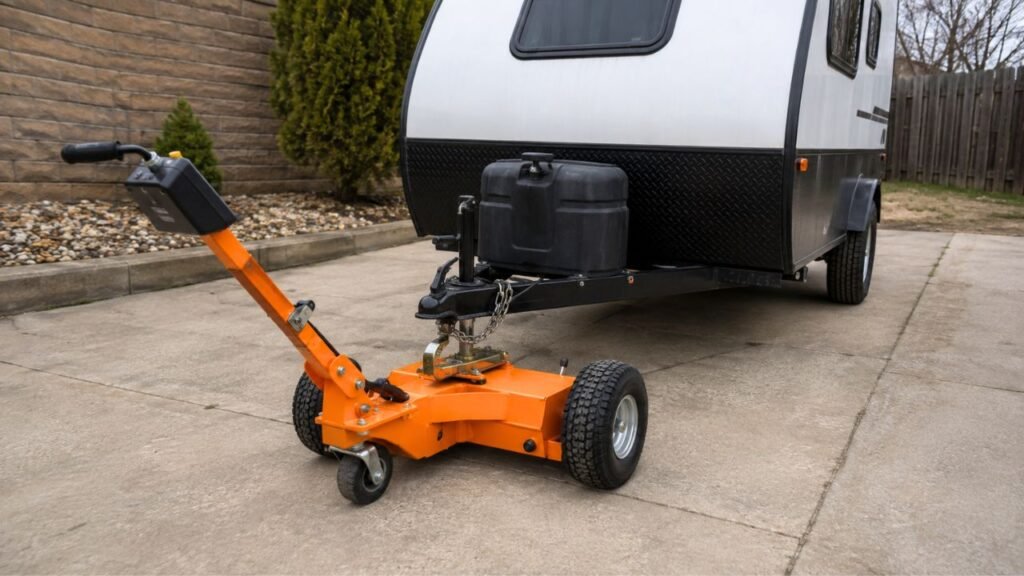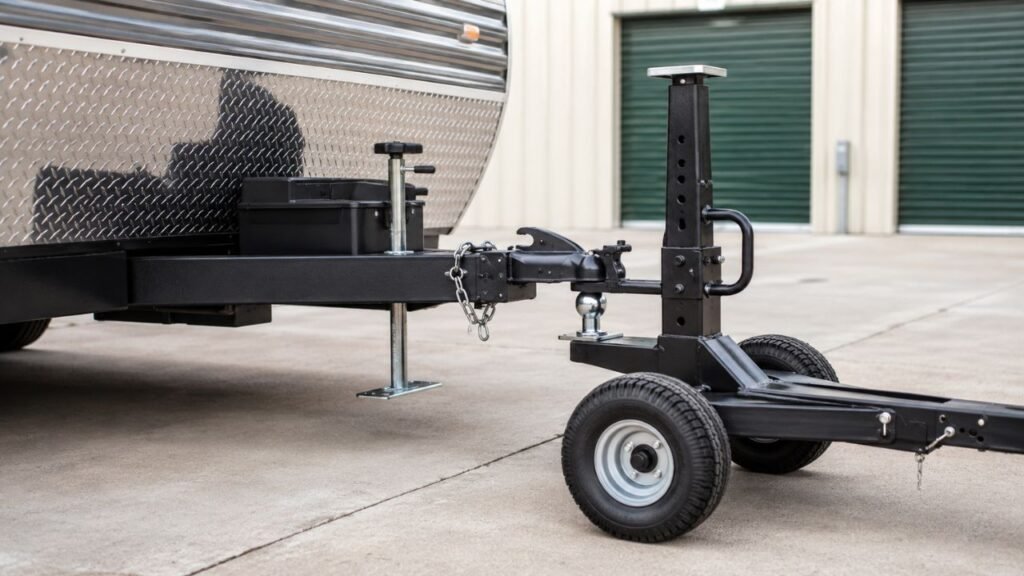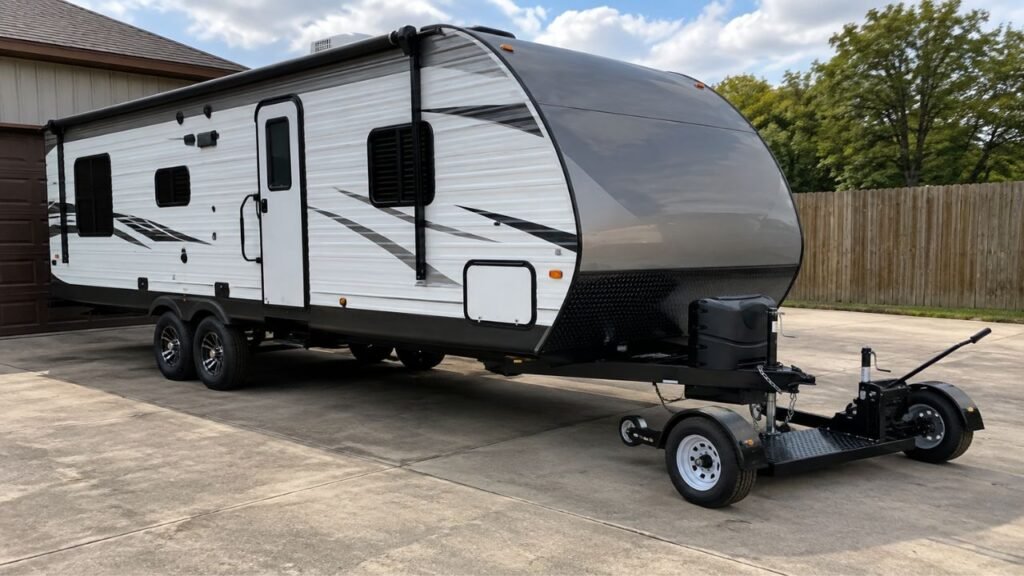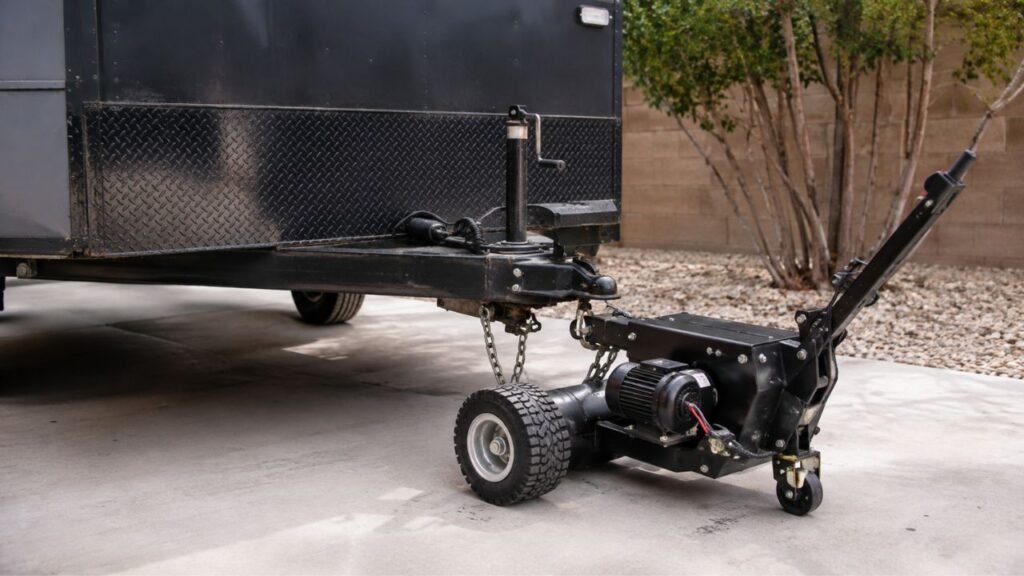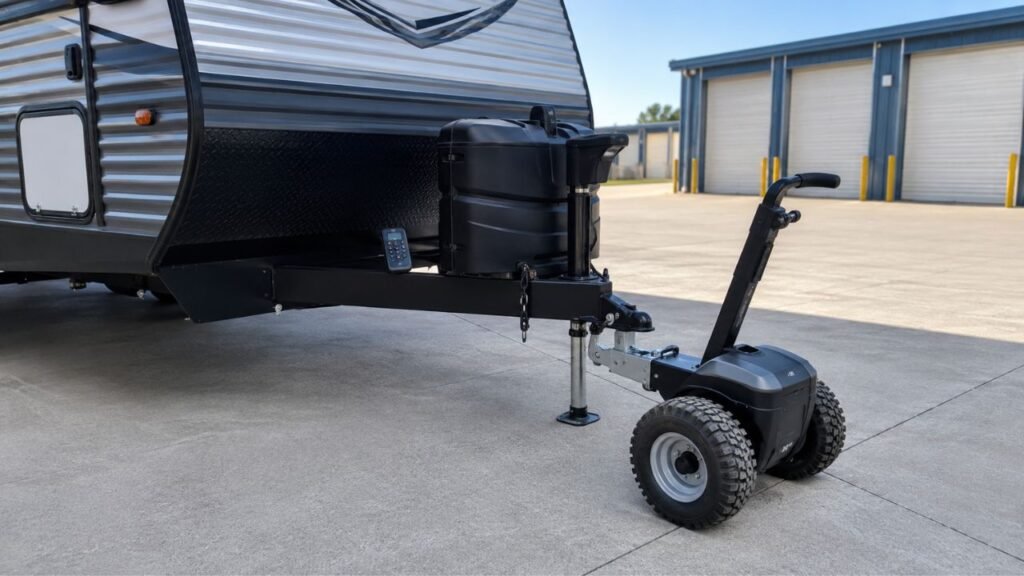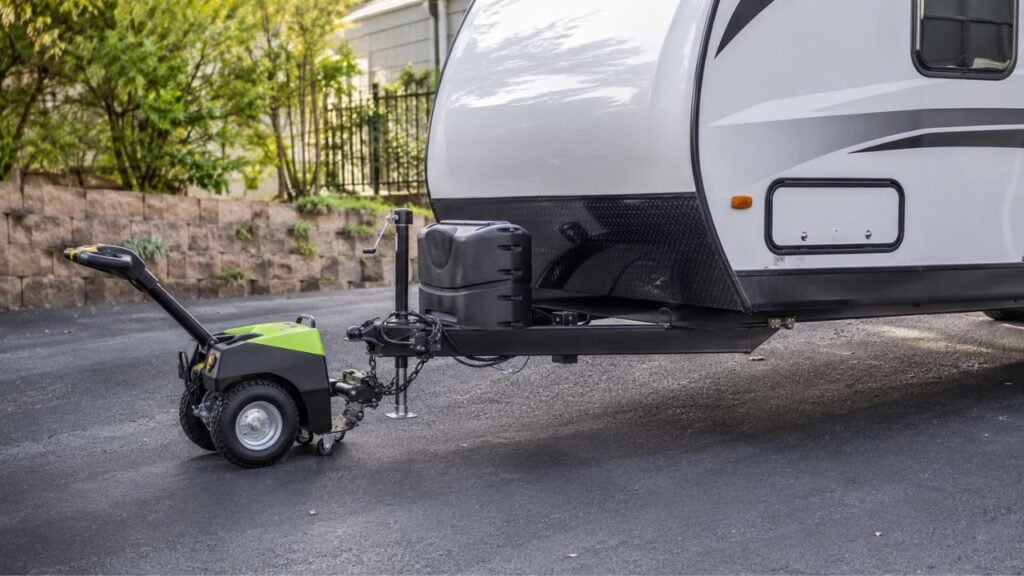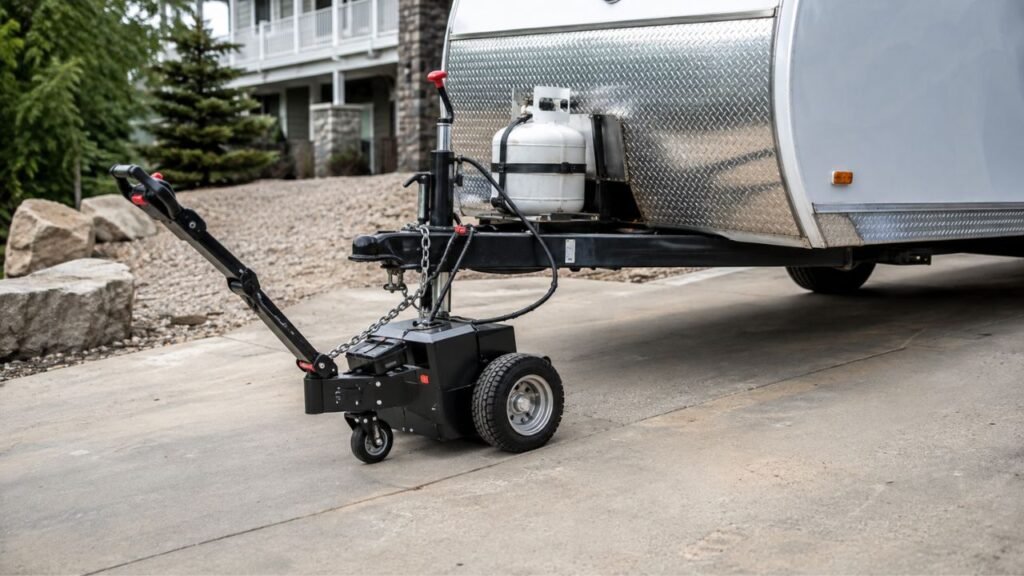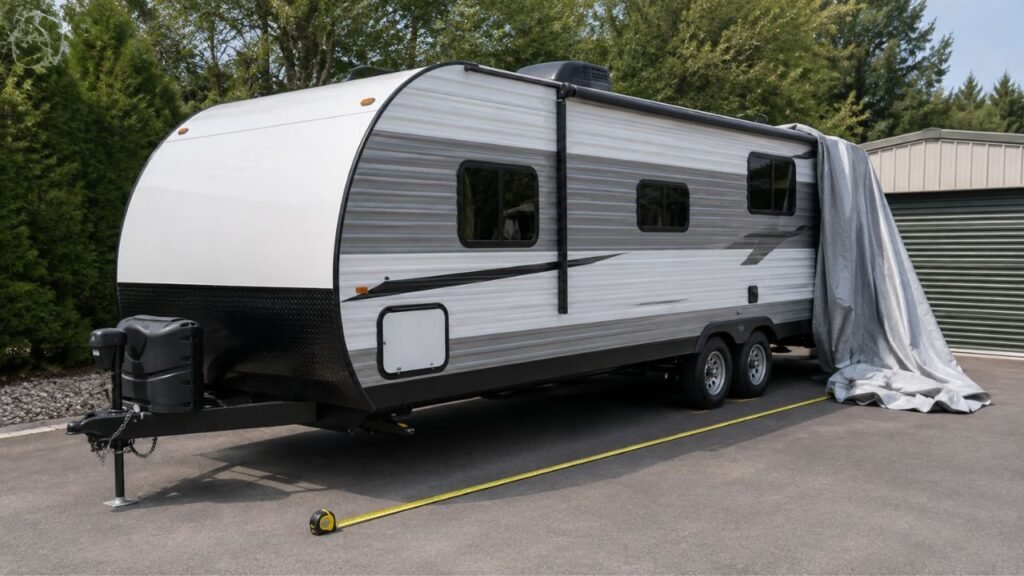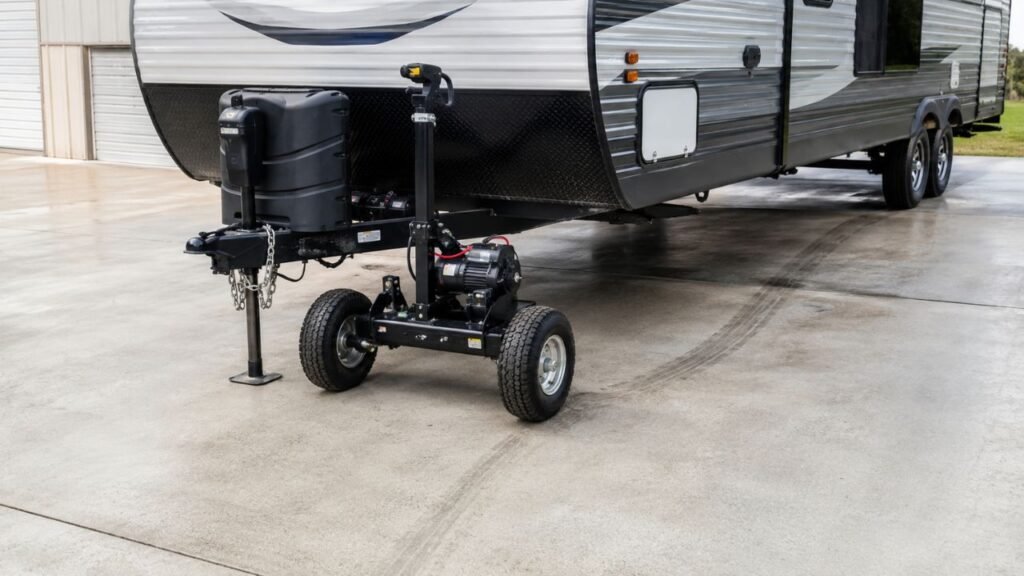
Trailer dolly tires usually slip on smooth concrete when the drive wheels cannot create enough traction to overcome the trailer’s resistance. Smooth or contaminated concrete can contribute, but low tongue weight, worn tires, sudden motor torque, tight turns, and trailer drag are often just as important.
If your dolly spins its tires instead of moving the trailer, you do not necessarily need a stronger dolly. I’ll help you narrow down the cause, check the setup, and improve traction without creating another problem.
Key Takeaways
- Smooth concrete can reduce usable grip, especially when polished or contaminated.
- Too little tongue weight can leave powered dolly tires without enough traction.
- Dust, moisture, oil, and garage residue can make slipping much worse.
- Sharp turns create tire scrub that can overwhelm the dolly’s available grip.
- Worn, hardened, or contaminated tires may lose traction even on dry concrete.
- Slow acceleration usually provides better traction than applying full power immediately.
- Always follow your dolly manufacturer’s tire pressure and tongue-weight limits.
Why Do Trailer Dolly Tires Slip on Smooth Concrete?
Several things can cause a trailer dolly to lose traction on concrete. In many cases, smooth flooring simply exposes another setup problem that was already limiting the dolly’s grip.
Smooth Concrete Provides Less Surface Texture
A rough concrete driveway has countless tiny peaks and valleys. Rubber tread deforms around those irregularities and creates useful mechanical grip.
A polished garage floor provides much less texture. The tire may still have friction, but there is less surface roughness helping it resist movement.
This becomes more noticeable with small dolly tires. Their contact area is limited compared with your trailer’s larger tires.
However, I would not blame smooth concrete automatically. Clean, dry concrete can still provide excellent traction. If the dolly suddenly slips badly, there is often another factor involved.
Too Little Tongue Weight Can Reduce Drive-Tire Traction
This is one of the most overlooked reasons trailer dolly wheels spin.
Your dolly needs downward pressure on its powered tires. That pressure allows the rubber to maintain useful contact with the concrete.
If very little trailer weight rests on the dolly, the motor can easily overpower the available grip. The wheels spin, but the trailer barely moves.
This can happen with rear-heavy trailers, boat trailers, or poorly distributed cargo. Moving gear behind the trailer axle can reduce effective tongue weight even further.
The confusing part is that the trailer itself may be heavy. A heavy trailer does not automatically mean the dolly has enough weight over its tires.
Dust, Water, Oil, and Garage Residue Reduce Grip
You may have enough traction on clean concrete but almost none once contamination gets involved.
Common garage-floor contaminants include:
- Fine concrete dust
- Dirt and sand
- Water or condensation
- Automotive fluids
- Grease
- Tire dressing
- Floor coatings or wax
- Rubber residue
A thin layer of contamination separates the tire from the concrete. That reduces the amount of usable friction the tire can generate.
This is why sweeping the floor sometimes solves the problem immediately.
Hard or Worn Dolly Tires May Not Grip Properly
Tire condition matters more than many owners realize.
Solid tires can become harder with age. Tread blocks can also round off after repeated use.
Once the rubber becomes smooth or hardened, the tire may slide more easily across polished concrete.
Inspect both drive tires closely. Look for glazing, worn tread, cracks, contamination, or uneven wear.
If one tire looks noticeably different from the other, that can also explain why one side spins first.
Too Much Motor Torque Can Break Traction
A powerful electric dolly can actually make traction problems more obvious.
Suppose the tire can transfer a certain amount of force before slipping. If the motor suddenly applies more force than the tire can transfer, the tire spins.
That does not mean the motor lacks power.
It means the motor has more torque than the surface can handle at that moment.
Starting gradually often works better than applying maximum throttle immediately. If your dolly offers a slower operating mode or reduction gear, that may also help.
Tight Turns Create Significant Tire Scrub
Does your dolly move straight without trouble but spin during turns?
That usually points toward turning resistance.
Trailer tires do not steer like the front wheels of a car. When you make a very tight turn, the trailer tires may need to scrub sideways across the pavement.
Tandem-axle trailers can create especially high resistance during sharp turns.
Your dolly then has two jobs. It must move the trailer forward while also overcoming sideways tire scrub.
That extra resistance can exceed available traction.
The Trailer May Be Resisting Movement
Sometimes the dolly tires are not the real problem.
The trailer may simply require more force than normal to move.
Check for:
- Trailer brakes that are not fully released
- Underinflated trailer tires
- Binding wheel bearings
- A tire resting against a curb
- A wheel sitting inside a concrete joint
- Stabilizer jacks touching the ground
- A tongue jack dragging
- An unnoticed driveway slope
- Excessive tandem-axle tire scrub
If something is resisting movement, the dolly may spin before overcoming that resistance.
What Your Trailer Dolly’s Slipping Pattern Can Tell You
The moment when slipping occurs gives you useful clues. Pay attention to whether the tires spin while starting, turning, climbing, or moving across one particular section of concrete.
| When the Dolly Slips | Likely Cause | Quick Check | First Thing to Try |
| Immediately when starting | Low tongue weight, excessive torque, dirty floor | Start with minimal throttle | Clean the area and accelerate slowly |
| Only during sharp turns | Trailer tire scrub | Try moving straight | Make a wider turn |
| Only on polished garage concrete | Low surface texture or contamination | Test another concrete area | Sweep, clean, and dry the floor |
| Only when concrete is damp | Reduced wet traction | Wait until completely dry | Retest on dry concrete |
| One tire spins first | Uneven loading or tire contact | Inspect both tires | Check positioning and tire condition |
| Slips after loading cargo | Weight distribution changed | Compare tongue load | Reposition cargo safely |
| Slips at a joint or threshold | Obstacle resistance | Test on flat concrete | Use a suitable transition ramp |
| Goes straight but will not pivot | Tandem-axle scrub | Try a sweeping turn | Avoid stationary pivoting |
This simple diagnosis can save you from replacing perfectly usable dolly tires.
How Does Tongue Weight Affect Trailer Dolly Traction?
Tongue weight plays a major role because the dolly’s drive tires need downward force to generate traction. However, both too little and too much tongue weight can create problems.
Too Little Tongue Weight
Too little tongue weight often causes drive-wheel spin.
Imagine pressing a rubber eraser lightly against a table. It is easy to slide.
Press harder, and it becomes more difficult to move.
A similar principle applies to your dolly tires. They need sufficient load to maintain traction against the concrete.
Low tongue weight can occur when cargo is positioned too far rearward. It may also happen with certain empty or lightly loaded trailers.
If the dolly spins easily while everything else appears normal, checking tongue weight is worthwhile.
Too Much Tongue Weight
More weight is not always better.
Your trailer dolly has a maximum tongue-weight rating. Exceeding it can overload the frame, drive system, tires, or hitch connection.
Heavy tongue load can also increase steering resistance. Tight turns may become much harder.
Never add large amounts of weight simply to stop tire spin.
The goal is correct weight distribution, not maximum downward pressure.
Stay Within the Manufacturer’s Operating Limits
Always check the specifications for your exact dolly.
Pay attention to:
- Maximum trailer weight
- Maximum tongue weight
- Recommended tongue-weight range
- Hitch requirements
- Tire type
- Tire pressure specifications
- Maximum slope or grade
Two dollies that look almost identical may have very different limits.
Staying inside those limits improves both traction and safety.
How to Stop Trailer Dolly Tires From Slipping on Concrete
Start with the easiest checks before changing tires or buying traction accessories. Most slipping problems can be narrowed down with basic cleaning, inspection, and setup changes.
Clean and Dry the Concrete
Start here because it costs nothing.
Sweep the entire route rather than cleaning only the area beneath the dolly.
Fine dust may be difficult to see. It can still reduce traction significantly.
If the surface has oil or grease, use a concrete-safe cleaner. Rinse away any residue and allow the floor to dry fully.
Do not assume a shiny floor is clean just because it looks clean.
Check Tongue Weight and Cargo Placement
Next, check how the trailer is loaded.
Look for heavy equipment stored behind the axle. That weight can reduce tongue load.
If your trailer allows safe cargo redistribution, move appropriate gear forward. Stay within your trailer’s recommended tongue-weight range.
Do not guess blindly.
If possible, measure tongue weight using suitable equipment. Knowing the actual number is much better than relying on appearance.
Accelerate Slowly
Electric motors can deliver torque almost instantly.
That is useful for moving heavy trailers, but sudden torque can break traction.
Apply power gradually.
Let the tire begin rolling before demanding more force.
If your dolly includes multiple speed or gearing options, use the manufacturer-recommended mode for heavy movement or low-speed control.
Inspect the Dolly Tires
Look closely at each drive tire.
Check for:
- Missing tread
- Rounded tread blocks
- Cracks
- Hardened rubber
- Oil contamination
- Uneven wear
- Embedded debris
- Tire damage
- Poor floor contact
Clean contaminated tires before testing again.
If the rubber has become hard and smooth with age, replacement may eventually be necessary.
Check Tire Pressure Carefully
Some pneumatic-tire dollies gain traction when pressure is adjusted within an approved range. Lower pressure can sometimes increase tire compliance and contact area.
But do not randomly let air out.
Too little pressure can damage the tire, increase rolling resistance, destabilize the dolly, or overload the sidewall.
Many modern dollies also use solid tires. Those tires cannot be adjusted at all.
Use the pressure specified for your exact model.
Make Wider Turns
Avoid forcing the trailer through an extremely tight pivot.
Start rolling straight first. Then gradually introduce the turn.
A wider arc reduces trailer-tire scrub and lowers the force demanded from the dolly.
For tandem-axle trailers, several smaller directional corrections may work better than one aggressive turn.
This technique also reduces stress on the dolly’s drivetrain.
Reduce Resistance From the Trailer
Before buying anything, make sure the trailer rolls freely.
Check:
- Trailer brakes are released
- Tires are properly inflated
- Bearings are not binding
- Wheel chocks are removed
- Stabilizers are raised
- Jack components are clear
- No wheel is trapped against an obstacle
- The travel path does not rise unexpectedly
A dolly cannot create unlimited traction.
Reducing unnecessary resistance is often more effective than adding more motor power.
Use a Stable Traction Mat When Necessary
A heavy rubber mat can help in a specific trouble spot.
This works particularly well where polished concrete consistently causes wheelspin.
Place the mat securely so it cannot bunch or shoot backward.
Avoid throwing loose boards, gravel, or random materials beneath spinning tires. Those materials may move suddenly and create another hazard.
Traction aids should support a correctly configured dolly, not compensate for an overloaded one.
Solid Rubber vs. Pneumatic Trailer Dolly Tires for Smooth Concrete
Different tire designs behave differently on polished surfaces. Neither option is automatically best because load, rubber compound, tread, and dolly design all influence traction.
| Tire Type | Grip Potential on Smooth Concrete | Advantages | Limitations |
| Solid rubber | Good with proper load and tread | No flats and little maintenance | Hard compound may conform less |
| Pneumatic rubber | Often very good | Flexible contact patch and adjustable pressure | Requires inflation maintenance |
| Semi-pneumatic | Moderate to good | Lower maintenance than pneumatic | Less adjustable |
| Wide pneumatic | Strong traction potential | Larger footprint and good compliance | May increase steering resistance |
| Track system | Very high contact area | Strong grip and stability | Expensive, heavy, and model-specific |
Do not install different wheels simply because they look grippier.
The new tire must match axle dimensions, load ratings, clearances, gearing, and manufacturer requirements.
A wider wheel could even contact the frame during steering.
For most owners, replacing worn tires with the correct original specification is the safer first option.
Why Does the Dolly Slip More When Turning Than Going Straight?
If your trailer dolly works normally in a straight line but slips during turns, the floor may not be your main problem.
Turning creates extra resistance.
Your trailer wheels are still pointed mostly forward while the trailer follows an arc. They may need to slide slightly sideways across the concrete.
That sliding force is called tire scrub.
Tandem axles create more scrub because multiple tires resist changing direction simultaneously.
The sharper you turn, the greater that resistance becomes.
Try using a wider turning radius. Keep the trailer moving slowly while steering instead of trying to rotate everything from a complete stop.
If the dolly immediately stops spinning, you have likely identified the problem.
What Should You Not Do When the Dolly Tires Keep Spinning?
Wheelspin can tempt you into forcing the dolly harder. That usually creates more heat and wear without producing useful movement.
Avoid these common mistakes:
- Do not hold full throttle while the wheels continuously spin.
- Do not exceed the dolly’s tongue-weight rating for extra traction.
- Do not randomly reduce pneumatic tire pressure.
- Do not place your hands or feet near spinning tires.
- Do not throw loose gravel beneath powered wheels.
- Do not force the trailer over curbs with motor power alone.
- Do not keep turning if the hitch connection starts twisting.
- Do not exceed the manufacturer’s permitted slope.
- Do not assume a larger motor will automatically improve grip.
Repeated wheelspin can wear tread surprisingly quickly.
It can also leave rubber marks on finished garage concrete.
Fix the cause rather than trying to overpower it.
When Is a Trailer Dolly the Wrong Tool for the Surface?
Trailer dollies work best when the surface and trailer remain inside the equipment’s operating limits. Some situations call for a different method rather than more traction.
Stop and reconsider the setup when you encounter:
- A steep driveway
- Wet polished concrete
- Oil-covered flooring
- Large curbs or thresholds
- Loose gravel immediately beside the concrete
- Extreme tandem-axle turning resistance
- A trailer exceeding the dolly’s rated capacity
- An unstable hitch connection
- Uncertain tongue weight
- A surface grade beyond the manufacturer’s limit
A powered dolly is useful because it gives you precise control.
That advantage disappears when the wheels cannot reliably maintain traction.
Do not treat the motor as a substitute for safe surface conditions.
Final Words
Smooth concrete can certainly contribute to trailer dolly wheelspin, but it is rarely the only cause.
I would troubleshoot the problem in this order: clean the surface, inspect the tires, confirm tongue weight, apply power slowly, make wider turns, and check the trailer for extra resistance.
That sequence handles the most likely problems without unnecessary modifications.
If everything checks out and the dolly still spins, then tire condition, tire design, or the dolly’s suitability for your trailer may deserve closer attention.
Related FAQs
Do Pneumatic Trailer Dolly Tires Grip Concrete Better Than Solid Tires?
Pneumatic tires can provide good grip because their flexible carcass conforms to the surface. However, solid tires can also perform well when their rubber compound, tread, and loading are suitable.
Can I Lower Trailer Dolly Tire Pressure to Improve Traction?
Sometimes, but only when your dolly manufacturer permits it. Lower pressure may increase tire compliance, but excessive deflation can damage the tire and reduce stability.
Why Does My Trailer Dolly Slip Only When I Turn?
Sharp turns create lateral tire scrub, especially with tandem-axle trailers. That extra resistance can exceed available dolly traction even when straight-line movement works normally.
Will a Rubber Mat Stop Trailer Dolly Tires From Spinning?
A securely placed rubber mat can improve grip on polished concrete. However, it will not solve incorrect tongue weight, dragging trailer brakes, overloading, or excessive turning resistance.
How Much Tongue Weight Does a Trailer Dolly Need for Good Traction?
There is no universal tongue-weight number for every dolly. Use your manufacturer’s specified operating range while also staying within your trailer’s safe tongue-weight requirements.
Can Worn Trailer Dolly Tires Cause Wheelspin on Concrete?
Yes. Worn tread, hardened rubber, contamination, or uneven tire contact can reduce traction significantly, particularly on smooth or polished garage floors.
Why Does My Electric Trailer Dolly Spin Its Tires but Not Move the Trailer?
The motor may be delivering more torque than the tires can transfer. Low tongue load, surface contamination, sharp turns, obstacles, or trailer drag can also cause the wheels to spin.
Are Trailer Dollies Safe to Use on Wet Concrete?
Wet concrete can reduce available traction, especially when the floor is smooth or contaminated. Let the surface dry when possible and follow your dolly manufacturer’s surface and slope limitations.

Jack Collins specializes in RV routes, trail access, and travel logistics. His how-to articles help RV and trailer owners plan smoother trips and avoid common mistakes. Every review focuses on performance, safety, and value.