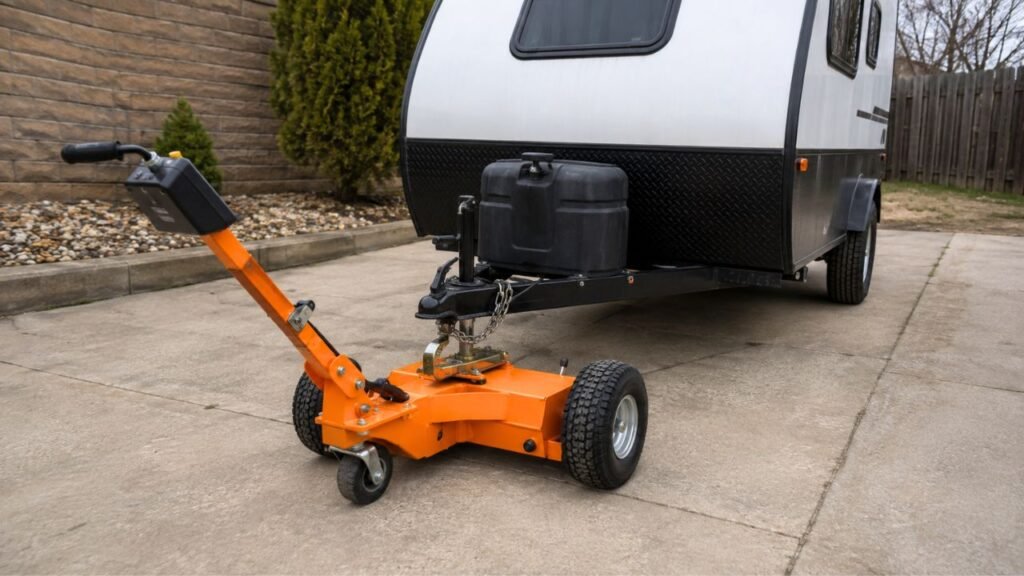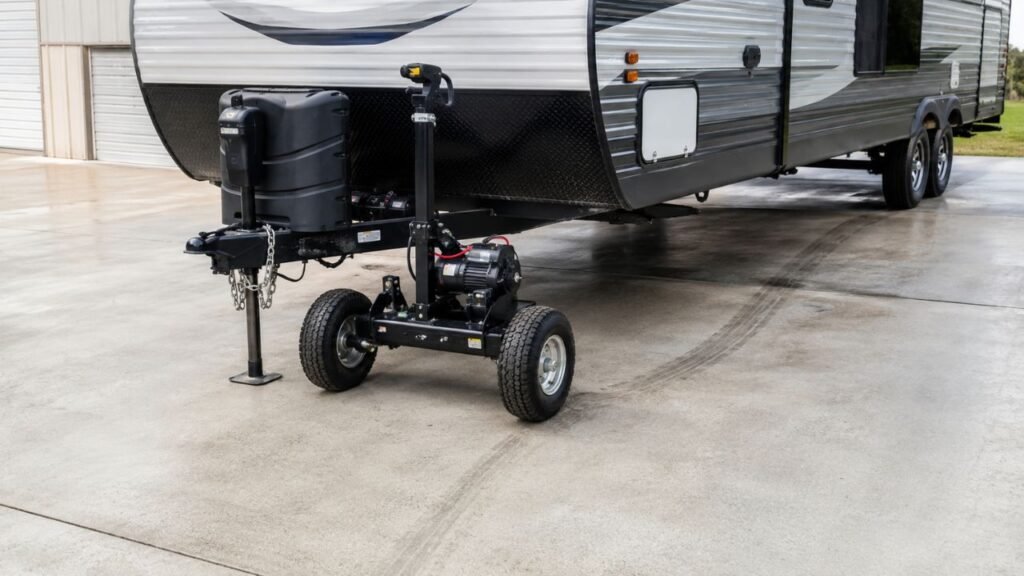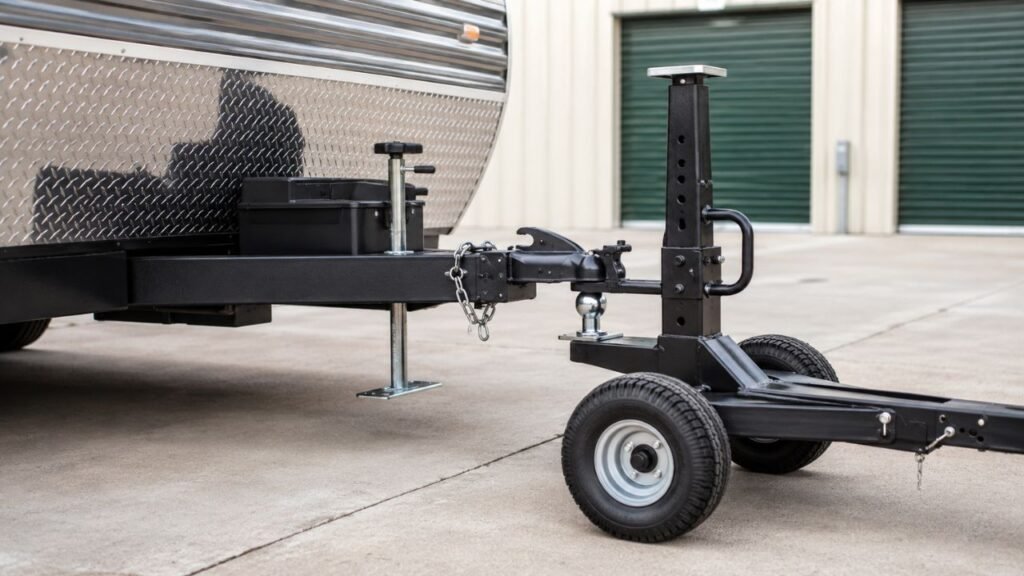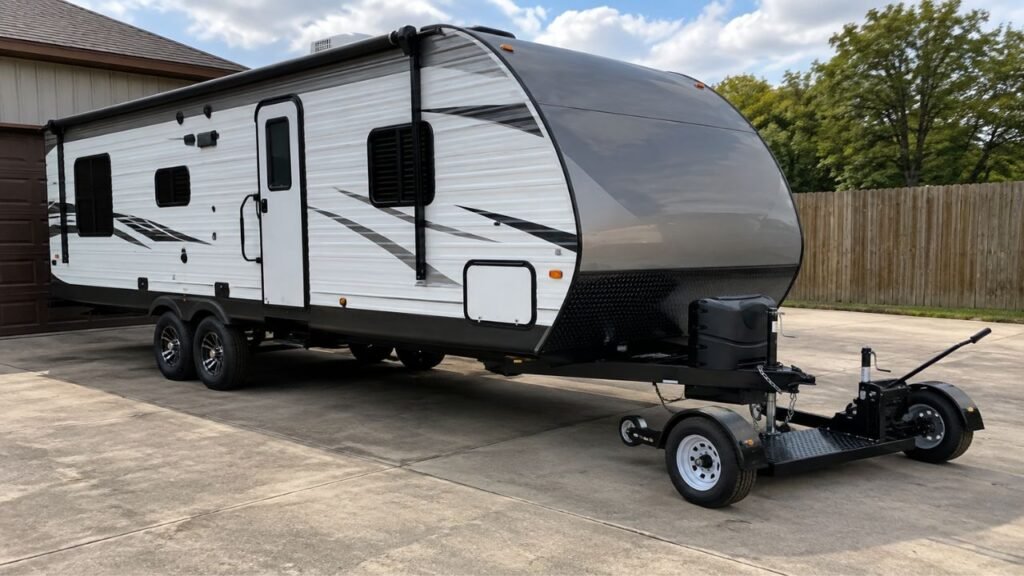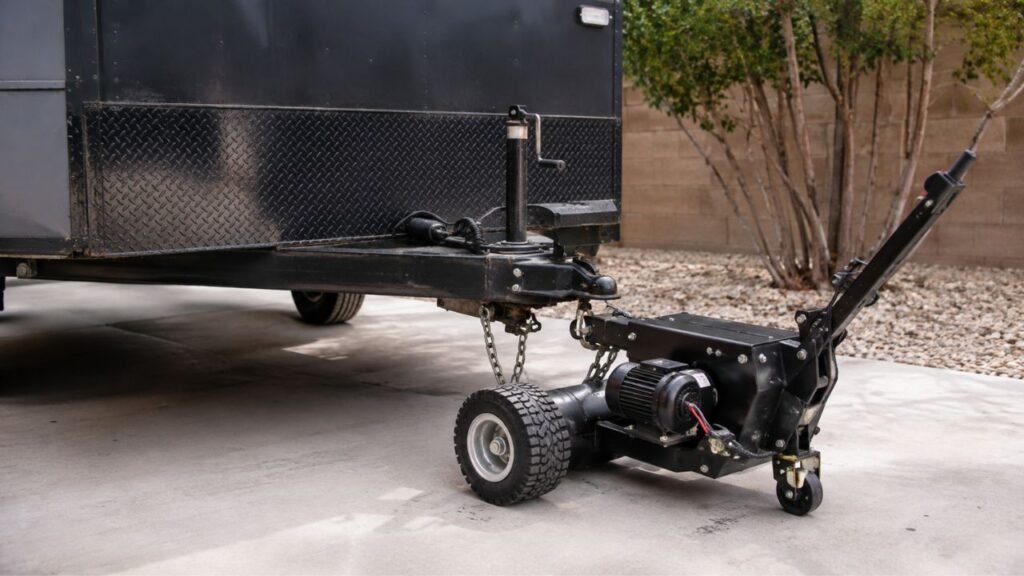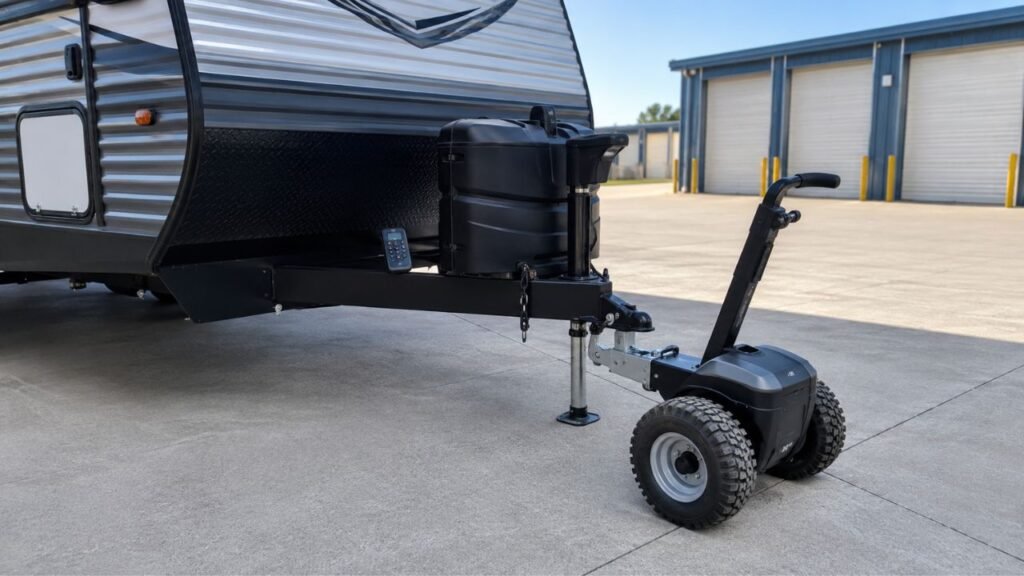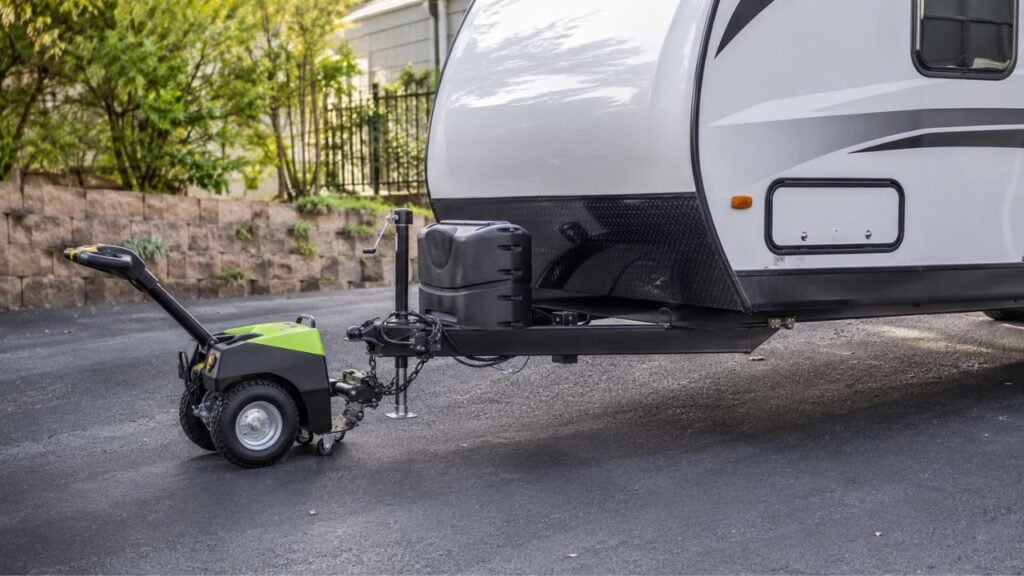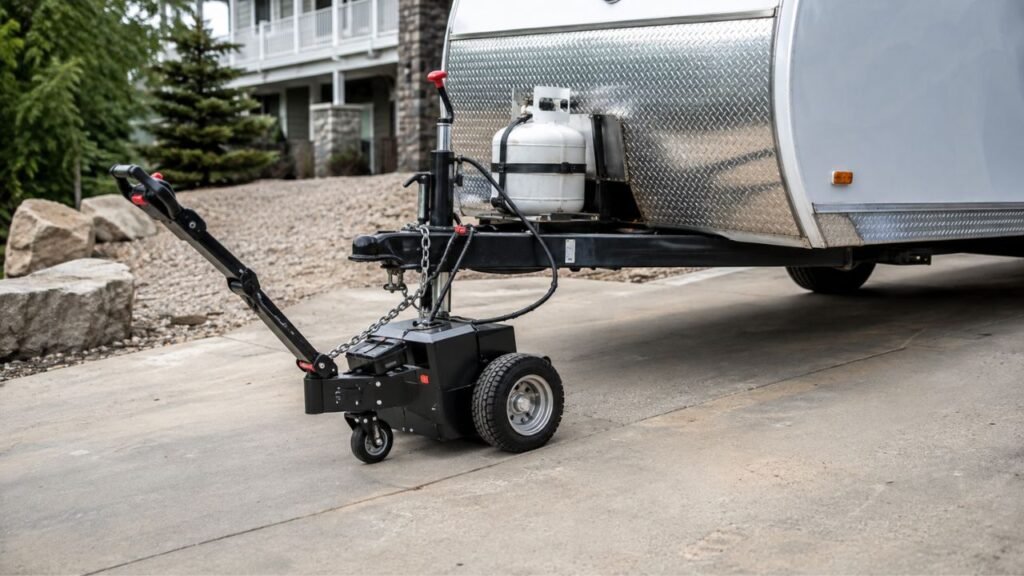
An electric trailer dolly usually loses power under load because the motor needs much more current while moving a trailer. A weak battery, voltage drop, excessive weight, mechanical drag, overheating, or poor wiring can prevent enough power from reaching the motor.
In this guide, I’ll help you narrow down the actual cause. We’ll check the battery, connections, load, terrain, tires, brakes, and protection systems before blaming the motor.
Key Takeaways
- A dolly working unloaded but struggling loaded often indicates voltage loss.
- A battery can look charged but still fail under heavy demand.
- Loose or corroded terminals can restrict current to the motor.
- Excessive trailer or tongue weight can overload the drive system.
- Grass, gravel, ramps, and slopes increase the motor’s workload.
- Sudden shutdowns can indicate thermal or overload protection.
- Wheel spin can feel like power loss but is often traction-related.
- Repeated breaker trips should be diagnosed instead of repeatedly reset.
Why Does an Electric Trailer Dolly Lose Power Only When Loaded?
A trailer dolly needs relatively little effort when running by itself. Once you connect a heavy trailer, everything changes.
The motor must create enough torque to move the trailer’s weight. It also has to overcome tire resistance, bearings, surface conditions, and any incline.
Producing more torque requires the motor to draw more electrical current. That increased demand often exposes problems that remain hidden without a load.
A weak battery may look perfectly normal while the dolly sits still. Once the motor starts demanding high current, battery voltage can drop sharply.
The same thing happens with poor cables and dirty terminals. They may carry a small current without trouble. Under heavy demand, resistance causes greater voltage loss and heat.
The basic sequence often looks like this:
More resistance → higher motor demand → greater current draw → voltage drop → reduced motor performance.
If the demand becomes excessive, the motor may slow significantly. A circuit breaker or controller may also shut everything down.
That is why troubleshooting should focus on the whole power system. Replacing the motor immediately is rarely the best first step.
What Your Dolly’s Symptoms Can Tell You
How the dolly behaves can provide useful clues. Pay attention to when the problem begins and what happens afterward.
| What the Dolly Does | Most Likely Cause | What to Look For | Check First |
| Runs well unloaded but slows immediately when attached | Weak battery or voltage drop | Motor becomes noticeably slower | Battery under load |
| Stops immediately with a heavy trailer | Overload or weak battery | Sudden complete shutdown | Weight and battery |
| Runs several minutes before stopping | Overheating | Works again after cooling | Motor and controller temperature |
| Works on concrete but struggles on grass | Rolling resistance or traction | Performance changes by surface | Tires and ground |
| Works level but struggles uphill | Excessive motor demand | Problem appears mainly on slopes | Grade limit |
| Cable or connector becomes hot | High electrical resistance | Warm terminal or plug | Connections |
| Motor runs but wheel spins | Poor traction | Drive tire spins quickly | Tire grip |
| Dolly strains despite a good battery | Mechanical resistance | Trailer seems hard to roll | Brakes and bearings |
This symptom-based approach can save you plenty of unnecessary repairs.
7 Common Reasons an Electric Trailer Dolly Loses Power Under Load
Power loss does not automatically mean the motor is failing. Several easier and cheaper problems can produce almost identical symptoms.
1. The Battery Is Weak Under Load
The battery is the first place I would check.
Electric trailer dollies can draw substantial current while starting or moving weight. An aging battery may struggle to supply that current consistently.
You may still measure normal-looking voltage while the dolly is sitting. That does not prove the battery is healthy.
Battery voltage can collapse once the motor begins working hard.
Common battery-related causes include:
- Low state of charge
- Aging lead-acid or AGM battery
- Sulfated battery plates
- Deteriorated internal cells
- Battery stored discharged for long periods
- Poor performance during very cold weather
- Battery not designed for the required current
If your dolly becomes weak immediately after attaching the trailer, test the battery under load.
A proper load test gives far more information than resting voltage.
2. Loose or Corroded Connections Are Causing Voltage Drop
High-current systems depend heavily on clean, tight electrical connections.
A slightly loose battery terminal may not cause obvious trouble unloaded. Under heavy current, that small resistance becomes much more important.
Electrical resistance wastes useful energy as heat.
The motor then receives less voltage than the battery produces.
Check these areas carefully:
- Positive battery terminal
- Negative battery terminal
- Cable lugs
- Quick-connect plugs
- Breaker terminals
- Controller connections
- Ground or negative cable connections
Look for corrosion, darkened metal, melted plastic, or loose hardware.
A connector becoming unusually warm is another useful warning sign.
Do not simply tighten everything as hard as possible. Follow the manufacturer’s recommended connection and terminal procedures.
3. The Battery Cables Are Too Small or Damaged
Battery cables must carry high current without excessive voltage loss.
Problems sometimes begin after owners replace original wiring themselves. A cable that looks thick enough may still be undersized internally.
Longer cables also create more resistance.
Potential cable problems include:
- Undersized replacement wires
- Damaged copper strands
- Loose crimp terminals
- Corrosion hidden inside cable ends
- Excessively long extension leads
- Partially melted connectors
Avoid choosing replacement cable size by appearance alone.
Use the size recommended for your specific dolly system. Current draw, cable length, voltage, and connector type all matter.
If the battery stays strong under load but motor voltage drops, cables deserve closer inspection.
4. The Trailer Is Too Heavy for the Dolly
Electric trailer dollies usually have more than one important limit.
Many owners only look at maximum trailer weight. Tongue weight can be just as important.
Your loaded trailer must remain within the manufacturer’s limits.
Remember that the trailer’s actual operating weight can exceed dry weight. Batteries, propane, water, cargo, tools, and accessories all add weight.
Excessive weight can cause:
- Sluggish acceleration
- High current draw
- Motor overheating
- Controller shutdown
- Breaker trips
- Reduced steering control
- Increased drivetrain stress
A dolly rated for a particular weight also may not perform equally everywhere.
Hard, level pavement places much less demand on the motor. A ramp or soft yard can require considerably more effort.
Always treat maximum capacity as a limit, not a performance target.
5. The Surface or Slope Is Increasing Resistance
Sometimes nothing is actually wrong with your dolly.
The ground may simply be making the trailer much harder to move.
Grass creates more rolling resistance than smooth concrete. Loose gravel can increase resistance while reducing traction at once.
An incline adds another major load.
Surfaces that can make a dolly struggle include:
- Thick grass
- Loose gravel
- Soft soil
- Wet pavement
- Uneven concrete
- Driveway lips
- Ramps
- Steep slopes
Turning sharply can also increase resistance during heavy maneuvers.
If the dolly works normally on flat pavement, test conditions matter.
Move the trailer onto a firm, level surface when possible. If performance returns, terrain was probably contributing significantly.
Always follow your dolly’s specific grade and surface restrictions.
6. Thermal or Overload Protection Is Cutting Power
Electric dollies commonly use protection systems to prevent damage.
These systems may interrupt power when current or temperature becomes excessive.
Your dolly may use:
- Resettable circuit breaker
- Thermal overload switch
- Controller current limiting
- Motor temperature protection
- Battery management protection on lithium systems
The shutdown pattern can tell you something useful.
If the dolly works initially but stops after sustained hard use, overheating becomes more likely.
If it begins working again after cooling, that clue becomes stronger.
However, do not assume the protection system itself is faulty.
It may be responding correctly to an overloaded motor.
Repeatedly resetting a breaker without finding the cause can create further problems.
7. Mechanical Drag Is Making the Motor Work Too Hard
Your dolly might be perfectly healthy electrically.
The trailer itself may be unusually difficult to move.
Mechanical resistance increases motor torque demand and current draw.
Check for:
- Low trailer tire pressure
- Low dolly tire pressure
- Dragging trailer brakes
- Failing wheel bearings
- Seized wheel bearings
- Jammed dolly caster
- Binding drivetrain components
- Debris around wheels
- Poorly lubricated moving parts
A dragging brake is especially easy to overlook.
The trailer may still move, but the dolly works much harder. That can create heat and repeated overload shutdowns.
If possible, check whether the trailer rolls normally on level ground.
Never manually push an uncontrolled heavy trailer to perform this test.
How to Diagnose Power Loss Under Load Step by Step
The best troubleshooting process starts with simple checks. Then you can move toward more technical electrical testing.
Step 1: Stop Forcing the Dolly
Stop using the dolly if you notice dangerous warning signs.
These include:
- Burning smell
- Repeated breaker trips
- Melted wiring
- Hot battery terminals
- Excessive motor heat
- Smoke
- Unusual grinding sounds
Secure the trailer before inspecting anything.
Continuing to force a stalled motor can create enormous current demand. That can damage wiring, connectors, batteries, and motor components.
Step 2: Test the Dolly Without the Trailer
Disconnect the dolly safely and operate it without trailer load.
Listen and watch carefully.
Does it accelerate normally?
Does it move equally well forward and backward?
And, does the motor sound smooth?
Does it stop unexpectedly?
If performance is poor even without a trailer, focus more heavily on:
- Battery condition
- Wiring
- Controller
- Motor
- Drive mechanism
If it works perfectly unloaded, load-related problems become more likely.
Step 3: Confirm Trailer and Tongue Weight
Before testing expensive electrical components, verify the actual load.
Check:
- Loaded trailer weight
- Tongue weight
- Dolly towing capacity
- Maximum tongue-weight capacity
- Permitted operating grade
- Approved surface conditions
Do not rely only on the trailer’s advertised dry weight.
Water and cargo can dramatically increase total weight.
If your trailer is near the dolly’s maximum limit, terrain matters even more.
Step 4: Fully Charge and Load-Test the Battery
Start with a complete battery charge.
Then observe what happens when the motor actually works.
A useful basic process is:
- Fully charge the battery.
- Check battery condition before operating.
- Run the dolly under normal trailer load.
- Observe voltage while the motor is operating.
- Watch for an unusually large voltage drop.
A battery that drops badly under load may need professional testing.
Many automotive and battery shops can perform a load test.
Replace the battery only with a compatible specification.
Step 5: Check for Voltage Drop
Voltage-drop testing can reveal problems that visual inspection misses.
Imagine your battery measures normally while the dolly is loaded. However, considerably less voltage reaches the motor controller.
Something between those points is consuming voltage.
Possible causes include:
- Poor terminals
- Weak cable connections
- Damaged wiring
- Corroded connectors
- High-resistance breaker
- Undersized cables
Testing voltage while current is flowing is especially useful.
A connection can look perfect until high current passes through it.
If you are unfamiliar with multimeter testing, get professional help. High-current DC wiring can become extremely hot during faults.
Step 6: Inspect Every High-Current Connection
Electrical inspection should go beyond the battery posts.
Check the entire path carrying motor current.
Inspect:
- Battery terminals
- Cable ends
- Power plugs
- Ground connections
- Fuse holders
- Circuit breakers
- Controller terminals
- Wire insulation
Look closely for discoloration and softened plastic.
Those signs often indicate heat caused by resistance.
Clean corrosion using the method recommended for your battery system.
Replace badly damaged connectors instead of repeatedly cleaning them.
Step 7: Reduce Mechanical Resistance
Now remove as much unnecessary resistance as possible.
Check:
- Dolly tire pressure
- Trailer tire pressure
- Trailer brakes
- Wheel bearings
- Ground conditions
- Dolly caster movement
- Obstacles around tires
Test again on hard, flat pavement.
If performance improves significantly, electrical power may not be your main problem.
The trailer was simply demanding too much effort.
Step 8: Pay Attention to When the Failure Happens
Failure timing gives valuable diagnostic information.
Stops immediately under load: Check the battery, overload, connections, and weight first.
Stops after several minutes: Motor or controller overheating becomes more likely.
Fails mostly uphill: Load demand or grade limitation deserves attention.
Fails mainly on grass: Rolling resistance and traction are likely contributing.
And if it fails when cables move: A loose or damaged electrical connection becomes suspicious.
These patterns are not absolute diagnoses.
They simply help you choose the right checks first.
Is It Actually Losing Power, or Are the Dolly Tires Slipping?
Not every weak-moving dolly is experiencing electrical power loss.
Sometimes the motor still produces plenty of power. The drive tire simply cannot transfer that force to the ground.
Watch the drive wheel while operating from a safe position.
If the wheel spins quickly but the trailer barely moves, think traction.
Common traction problems include wet concrete, gravel, grass, and worn tires.
Poor weight placement can also reduce useful pressure over the drive tire.
True power loss usually looks different.
Motor speed drops heavily, acceleration disappears, or electrical power shuts off entirely.
Knowing the difference prevents unnecessary battery and motor replacements.
Can Too Much Tongue Weight Cause the Dolly to Lose Power?
Yes, excessive tongue weight can make an electric dolly struggle.
Tongue weight adds direct load to the dolly’s structure and drive system. Going beyond the rated limit can increase stress dramatically.
Excessive tongue weight may cause slow movement, overheating, poor steering, or overload protection.
However, very low effective weight on a powered wheel can cause problems too.
The tire may lose traction before the motor reaches full capability.
That is why proper tongue weight matters for more than capacity.
Always use the range approved for your particular dolly.
Why Does the Dolly Lose More Power Going Uphill?
An uphill trailer requires considerably more force than one moving level.
That extra force increases motor current demand.
As motor demand rises:
- Battery voltage may sag more.
- Cable voltage losses become larger.
- Motor temperature rises faster.
- Controller current limits may activate.
- Traction becomes more important.
- Circuit breakers may trip.
Never assume a dolly’s weight rating applies equally to steep slopes.
Manufacturers often specify separate limits for grade and operating surface.
If your dolly struggles only uphill, check those restrictions first.
What Should You Fix First?
It is easy to start replacing expensive parts too soon. I suggest working through the simplest causes first.
- Fully charge and test the battery.
- Clean and tighten battery connections.
- Inspect cables for heat and damage.
- Confirm trailer and tongue weight.
- Test on hard, level pavement.
- Correct tire pressure and mechanical resistance.
- Allow an overheated system to cool.
- Investigate the controller, motor, or drivetrain afterward.
This order helps prevent unnecessary repairs.
Battery and connection problems are also easier to confirm.
When Does the Motor or Controller Become the Likely Problem?
Motor or controller faults should move higher on your list only after basic checks pass.
Suppose the battery tests well under load.
Your cables also deliver proper voltage to the controller. Connections remain cool, and the trailer is comfortably within weight limits.
You also confirmed that tires, brakes, and bearings move normally.
If the dolly still struggles badly on level pavement, deeper problems become more likely.
Watch for symptoms such as:
- Burned electrical smell
- Grinding from the drive system
- Erratic motor operation
- Repeated unexplained breaker trips
- Motor failing in one direction
- Controller cutting power randomly
- Unusual sparking
Internal motor and controller work may require specialized knowledge.
Contact the manufacturer or a qualified technician if necessary.
Avoid opening sealed high-current electronics unless you understand the system.
How to Prevent Power Loss Under Load
A few maintenance habits can prevent many of these problems. Pay particular attention to anything carrying motor current.
- Recharge the battery properly after use.
- Follow storage charging instructions during long periods.
- Keep battery terminals clean and tight.
- Replace damaged connectors quickly.
- Never substitute undersized battery cables.
- Check trailer tire pressure regularly.
- Maintain trailer wheel bearings.
- Make sure trailer brakes fully release.
- Stay within towing and tongue-weight limits.
- Avoid prolonged operation near maximum load.
- Follow manufacturer limits for slopes.
- Avoid unsuitable soft or slippery surfaces.
- Investigate recurring breaker trips immediately.
You do not need complicated maintenance every time.
A few quick checks before moving can prevent major problems.
Final Verdict
An electric trailer dolly that loses power under load usually has one of two problems. Either enough electrical power is not reaching the motor, or the trailer is creating excessive resistance.
Start with the battery and high-current connections. Then check trailer weight, terrain, tire pressure, brakes, and wheel bearings.
If everything outside the dolly checks out, investigate thermal protection, the controller, motor, and drivetrain. Working in that order usually makes troubleshooting faster and much less expensive.
Related FAQs
Why Does My Electric Trailer Dolly Work Without a Load but Not With a Trailer?
A heavy trailer increases motor current demand significantly. A weak battery, voltage drop, excessive trailer resistance, or overload protection may only appear once that extra demand is present.
Can a Battery Show 12 Volts and Still Be Bad?
Yes. A battery can show reasonable resting voltage yet collapse under load. Testing voltage while the motor operates gives you a much better indication of battery condition.
Why Does My Trailer Dolly Stop and Start Working Again Later?
The motor, controller, breaker, or battery protection system may be overheating or limiting current. If operation returns after cooling, thermal protection is a strong possibility.
Can Loose Battery Terminals Make an Electric Dolly Feel Weak?
Yes. Loose or corroded terminals create electrical resistance. That resistance causes voltage loss and heat, especially when the motor demands high current.
Why Does My Electric Trailer Dolly Struggle on Grass?
Grass increases rolling resistance and can reduce tire traction. The motor must work harder, which increases current demand and makes an already weak electrical system more noticeable.
Can Low Trailer Tire Pressure Make a Dolly Lose Power?
Low tire pressure does not directly reduce electrical power. It increases rolling resistance, forcing the motor to draw more current and making the dolly feel weaker.
Can Dragging Trailer Brakes Overload an Electric Dolly?
Yes. A dragging brake continuously resists trailer movement. That extra load can slow the motor, increase heat, and eventually activate overload or thermal protection.
Should I Keep Resetting the Circuit Breaker if My Dolly Trips?
No. Repeated breaker trips usually indicate overload, overheating, resistance, or an electrical fault. Find the cause before continuing to operate the dolly.
Does a Bigger Battery Give an Electric Trailer Dolly More Power?
Not necessarily. The battery must match the dolly’s required voltage, chemistry, current capability, capacity, and charging system. A physically larger battery does not automatically increase safe motor power.

Jack Collins specializes in RV routes, trail access, and travel logistics. His how-to articles help RV and trailer owners plan smoother trips and avoid common mistakes. Every review focuses on performance, safety, and value.