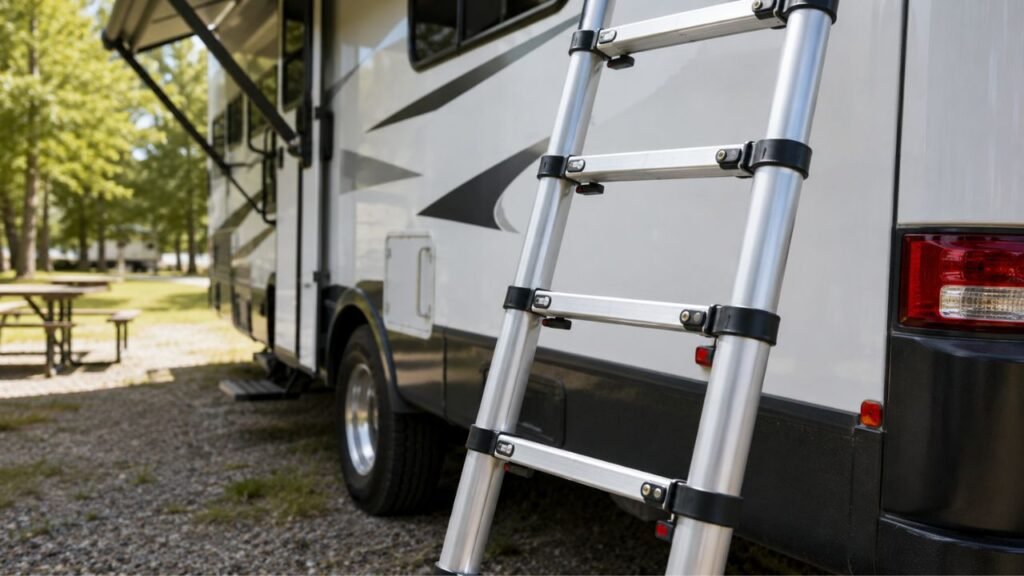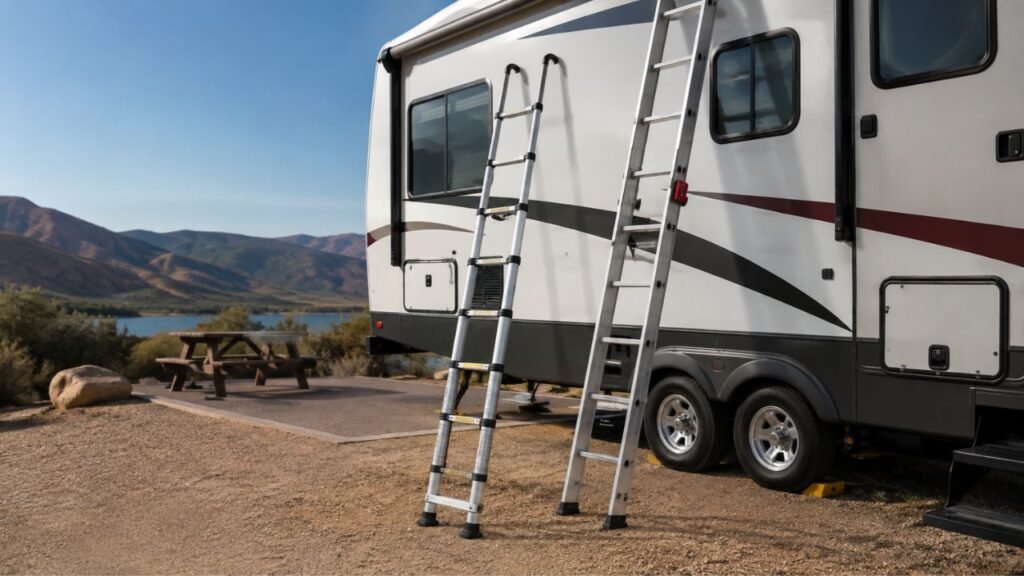
For most RV owners, a telescoping ladder is more practical than an extension ladder. It provides useful roof access while collapsing small enough for an RV storage compartment. An extension ladder feels more rigid and may reach higher, but transporting it is usually much harder.
That does not mean a telescoping ladder wins in every situation. Below, I’ll compare storage, reach, stability, setup, weight capacity, safety, and everyday RV use. By the end, you should know which ladder actually fits your rig and travel style.
Key Takeaways
- A telescoping ladder is usually easier to store inside an RV.
- Extension ladders generally feel more rigid when fully extended.
- Advertised ladder length is not the same as usable vertical height.
- Taller RVs may require more reach than compact ladders provide.
- Both ladder types need stable, level footing before climbing.
- Your ladder rating must include your weight and carried tools.
- Telescoping ladder locks require careful inspection before every climb.
- RV sidewalls and roof edges need protection from ladder contact.
- Most recreational RVers will find telescoping models more convenient.
Telescoping Ladder vs Extension Ladder for RVs: Quick Comparison
Both designs can help you reach an RV roof, but they solve different problems. This quick comparison shows where each type usually performs better.
| Factor | Telescoping Ladder | Extension Ladder | Better for Most RVers |
| Stored size | Very compact | Long and bulky | Telescoping |
| RV compartment storage | Usually easy | Often difficult | Telescoping |
| Campsite portability | Easier | More awkward | Telescoping |
| Maximum available reach | Moderate to high | Often higher | Extension |
| Rigidity | Some flex possible | Usually more rigid | Extension |
| Adjustable working height | Excellent | Good | Telescoping |
| Setup space | Usually less | Usually more | Telescoping |
| Moving around slide-outs | Easier | More difficult | Telescoping |
| Lock inspection | More individual locks | Simpler mechanism | Extension |
| Travel convenience | Excellent | Situational | Telescoping |
| Frequent high-level work | Good | Often better | Extension |
The important thing is not choosing the ladder with more advantages. You need the ladder whose advantages match how you use your RV.
Why a Telescoping Ladder Is Usually More Practical for RV Travel
An RV ladder spends much more time stored than being climbed. That makes portability and storage especially important for travelers.
It Takes Far Less RV Storage Space
Storage is where a telescoping ladder earns its biggest advantage.
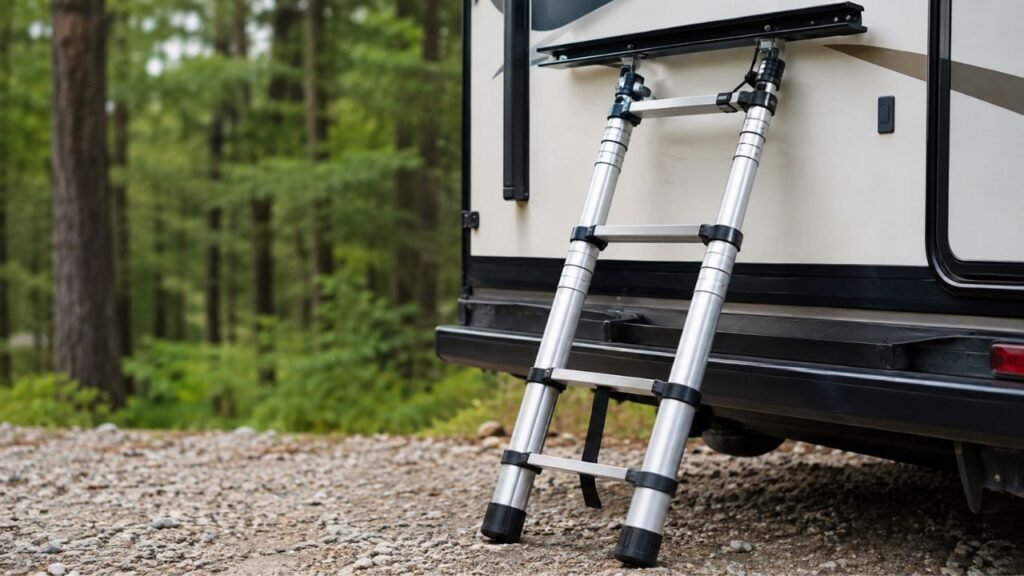
Its rails collapse inside each other when you finish using it. Many models shrink to only a few feet in length.
That makes them much easier to fit inside:
- Basement storage bays
- Pass-through compartments
- Rear storage compartments
- Pickup truck beds
- Tow vehicles
- Larger interior closets
- Toy-hauler storage areas
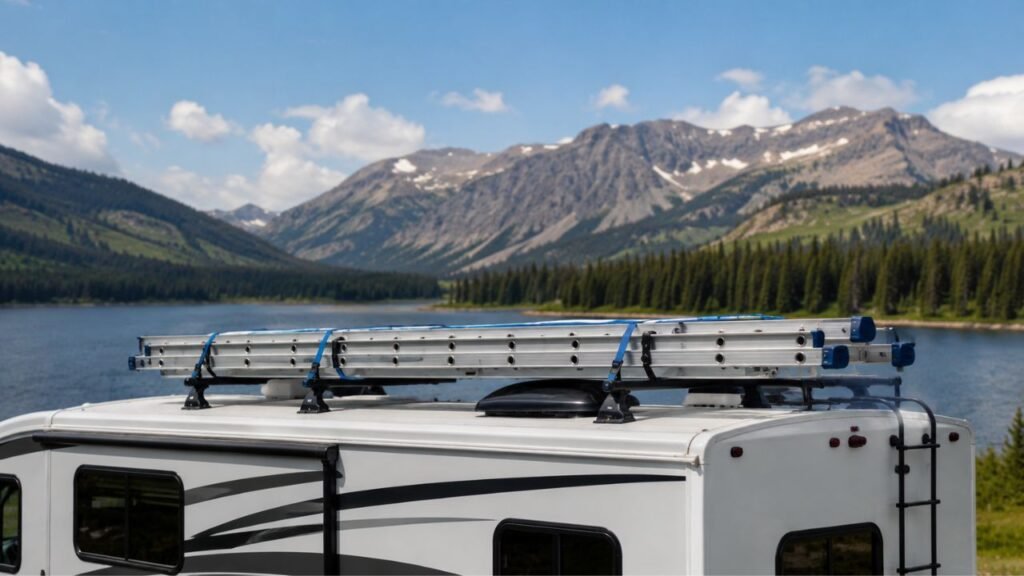
An extension ladder works differently. Its sections overlap, but they never disappear inside each other completely.
Even a relatively short extension ladder can remain several feet long when closed. Finding room for that length can become difficult.
This is especially noticeable in Class B and Class C motorhomes. Storage openings may be much smaller than the compartments behind them.
Before ordering any ladder, measure the storage door opening too. A ladder may technically fit inside the compartment yet never pass through its door.
It Is Easier to Carry Around a Campsite
Campsites rarely give you an empty workspace around your RV.
You may need to work around trees, picnic tables, utility pedestals, awnings, slide-outs, vehicles, and neighboring campsites.
A collapsed telescoping ladder is much easier to carry through these obstacles.
You can position it beside the RV before extending it. That reduces the chance of swinging a long aluminum ladder into the sidewall.
A traditional extension ladder can be much more awkward.
You often need enough open space to turn and position the entire ladder. That gets annoying quickly at tight campgrounds.
You Can Adjust It for Different RV Maintenance Jobs
You will not always need full roof height.
Sometimes you may only need enough height for:
- Inspecting roof seals
- Checking an awning
- Cleaning solar panels
- Reaching slide toppers
- Inspecting roof vents
- Washing upper sidewalls
- Checking clearance lights
A telescoping ladder lets you adjust its height for different jobs.
That can make quick inspections easier because you are not dealing with maximum ladder length every time.
Always follow the ladder manufacturer’s instructions for partial extension. Some designs require specific sections to be opened in a particular sequence.
It Usually Does Not Require an Exterior Carrying Rack
Storage can become a second project with an extension ladder.
You may need:
- A pickup-bed rack
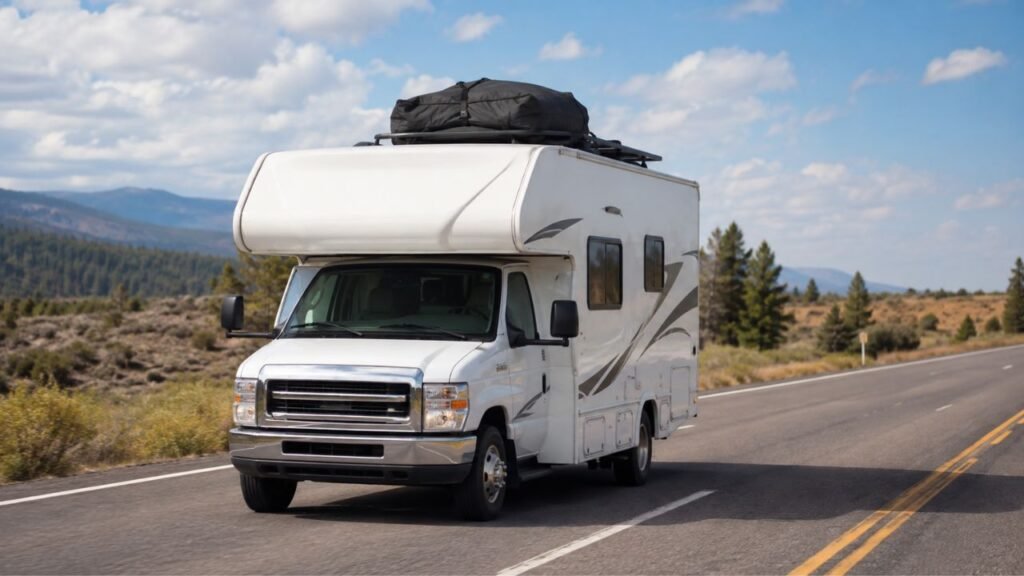
- Roof-mounted ladder rack
- Rear ladder carrier
- Dedicated trailer storage arrangement
- Large tow-vehicle cargo area
Those solutions add cost and complexity.
A telescoping ladder can often stay inside a protected storage compartment. That also keeps it away from road spray, rain, dust, and salt.
For frequent RV travel, that simplicity matters.
Where an Extension Ladder Still Beats a Telescoping Ladder
Telescoping ladders are convenient, but convenience is not everything. Extension ladders still have meaningful advantages for certain RV owners.
Extension Ladders Usually Feel More Rigid
A quality extension ladder typically feels more solid underfoot.
Its longer rails have fewer telescoping joints between the ground and your climbing position.
A telescoping ladder can have noticeable movement when fully extended. You may feel slight rail flex or movement between sections.
That does not automatically mean the ladder is unsafe.
A properly rated telescoping ladder can be completely suitable when correctly used. Still, some people simply feel more comfortable on a rigid ladder.
If you frequently spend extended periods working near roof height, that extra rigidity may matter.
They Offer More Options for Greater Reach
Extension ladders are available in very long configurations.
That can help when working around:
- Tall fifth wheels
- Large Class A motorhomes
- High toy haulers
- Raised storage buildings
- Home roofs during non-RV use
This matters because ladder length and actual working height are different.
A ladder leaning against an RV does not stand vertically. Part of its total length extends outward from the RV.
If your motorhome has a particularly high roofline, a compact telescoping ladder may not provide enough useful access.
Their Mechanisms Are Simpler to Inspect
Telescoping ladders contain multiple moving sections.
Each section may have:
- Locking mechanisms
- Guides
- Sliding tubes
- Release controls
- Alignment points
An extension ladder normally uses fewer sliding sections.
You still need to inspect the rails, rungs, feet, locks, rope, pulley, and fasteners. However, the overall structure is easier to visually understand.
This can be useful for frequent heavy use.
They Make More Sense When Storage Is Already Solved
Storage may not be a problem for everyone.
An extension ladder becomes much more practical when you already have:
- A pickup with a ladder rack
- A dedicated service vehicle
- A large toy-hauler garage
- Exterior ladder storage
- Permanent storage at your seasonal campsite
In those situations, portability becomes less important.
Then the greater rigidity and available reach become stronger advantages.
How Much Ladder Height Do You Actually Need for an RV?
Choosing ladder height deserves more attention than it normally gets. Buying by advertised length alone can leave you with the wrong ladder.
Start With the RV Roofline, Not Advertised Ladder Length
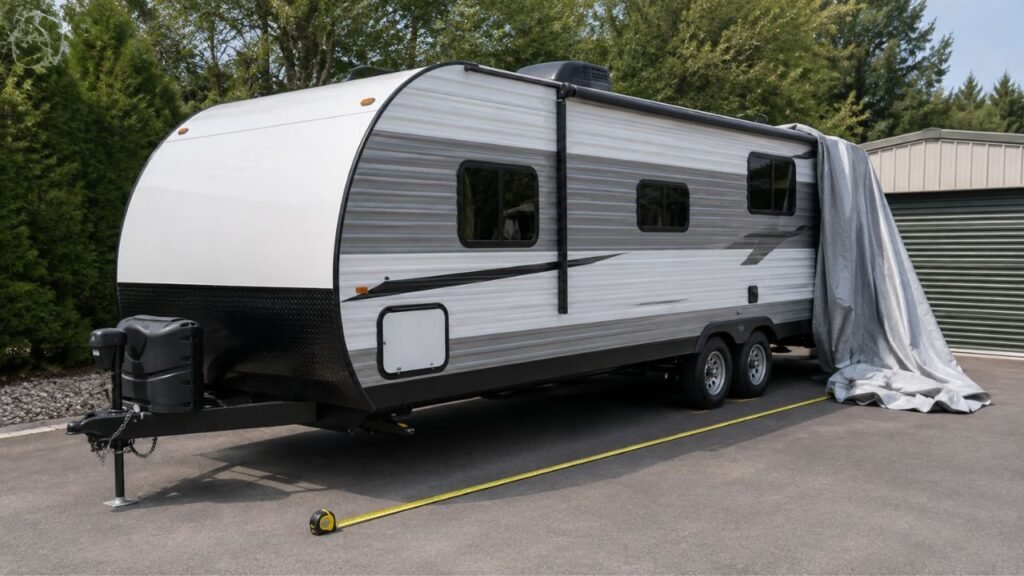
Measure your actual RV first.
You need to know the distance from the ground to the roof edge where you intend to access it.
Do not automatically use the manufacturer’s overall vehicle height.
That measurement may include:
- Air conditioners
- Roof antennas
- Satellite equipment
- Vent covers
- Solar equipment
Those components can make the published RV height taller than the roof edge itself.
You also need to remember that leaning ladders lose vertical height.
A 12-foot ladder does not place its top 12 feet vertically above the ground. The bottom must sit away from the RV at a safe angle.
That geometry reduces actual vertical reach.
Allow Enough Ladder Above the Roof Edge for Safe Access
Getting your hands near the roof is different from safely stepping onto it.
With a conventional portable ladder used to access an elevated surface, general ladder guidance calls for enough ladder extending above the landing to provide secure hand support.
A commonly used benchmark is approximately three feet above the landing surface.
However, specialized RV ladder systems can use different attachment designs.
Some mount into dedicated receivers or brackets instead of functioning like ordinary leaning ladders.
Always follow the instructions supplied with your exact ladder and RV.
Do not combine mounting instructions from one ladder design with another.
Typical RV Type Changes the Ladder Decision
Different RV styles create different access problems.
Class B camper vans usually have limited storage. Their lower roof height often makes a compact telescoping ladder especially convenient.
Class C motorhomes generally work well with telescoping ladders because storage and portability remain important.
Travel trailers can also be good candidates. The ladder can often ride inside the trailer or tow vehicle.
Fifth wheels can have much taller rooflines. You need to measure carefully before assuming a compact ladder will work.
Toy haulers provide more storage space, so either ladder design may be practical.
Class A motorhomes vary considerably in height. The correct choice depends heavily on the individual coach.
Telescoping vs Extension Ladder Stability Around an RV
Stability depends on much more than ladder type. Ground condition, angle, feet, locks, and setup all affect how secure a ladder feels.
What Telescoping Ladder Flex Actually Feels Like
A telescoping ladder contains numerous nested rail sections.
As you climb higher, those connections can allow small amounts of movement.
You may notice:
- Slight rail flex
- Minor rung movement
- Side-to-side movement
- Increased movement at full extension
This can feel strange if you are accustomed to rigid ladders.
However, movement alone does not prove the ladder is unsafe.
The important questions are whether the ladder is properly rated, undamaged, locked, correctly positioned, and being used as designed.
Why Extension Ladders Often Feel More Solid
Extension ladders use long overlapping rails.
That design often creates a more continuous structure under load.
Many people therefore feel more confident while spending extended periods at height.
That makes extension ladders attractive for repeated roof maintenance.
The tradeoff is that you must transport and position a much larger object.
For occasional RV inspections, many owners prefer slightly less rigidity in exchange for easier handling.
A Stabilizer Bar Can Matter More Than Ladder Type
Base width strongly influences how planted a ladder feels.
Some portable ladders include a wide stabilizer bar across the bottom.
This can improve:
- Side-to-side stability
- Foot spacing
- Ground contact
- Confidence while climbing
Some ladders also accept approved top stabilizers.
These can spread the contact area and sometimes help keep rails away from sensitive surfaces.
Only use stabilizers designed for your specific ladder.
Improvised attachments can change how the ladder carries weight.
Uneven Campsites Can Make Either Ladder Unsafe
Campground terrain is rarely perfect.
You may encounter:
- Gravel
- Sand
- Wet grass
- Soft dirt
- Mud
- Sloped pads
- Uneven asphalt
- Roadside shoulders
Neither ladder design fixes unstable ground.
The ladder feet need firm, stable support before you climb.
Do not level a ladder using random rocks, loose boards, leveling blocks, or other improvised objects.
If you cannot create a secure setup, move the RV or delay the job.
Can You Lean a Portable Ladder Against an RV?
You should be more careful leaning a ladder against an RV than against a solid building. RV exterior materials can be easier to damage.
Why RV Sidewalls Need More Care Than House Walls
An RV exterior contains many delicate surfaces.
Possible ladder contact points include:
- Fiberglass panels
- Aluminum siding
- Roof trim
- Window frames
- Drip rails
- Awning components
- Roof membrane edges
- Sealant joints
- Decorative panels
A ladder concentrates weight through relatively small contact points.
That can leave scratches, dents, pressure marks, or damaged sealant.
Some components may also look sturdy without being structural.
An awning rail, decorative trim piece, or gutter should never automatically be treated as a ladder support.
Use the Ladder’s Intended Contact or Mounting System
Some portable RV ladders are specifically designed for motorhomes and trailers.
Depending on the system, they may use:
- Dedicated receiver brackets
- Hooks
- Rubber contact pads
- Shaped supports
- Wider contact points
These systems help control how ladder loads reach the RV.
If your ladder uses an RV-specific attachment system, install it exactly as directed.
Do not replace required brackets with homemade mounting points.
Do Not Assume Hooks Automatically Make a Ladder RV-Safe
Hooks can look reassuring, but they still need a suitable anchor.
Never assume a hook can safely grab:
- An awning rail
- Rain gutter
- Roof rack
- Ladder trim
- Window frame
- Roof molding
The connection must be designed to carry the ladder load.
A hook attached to a weak RV component can create a more dangerous situation than a properly positioned leaning ladder.
Which Ladder Is Easier to Store and Transport in an RV?
For everyday RV travel, the telescoping ladder wins this category comfortably.
Its collapsed dimensions make it much easier to fit inside limited storage.
An extension ladder usually needs a long compartment, pickup bed, roof rack, or outside carrier.
Weight also matters, but do not assume every telescoping ladder is lighter.
Some heavy-duty telescoping models can weigh surprisingly close to traditional ladders.
Check the actual product weight before buying.
Storage cleanliness matters too.
A ladder picks up mud, sand, bugs, sealant, and campsite dirt. Keeping it inside your living area may not be ideal.
A basement compartment is usually much more convenient.
Whatever ladder you choose, secure it before towing.
A heavy ladder should not slide around inside an RV storage bay.
One practical rule is worth remembering: measure the storage opening, not just the compartment.
Which Ladder Is Easier to Set Up Beside an RV?
A telescoping ladder usually requires less space while you position it. An extension ladder offers a simpler structure once it is fully set.
Telescoping ladder setup advantages:
- Easier to carry while collapsed
- Easier to maneuver beside slide-outs
- Requires less turning room
- Can often be adjusted for different heights
- Usually easier to store after use
Extension ladder setup advantages:
- Familiar structure for many users
- Fewer individual locking sections
- Easy to visually inspect
- Often feels more rigid
- Available in greater overall lengths
For many RV owners, the telescoping ladder is easier to handle alone.
However, ladder size and personal strength can change that answer.
Never attempt to control a ladder you cannot safely lift or position.
Are Telescoping Ladders Safe Enough for RV Roof Access?
A quality telescoping ladder can be suitable for RV roof access when correctly selected and used. Safety depends on the whole setup, not just the ladder design.
The Design Is Not the Main Safety Test
Do not judge a ladder entirely by whether it telescopes.
Look at the individual ladder instead.
Check its:
- Intended use
- Rated load
- Maximum length
- Locking system
- Feet
- Rail condition
- Manufacturer instructions
- Applicable safety documentation
A poorly built extension ladder can be unsafe.
A properly manufactured telescoping ladder can perform very well.
The specific model matters more than assumptions about the category.
Check Every Telescoping Section Before Climbing
Each section needs to lock correctly.
Before climbing, inspect:
- Lock indicators
- Rung engagement
- Rail alignment
- Dirt around mechanisms
- Sand inside sliding sections
- Damaged tubes
- Cracked feet
Some ladders provide visual indicators showing whether each rung is locked.
Others use an audible click or mechanical indicator.
Learn how your exact ladder confirms engagement.
Do not climb until every required section is secured.
Understand the Duty Rating
Ladder capacity is not simply your body weight.
The ladder supports everything you bring onto it.
That can include:
- Clothing
- Work boots
- Tool belt
- Caulk gun
- Sealant
- Cleaning supplies
- Replacement parts
If you weigh 220 pounds and carry 25 pounds of equipment, the ladder is supporting approximately 245 pounds.
Always leave appropriate capacity instead of treating the maximum rating as a target.
Look for Applicable U.S. Safety Standards
For portable metal ladders sold in the United States, ANSI A14 standards are commonly referenced.
Portable metal ladders fall under ANSI A14.2 requirements.
When shopping, look beyond marketing phrases.
Do not assume a ladder meets a standard simply because a product listing says “ANSI approved.”
Check the manufacturer’s documentation for the exact model.
Reliable companies should clearly identify specifications, testing information, instructions, and load ratings.
The 4-to-1 Rule Matters With Either Leaning Ladder
A conventional leaning ladder needs the correct angle.
A common setup guideline is the 4-to-1 rule.
For approximately every four feet of vertical ladder height, the base sits about one foot away from the supporting surface.
For example, a ladder contacting the RV around 12 feet high would generally need its base roughly three feet outward.
This creates a safer climbing angle than standing the ladder nearly vertical.
However, specialized RV ladder systems may specify different positioning.
A receiver-mounted ladder should follow its own installation instructions.
Never force a specialized design into a generic setup rule when its manufacturer provides different guidance.
Telescoping vs Extension Ladder Weight Capacity
You may hear that extension ladders always support more weight.
That is too broad.
Weight capacity depends on the individual ladder, not simply its design.
You can find substantial duty ratings in both categories.
The better approach is comparing the labels on the exact ladders you are considering.
Remember to include your entire working load.
That means:
Body weight + clothing + footwear + tools + carried supplies = total ladder load.
Do not choose a ladder whose rating barely covers that number.
A generous margin gives you more flexibility when carrying maintenance equipment.
Which Ladder Requires More Maintenance?
Both ladder types need inspection, but their moving parts are different. A telescoping ladder deserves extra attention around its nested sections and locks.
Telescoping Ladder Maintenance
Pay particular attention to:
- Telescoping tubes
- Rung locks
- Lock indicators
- Rail alignment
- Retraction mechanisms
- Rubber feet
- Stabilizer hardware
Sand and campground dirt can work their way into sliding sections.
Keep the ladder clean and dry before storage.
Do not automatically spray oil or lubricant into the locking system.
Some lubricants attract dirt and can interfere with certain mechanisms.
Follow the manufacturer’s cleaning and lubrication instructions.
Extension Ladder Maintenance
Inspect:
- Side rails
- Rungs
- Rung locks
- Pulley
- Rope
- Fasteners
- Shoes or feet
- Section guides
Pay particular attention to damaged rails or loose hardware.
Replace worn ropes or damaged components according to manufacturer instructions.
Do not continue using a ladder with structural damage.
RV Storage Conditions Can Accelerate Wear
RV travel exposes equipment to difficult conditions.
A ladder may encounter:
- Road salt
- Campground sand
- Condensation
- High humidity
- Rain
- Mud
- Temperature swings
An exterior-mounted extension ladder receives much more direct exposure.
A telescoping ladder stored inside a compartment gets better protection.
However, putting a wet ladder into a sealed storage bay can create corrosion and moisture problems.
Let it dry before long-term storage whenever possible.
Who Should Choose a Telescoping Ladder for an RV?
A telescoping ladder makes the most sense when storage and portability are major priorities.
It is especially practical for:
- Full-time RVers with limited storage
- Class B camper-van owners
- Class C motorhome owners
- Travel-trailer owners
- RVers without exterior ladder racks
- People performing occasional roof inspections
- Owners cleaning solar panels
- RVers inspecting roof sealant
- Campers who move frequently
- Anyone wanting one compact multipurpose ladder
For the average recreational RVer, this is usually the more practical category.
You get useful height without dedicating a huge section of your rig to ladder storage.
Who Should Choose an Extension Ladder Instead?
An extension ladder becomes more appealing when maximum rigidity or reach matters more than portability.
It can be a better choice for:
- Frequent roof maintenance
- Very tall fifth wheels
- Large Class A motorhomes
- RV service technicians
- Owners with pickup ladder racks
- Seasonal RV sites
- Toy haulers with large garages
- Users uncomfortable with telescoping ladder flex
- People needing additional reach for home projects
If transporting the ladder is already solved, an extension model becomes much easier to justify.
What to Check Before Buying Either Ladder for Your RV
Do not shop by extended height alone. A good RV ladder needs to fit your vehicle, your storage, and your body.
Check these details before ordering:
- RV roof-edge height
- Required access height
- Ladder extended length
- Usable working height
- Collapsed length
- Collapsed width
- Storage-door opening
- Available compartment depth
- Ladder weight
- Duty rating
- Stabilizer width
- Foot design
- Rung width
- Rung grip
- Telescoping lock indicators
- Approved accessories
- RV contact method
- Applicable safety documentation
- Manufacturer instructions
- Warranty coverage
- Replacement-part availability
- Your body weight
- Expected tool weight
- Travel storage method
Taking ten minutes to measure everything can prevent a frustrating purchase.
Common RV Ladder Mistakes to Avoid
Several ladder problems around RVs start before anyone actually climbs. Avoiding these mistakes can make either design much easier to use safely.
Buying by Advertised Height Alone
Advertised ladder length does not equal vertical reach.
The ladder needs to lean at the proper angle.
You may also need additional ladder length above the roof edge.
Measure the RV instead of guessing from the ladder’s product name.
Choosing the Tallest Telescoping Ladder Just Because It Fits
Longer is not automatically better.
Extra length often means:
- More weight
- More flex
- More sections
- Higher cost
- Larger collapsed dimensions
Buy enough height for your actual RV.
There is little benefit in carrying several unnecessary feet everywhere.
Ignoring the Collapsed Width and Storage Door
This mistake is easy to make.
You measure a large basement bay and assume the ladder fits.
Then you discover the compartment door is narrower.
Always measure:
- Door width
- Door height
- Interior clearance
- Turning space
The opening is often the real limitation.
Leaning the Ladder Against Fragile RV Trim
Do not casually lean a ladder against anything that looks convenient.
Avoid assuming these parts can carry weight:
- Awning rails
- Gutters
- Roof trim
- Window frames
- Decorative molding
Use an approved contact location or mounting arrangement.
Using Leveling Blocks Under Ladder Feet
RV leveling blocks are useful under tires and stabilizers.
That does not make them safe ladder platforms.
Loose blocks can move, tilt, or shift while you climb.
Set the ladder on firm, stable ground instead.
Climbing Before Checking Every Lock
This is especially important with telescoping ladders.
One partially engaged section can create a dangerous failure.
Check every required lock before placing your weight on the ladder.
Repeat the check whenever you change ladder height.
Carrying Too Much Equipment Up the Ladder
It is tempting to climb while holding everything you need.
That can reduce your grip and affect balance.
Whenever possible, keep your hands available for climbing.
Use manufacturer-approved methods for raising tools separately when appropriate.
Using an Aluminum Ladder Near Electrical Hazards
Most telescoping and many extension ladders are aluminum.
Aluminum conducts electricity.
Pay attention to:
- Overhead power lines
- Campground utility equipment
- Electrical service connections
- Other energized equipment
If electrical exposure is possible, use equipment specifically designed for that environment.
Telescoping Ladder vs Extension Ladder by RV Type
Your RV style can make one ladder much more convenient than another. Use this table as a starting point, then measure your actual rig.
| RV Type | Usually More Practical | Why |
| Class B camper van | Telescoping | Storage space is extremely limited |
| Class C motorhome | Telescoping | Good balance of reach and portability |
| Travel trailer | Telescoping | Fits easier in tow vehicle or pass-through |
| Fifth wheel | Depends | Greater roof height may require more reach |
| Toy hauler | Either | Large storage space gives more options |
| Class A motorhome | Depends | Height and storage vary significantly |
| RV service vehicle | Extension or heavy-duty telescoping | Frequent use changes priorities |
Do not treat this chart as a fixed rule.
A tall travel trailer might need more ladder than a low-profile Class A. Your actual measurements always matter more than RV category.
So, Which Is More Practical for an RV?
For most RV owners, a good telescoping ladder is the more practical choice.
It solves one of the biggest RV problems: storage.
You can collapse it, put it inside a compartment, and carry it from campground to campground without dedicating an exterior rack to it.
It also provides enough reach for many common jobs, including roof inspections, seal checks, solar-panel cleaning, and awning maintenance.
An extension ladder still wins when your priorities change.
Choose one when you need greater reach, prefer maximum rigidity, or regularly perform high-level maintenance.
It also makes sense when you already have a convenient place to transport it.
The best choice therefore depends on one simple question:
Do you need maximum ladder performance, or maximum RV practicality?
For most travelers, practicality wins.
Final Words
If you travel regularly and only need occasional roof access, I would lean toward a quality telescoping ladder. Its compact storage and easier campsite handling make everyday RV life simpler.
If you own a particularly tall rig or spend considerable time working at roof height, an extension ladder deserves serious consideration.
Whichever style you choose, measure your RV first.
Measure the roof edge, storage compartment, and compartment opening. Then compare those measurements with the actual ladder specifications.
That approach will help you buy a ladder that works both on the roof and on the road.
Related FAQs
Are Telescoping Ladders Good for RVs?
Yes, telescoping ladders can work very well for RVs because they collapse into a compact package while still providing useful height. Choose a properly rated model with secure locking sections, stable feet, and enough length for your actual RV roofline.
Are Telescoping Ladders Less Stable Than Extension Ladders?
Telescoping ladders may feel more flexible because they contain multiple nested rail sections. Extension ladders usually feel more rigid, but actual safety depends on ladder quality, setup angle, footing, condition, and correct use.
What Size Telescoping Ladder Do I Need for an RV?
Measure from the ground to your intended roof-access point before choosing. Remember that a leaning ladder loses vertical height, and roof access may require additional length above the landing area depending on the ladder system.
Is a 12.5-Foot Telescoping Ladder Tall Enough for an RV?
A 12.5-foot ladder may work for many RVs, but it is not automatically tall enough for every rig. Fifth wheels and tall motorhomes can require additional reach, so measure your roof-edge height before buying.
Can I Lean a Telescoping Ladder Against My RV?
You may be able to when the ladder and RV manufacturer permit that setup. Use an appropriate contact point and avoid placing concentrated ladder pressure against delicate trim, gutters, awning rails, seals, or unsupported panels.
How Far Should a Ladder Extend Above an RV Roof?
Conventional portable-ladder guidance commonly calls for roughly three feet of extension above an elevated landing when the ladder provides roof access. Specialized RV-mounted ladder systems may use different requirements, so always follow the instructions for your exact setup.
Can I Use a Telescoping Ladder at Partial Height?
Many telescoping ladders can be used at different heights, but extension procedures vary between models. Follow the manufacturer’s instructions carefully and make sure every required rung or section is completely locked before climbing.
Are 330-Pound Telescoping Ladders Safe?
A 330-pound rating only tells you the ladder’s stated load capacity. Safety also depends on construction quality, locking mechanisms, ladder condition, proper footing, setup angle, and following the manufacturer’s instructions.
Should I Get a 12.5-Foot or 14.5-Foot RV Ladder?
Choose based on your measured roof-access height rather than assuming taller is better. A 14.5-foot model offers more reach, but it may also weigh more, flex more, and take up additional storage space.
Can You Store a Telescoping Ladder Outside an RV?
You can if the ladder manufacturer allows outdoor storage and you secure it properly. However, exterior storage exposes the ladder to rain, road grime, salt, sand, and moisture that can affect sliding sections and locking mechanisms.

Jack Collins specializes in RV routes, trail access, and travel logistics. His how-to articles help RV and trailer owners plan smoother trips and avoid common mistakes. Every review focuses on performance, safety, and value.