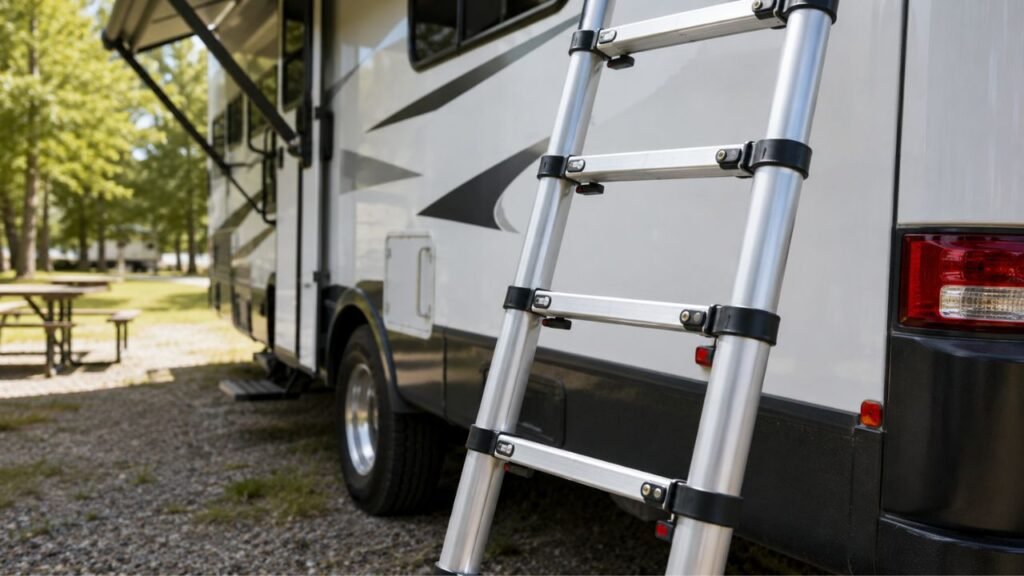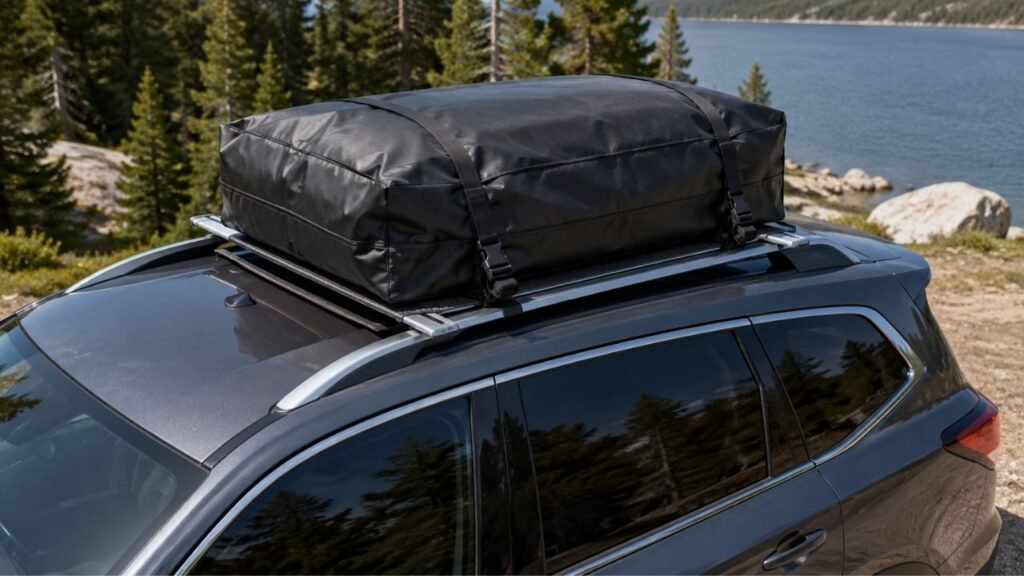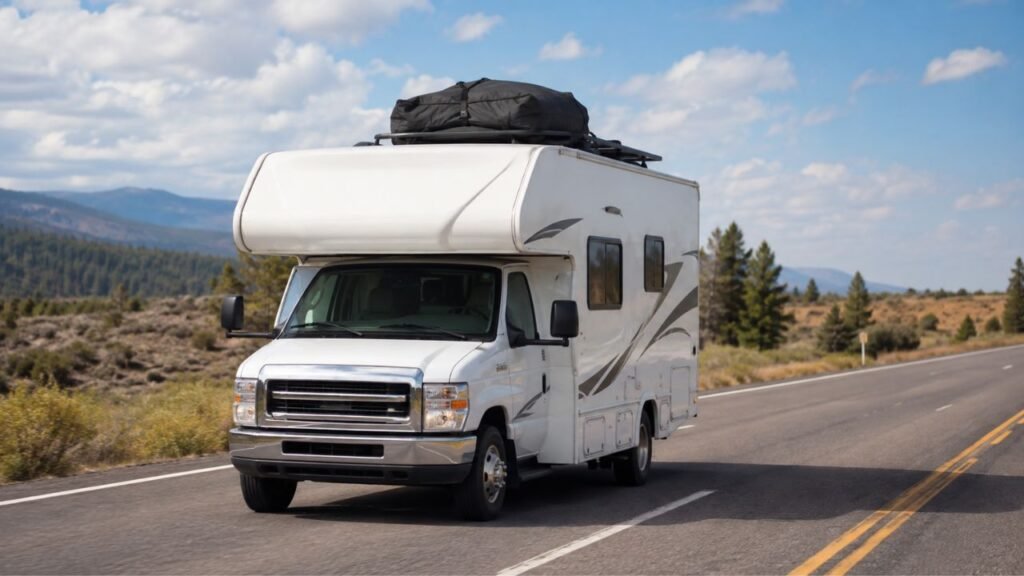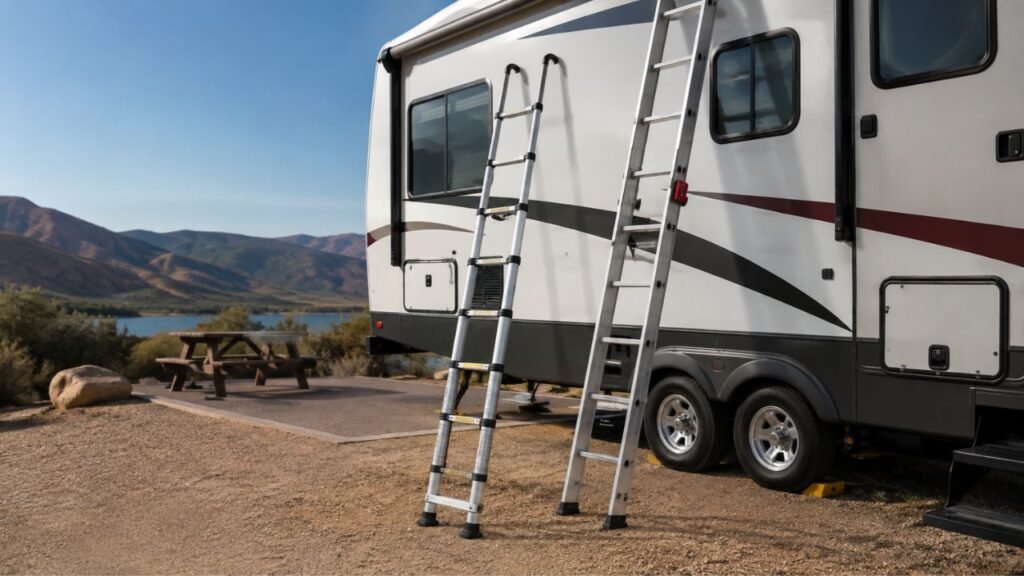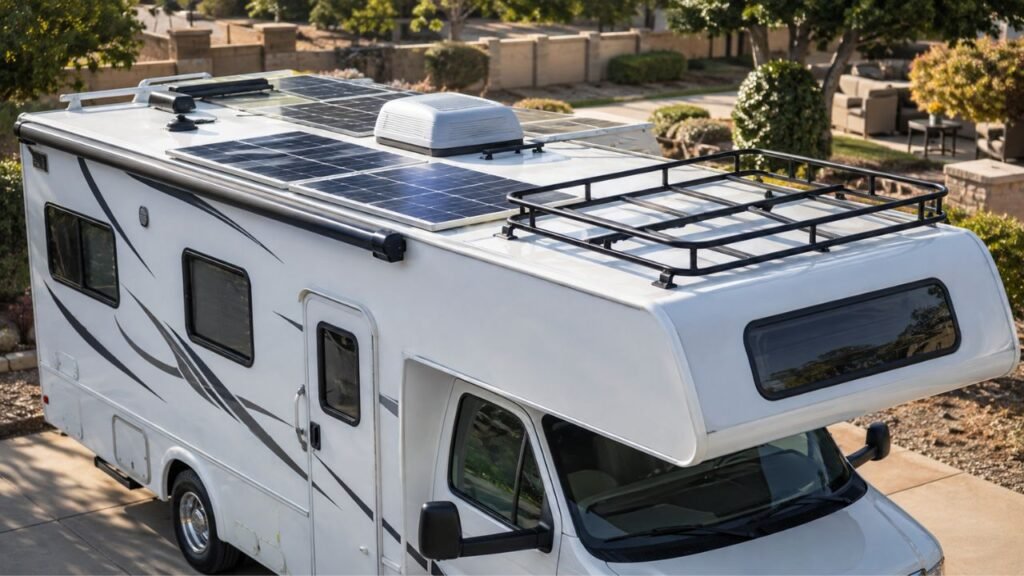
Yes, you can install an RV roof rack near solar panels. The rack must not shade the panels, block airflow, pinch wiring, interfere with maintenance, or exceed your RV’s roof-load limits. There is no universal minimum distance that works for every RV setup.
The right spacing depends on your panel height, rack design, cargo, roof construction, and nearby equipment. Below, I’ll show you how to plan the layout and avoid problems before drilling into your RV roof.
Key Takeaways
- An RV roof rack can usually be installed beside existing solar panels.
- There is no universal minimum rack-to-solar-panel clearance.
- Keep rack rails and cargo from casting regular shadows across solar cells.
- Leave enough room for cooling, cleaning, wiring, and panel maintenance.
- Check the RV’s roof-load limit before adding a rack and cargo.
- Do not assume every part of the RV roof can support mounting hardware.
- Plan for the cargo you will carry, not just the empty rack.
- Recheck rack hardware, roof seals, and solar wiring after installation.
How Close Can an RV Roof Rack Be to Solar Panels?
You may be hoping for a simple answer like two inches or six inches. Unfortunately, that number would not be reliable for every RV.
A rack can be physically close to a solar panel if it does not create functional problems.
For example, a low rack rail sitting beside a raised rigid panel may cause almost no shading. A taller rail placed the same distance away could cast a long shadow across the panel during morning or afternoon sunlight.
The correct clearance should allow you to:
- Keep regular shadows away from active solar cells.
- Maintain airflow around and below rigid panels.
- Reach panel mounting brackets when necessary.
- Inspect and clean the panel.
- Protect solar wiring from rubbing against the rack.
- Remove the panel later without dismantling the entire roof system.
You should also check the installation instructions for your rack and solar panels.
If either manufacturer specifies a particular clearance, mounting location, or structural requirement, follow that requirement instead of relying on a general rule.
What Problems Can a Roof Rack Cause Near RV Solar Panels?
A properly planned rack should not hurt your solar system. Problems usually begin when the rack, cargo, wiring, and panels are treated as separate projects instead of one complete roof layout.
Solar Panel Shading
Shading is probably the biggest concern.
A roof rack rail may look harmless when the sun is directly overhead. A few hours later, the same rail can cast a longer shadow across the solar cells.
Partial shading can reduce solar output more than many RV owners expect.
The exact loss depends on several factors, including:
- Which cells are shaded.
- The panel’s internal cell layout.
- Bypass diode configuration.
- How multiple panels are wired.
- MPPT charge controller behavior.
- How long the shade remains over the panel.
This is why I would not judge clearance by distance alone.
Look at the actual shadow.
You also need to consider what goes on the rack. A bare crossbar might cause no meaningful shade, while a cargo box or kayak mounted on it could cover a large section of the solar array.
Restricted Airflow and Higher Panel Temperature
Rigid solar panels normally need airflow around them.
Solar cells become less efficient as panel temperature rises. The small air space under a properly mounted rigid panel helps heat escape.
Installing a roof rack beside the panel usually does not stop that airflow.
Problems are more likely when you add:
- A solid rack deck.
- Closely packed storage boxes.
- Large cargo platforms.
- Panels surrounded by tall equipment.
- Objects pressed directly against the panel frame.
Try to keep the area around the panel relatively open.
You do not need huge gaps everywhere. You simply want air to remain able to move around the installation.
Limited Cleaning and Maintenance Access
This is one issue I would think about before installing anything permanently.
Solar panels need occasional cleaning and inspection.
You may eventually need to reach:
- Panel mounting brackets.
- Roof sealant.
- MC4 connectors.
- Cable glands.
- Wiring.
- Panel frame bolts.
If the rack sits extremely close to the panel, you may not be able to reach any of those parts later.
Leave enough working room for your hands and basic tools whenever possible.
That small amount of planning can save a frustrating roof teardown later.
Cable Chafing or Pinching
Solar wiring should never become trapped between rack components.
Highway vibration can make a cable rubbing against metal slowly wear through its insulation.
Pay particular attention to cables running near:
- Rack feet.
- Crossbars.
- Side rails.
- Mounting brackets.
- Sharp aluminum edges.
- Cargo straps.
Secure cables so they cannot swing into the rack while driving.
Also avoid making extremely tight bends around rack hardware.
Wind, Vibration, and Uplift
Your RV roof experiences much more stress on the highway than it does while parked.
Crossbars, panels, cargo boxes, and other rooftop accessories all interact with moving air.
Poorly mounted equipment may experience:
- Vibration.
- Buffeting.
- Wind noise.
- Fastener movement.
- Uplift forces.
That does not mean installing a rack near solar panels is unsafe.
It simply means everything needs to be mounted according to the rack and RV manufacturer’s requirements.
How Much Clearance Should You Leave Around the Solar Panels?
Instead of trying to follow one universal measurement, check each type of clearance individually. This gives you a much more reliable roof layout.
| Area to Check | Clearance Should Allow For | What to Look For |
| Rack rail beside panel | Minimal regular shading | Watch the rail’s shadow across the panel |
| Under rigid panel | Cooling airflow | Keep ventilation paths open |
| Panel perimeter | Cleaning and inspection | Make sure hands and tools can reach hardware |
| Solar cables | Safe bends and movement | Prevent rubbing, pinching, or sharp-edge contact |
| Roof vents | Full opening movement | Open each vent before final installation |
| Air conditioner | Operation and service access | Keep required areas unobstructed |
| Rack cargo area | Loaded rack dimensions | Test with actual cargo when possible |
| Rack mounting area | Structural support | Use approved attachment locations |
The most important point here is simple.
Clearance should be based on function, not an arbitrary number.
A three-inch gap may work beautifully on one RV and cause shading or maintenance problems on another.
Manufacturer-specific clearance requirements should always take priority.
How to Plan the Roof Layout Before Installing the Rack
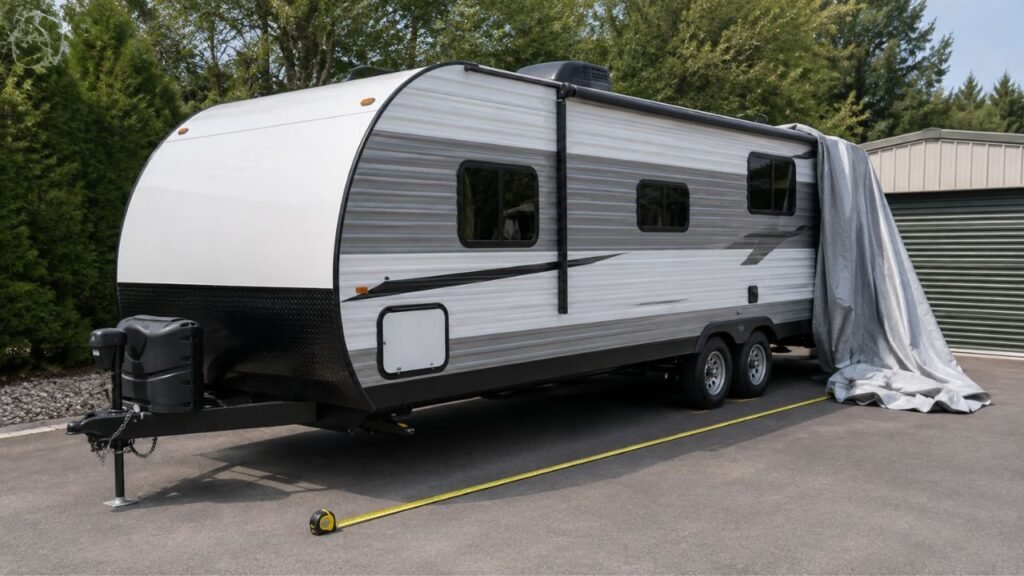
A few minutes with a tape measure can prevent an expensive mistake. I recommend treating the entire roof as one system before deciding where the rack belongs.
- Measure the usable roof length and width.
- Record each solar panel’s exact dimensions.
- Include solar mounting brackets in your measurements.
- Mark the location of roof vents.
- Mark your air conditioner.
- Mark antennas and satellite equipment.
- Mark plumbing vents and skylights.
- Locate the solar cable entry gland.
- Identify existing roof tracks or mounting points.
- Use painter’s tape to mark possible rack locations.
- Check whether every roof vent can fully open.
- Leave access for panel cleaning and inspection.
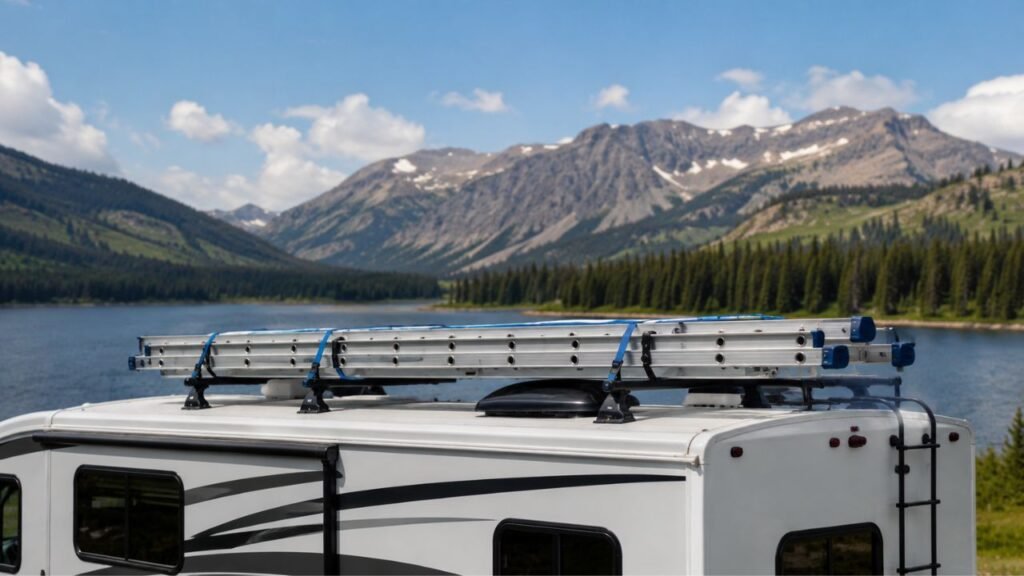
- Account for cargo boxes, bikes, kayaks, or ladders.
- Calculate the weight of the rack and intended cargo.
- Confirm your RV’s roof-load limit.
- Measure the RV’s final overall height.
That last point is easy to overlook.
A taller roof rack can change whether your RV clears low branches, storage buildings, fuel-station canopies, or other overhead obstacles.
Write the new overall height somewhere visible inside the RV after installation.
Where Should You Position a Roof Rack Relative to Solar Panels?
There are several workable layouts. The best one depends on your roof shape, panel arrangement, and what you intend to carry.
Installing the Rack Beside the Solar Panels
This is often the simplest arrangement.
Your solar panels stay in their existing locations while the rack occupies unused roof space.
If possible, keeping the rack rail roughly level with or lower than the solar panel’s upper surface can help reduce shading.
However, do not treat that as a universal rule.
You still need to check the actual shadow at different sun angles.
This layout usually works well when the RV has a wide roof and the solar panels occupy only part of it.
Installing Rack Crossbars Between Solar Panels
Crossbars can sometimes fit between separate solar panels.
This may make good use of unused roof space, but measure carefully.
You need enough room for:
- The crossbar itself.
- Panel mounting brackets.
- Wiring.
- Panel removal.
- Cleaning access.
Do not squeeze a crossbar into a narrow space just because it technically fits.
You may regret it when you need to remove a panel later.
Installing a Rack Higher Than the Solar Panels
A taller rack can help clear roof vents or other equipment.
It can also create longer shadows.
The higher the rail sits above the active solar cells, the farther its shadow can travel when the sun is low.
You should also consider increased:
- Vehicle height.
- Wind exposure.
- Wind noise.
- Cargo movement.
A raised rack can work well, but it needs more careful planning.
Installing a Rack Around Existing Roof Equipment
Solar panels are rarely the only equipment on an RV roof.
You may already have:
- An air conditioner.
- Roof vents.
- Skylights.
- Antennas.
- Plumbing vents.
- Satellite equipment.
- Internet equipment.
Try to create one complete roof plan instead of fitting each component wherever there happens to be space.
You need clearance not only for normal operation but also future repair work.
Your air conditioner, for example, may eventually need servicing.
Do not permanently trap it behind rack rails and solar panels.
Can You Carry Cargo Next to RV Solar Panels?
The rack itself is only half the equation. You should plan around whatever you intend to put on the rack because cargo often creates more solar shading than the rails.
Cargo Boxes
A low rack rail may sit safely beside a solar panel.
Add a tall cargo box and the situation changes completely.
The box may cast a wide shadow for several hours each day.
Before permanently installing the rack, estimate where your cargo box will sit when loaded.
If possible, temporarily position the actual box and check its shadow.
Kayaks and Canoes
Kayaks can create significant shade because they sit high above the roof.
Their length also means the shadow may move across several panels during the day.
Watch the tie-down straps too.
Loose straps should never flap against solar panels, wiring, or roof sealant while driving.
Bikes and Other Tall Gear
Bikes create irregular shadows from wheels, frames, handlebars, and seats.
That does not mean bikes cannot be carried beside solar panels.
You just need to accept that solar production may drop while the bikes are mounted.
If solar power is essential during long off-grid stays, consider whether another bike-carrying location would work better.
Lumber, Ladders, and Temporary Loads
Occasional loads deserve the same care.
A ladder or piece of lumber should not:
- Rest on the solar glass.
- Press against panel frames.
- Trap wiring.
- Cover panel ventilation.
- Rub against cables while driving.
Remember that an RV roof rack is not truly compatible with your solar setup unless it also works safely when loaded.
Is It Better to Mount Solar Panels on the Rack or Beside It?
Both arrangements can work. The best option depends on whether solar generation or cargo capacity is your bigger priority.
| Configuration | Advantages | Drawbacks |
| Panels mounted directly to RV roof | Low profile and leaves rack available for cargo | Panel removal may be harder |
| Panels mounted directly to roof rack | Good airflow and easier repositioning | Uses rack space |
| Panels beside a separate roof rack | Keeps solar and cargo systems separate | Requires careful shade planning |
| Large solar rack covering most roof | Can maximize solar capacity | Reduces conventional cargo space |
If your panels are already securely mounted to the RV roof, I generally would not relocate them just because you are adding a rack.
First see whether a separate rack can fit without creating shading or structural problems.
Moving a working solar installation introduces additional wiring, mounting, and sealing work that may not be necessary.
Can Your RV Roof Support a Rack and Solar Panels Together?
Roof space is not the only limitation. You also need to confirm that the structure can safely support everything you plan to install.
Check the RV Manufacturer’s Roof-Load Limit
Your roof rack might have a high advertised load rating.
That does not automatically mean your RV roof can carry that much weight.
Think of the system as having several limits:
- RV roof limit.
- Rack limit.
- Mounting-point limit.
- Cargo limit.
The lowest applicable limit controls the installation.
Never assume that a rack rated for 300 pounds means you can put 300 pounds on any RV roof.
Your RV owner’s manual or manufacturer should be the primary source for structural limits.
Add Up Every Pound on the Roof
Include more than just cargo.
Your calculation may need to include:
- Roof rack.
- Rack feet and hardware.
- Solar panels.
- Solar mounting brackets.
- Cargo box.
- Bikes.
- Kayaks.
- Ladders.
- Other permanently mounted accessories.
Remember that carrying capacity can also depend on how the load is distributed.
A large load spread across approved mounting points is very different from concentrating the same weight in one weak roof area.
Use Approved Structural Mounting Points
Do not assume that every rack should simply be screwed into roof rafters.
RV roofs vary enormously.
Depending on your vehicle, an approved installation may use:
- Factory roof mounting points.
- Existing roof tracks.
- Rain gutters.
- Structural framing.
- Reinforced roof sections.
- Sidewall-supported mounting.
- Manufacturer-approved fastener systems.
Before drilling, confirm what is underneath the mounting area.
Guessing can lead to water leaks or structural damage.
Does the Type of RV Roof Change the Installation?
Yes. Roof construction affects how you mount the rack, how you seal penetrations, and where the rack can safely carry loads.
Rubber or TPO/EPDM Roofs
A rubber-style roof membrane is not the structural part of the roof.
You need to identify suitable support underneath it.
Any penetration also needs proper sealing using materials compatible with the roof membrane.
Avoid assuming that more screws automatically create a stronger installation.
Improperly located fasteners can create leaks without adding meaningful strength.
Fiberglass Roofs
Fiberglass roofs can be strong, but the mounting method still matters.
Drilling blindly through fiberglass can cause cracking, leaks, or poor load distribution.
Use rack hardware and mounting methods approved for your particular roof.
Backing plates or reinforced mounting areas may be necessary in some installations.
Aluminum or Metal Van Roofs
Many camper vans have factory channels, tracks, or designated mounting points.
These can make rack installation easier because you may not need to create random new roof penetrations.
Use the factory attachment locations whenever your rack system is designed for them.
Pop-Up and Specialty Roofs
Pop-up roofs require extra caution.
Additional roof weight may affect:
- Lift mechanisms.
- Gas struts.
- Hinges.
- Roof balance.
- Opening effort.
Do not assume a rack designed for a fixed RV roof will work safely on a lifting roof.
Check the roof manufacturer’s specific load requirements first.
How to Install the Roof Rack Without Damaging the Solar System
The exact mounting procedure varies by rack and RV, so always follow the manufacturers’ instructions. However, the planning sequence below can help you avoid the most common conflicts.
1. Isolate the Solar System
Before working near solar wiring, follow the correct procedure for disconnecting or isolating the solar charging system.
Do not assume exposed solar cables are inactive simply because the RV is switched off.
2. Measure and Mark the Rack Location
Use your roof measurements to mark the proposed rack position.
Painter’s tape works well because you can move it without drilling anything.
3. Temporarily Position the Rack
Test-fit the major rack components before making permanent holes.
This is when you want to discover clearance problems.
4. Check for Solar Shading
Look at where the rack’s rails and crossbars cast shadows.
If practical, inspect the setup at more than one time of day.
5. Open Every Roof Vent
Open vents completely.
Check air-conditioner service areas and any moving rooftop equipment.
Make sure nothing collides with the rack.
6. Confirm Structural Mounting Locations
Verify that each rack foot or mounting bracket sits where the RV manufacturer permits it.
Do this before drilling.
7. Install the Rack Mounting Hardware
Follow the rack manufacturer’s instructions carefully.
Use the specified fasteners, backing hardware, and torque values.
8. Seal Roof Penetrations Properly
Any new hole through an RV roof can become a leak.
Use sealants compatible with your roof construction and the installation instructions.
9. Protect Nearby Solar Wiring
Route solar cables away from sharp edges and moving rack components.
Secure them so highway vibration cannot make them rub against metal.
10. Tighten Rack Hardware Correctly
More torque is not always better.
Overtightening can damage mounting surfaces or hardware.
Use the manufacturer’s torque requirements when provided.
11. Reconnect and Test the Solar System
After installation, confirm that your solar system is operating normally.
Compare output under similar conditions if you suspect shading.
12. Perform a Final Inspection
Before a long trip, check:
- Rack movement.
- Loose hardware.
- Roof seals.
- Cable routing.
- Panel mounting brackets.
- Vent operation.
- Cargo clearance.
Do one more inspection after your first few drives.
How Can You Check Whether the Rack Will Shade the Panels?
You do not need sophisticated equipment to perform a useful shading check. A careful test fit will tell you a lot.
- Temporarily position the rack before permanent mounting.
- Look for shadows crossing active solar cells.
- Check the roof in morning and afternoon sunlight.
- Test the rack with actual cargo when possible.
- Check solar output before and after installation.
- Avoid judging the layout only at midday.
- Remember that your RV will face different directions at different campsites.
That last point matters more on an RV than on a house.
Your RV may face east today and west tomorrow.
For that reason, rules such as always placing the rack on one particular side of the solar array are not always practical.
The safer approach is reducing predictable shade from every reasonable direction.
Does Series or Parallel Wiring Matter if the Rack Causes Shade?
Wiring configuration can influence how an array reacts to shade. However, changing wiring should not be your first solution to a poorly positioned roof rack.
Series-Connected Panels
In a series array, panels share the same current path.
Shading one part of the system can affect how the string operates.
Bypass diodes inside many solar panels help limit some shading effects, but they do not make shade irrelevant.
Parallel-Connected Panels
Parallel wiring can sometimes isolate shading effects more effectively between individual panels.
However, it also changes:
- Current.
- Wire-size requirements.
- Fuse requirements.
- Charge-controller considerations.
That means parallel is not automatically better for every RV.
Fix the Shade Before Changing the Wiring
If a rack rail creates predictable shade every afternoon, moving the rack is usually a better solution than redesigning the electrical system around the shade.
Think of wiring optimization as the second step.
Your first goal should be preventing avoidable shadows.
Should the Roof Rack Be Higher or Lower Than the Solar Panels?
A lower-profile rack is usually easier to manage around solar panels because it tends to cast shorter shadows and adds less overall vehicle height.
However, a higher rack may be necessary to clear:
- Roof vents.
- Air conditioners.
- Existing panels.
- Other rooftop accessories.
A taller rack may also allow long cargo to span across rooftop equipment.
The downside is that height can increase:
- Shadow length.
- Wind exposure.
- Wind noise.
- Vehicle height.
I would not choose rack height based only on appearance.
Pick the lowest configuration that still provides the clearance your equipment needs.
Will a Roof Rack Affect Solar Panel Cooling?
A normal open-style rack installed beside solar panels should not cause a major cooling problem.
The concern becomes greater when the installation prevents air from moving around the panel.
Examples include:
- Solid rack flooring beside panels.
- Large storage boxes packed tightly around them.
- Cargo covering the panel edges.
- Objects installed directly beneath an elevated panel.
Rigid panels generally benefit from airflow beneath them.
Do not close that gap unless your solar-panel manufacturer specifically permits the installation method.
Can a Roof Rack Cause Wind Noise Around Solar Panels?
Yes, adding a roof rack can change airflow around your RV.
Crossbars and rails can produce turbulence that causes:
- Whistling.
- Humming.
- Vibration.
- Buffeting.
Solar panels can also influence airflow, especially when rack bars sit close to their leading edges.
If new noise appears after installation, inspect:
- Crossbar position.
- Loose rack hardware.
- Exposed slots.
- Cable movement.
- Rack fairings.
- Solar panel brackets.
Do not automatically assume the solar panel itself is causing the noise.
Often, the rack or a loose component is responsible.
What Should You Check After Installing the Rack?
The first inspection should not be the last one. Road vibration, weather, and temperature changes can expose installation problems that were not obvious in your driveway.
- Check rack feet for movement.
- Inspect bolts and mounting hardware.
- Look for cracks or gaps in roof sealant.
- Inspect solar mounting brackets.
- Look for cable chafing.
- Check MC4 connectors and cable routing.
- Look for unexpected panel shadows.
- Watch for signs of water intrusion.
- Listen for new wind noise.
- Check solar output.
- Confirm roof vents still operate correctly.
- Recheck your RV’s overall height.
- Inspect cargo straps after every loading change.
I would perform an early inspection after the rack has seen some highway miles.
After that, include the rack and solar system in your normal seasonal roof inspection routine.
Common Mistakes When Installing a Roof Rack Near Solar Panels
Most problems can be prevented during the planning stage.
- Choosing rack position before considering actual cargo.
- Checking solar shadows only at midday.
- Placing tall rails directly beside active solar cells.
- Assuming a specific number of inches guarantees enough clearance.
- Blocking panel removal.
- Trapping solar connectors beneath rack hardware.
- Allowing cables to rub against metal rails.
- Drilling without confirming structural support.
- Looking only at rack capacity.
- Ignoring the RV manufacturer’s roof-load limit.
- Blocking air-conditioner service access.
- Preventing a roof vent from opening completely.
- Forgetting the added overall vehicle height.
- Permanently drilling before performing a test fit.
If you avoid those mistakes, you eliminate most of the common conflicts between RV solar panels and roof racks.
When Should You Not Install the Rack in That Location?
Sometimes the best solution is moving the rack rather than forcing the original layout to work.
Do not use that location if:
- Rack rails regularly shade active solar cells.
- Cargo would cover a large part of your solar array.
- You cannot find an approved structural mounting point.
- Combined roof weight would exceed manufacturer limits.
- The rack blocks important maintenance access.
- A roof vent cannot open fully.
- Solar wiring would become trapped or pinched.
- Rack hardware would interfere with panel brackets.
- The rack cannot be secured using the approved mounting method.
Changing the roof layout before drilling is much easier than fixing structural, electrical, or water-leak problems afterward.
DIY or Professional Installation?
Installing a roof rack near solar panels can be a reasonable DIY job when your RV has clear factory mounting points and the rack manufacturer provides detailed instructions.
The project becomes more complicated when you need to modify the roof itself.
I would consider professional installation if:
- You cannot identify the roof structure.
- New structural holes must be drilled.
- Your RV has a fiberglass roof.
- Solar wiring needs to be relocated.
- Roof reinforcement may be necessary.
- You are unsure about roof-load limits.
- The rack manufacturer requires specialized mounting.
Paying for professional help is much cheaper than repairing a leaking or structurally damaged RV roof.
Final Verdict
Yes, you can install an RV roof rack near solar panels, and the two systems can work very well together when the roof layout is planned carefully.
The most important factor is not finding a universal number of inches between them. You need enough functional clearance to prevent predictable shading, maintain solar-panel airflow, protect wiring, preserve maintenance access, and keep the entire roof within its structural limits.
Before making permanent holes, test-fit the rack and consider the cargo you will actually carry. A rack that works perfectly while empty may become a solar-shading problem once you add a kayak, cargo box, bikes, or other tall gear.
Plan the complete roof as one system, and you will have a much better chance of keeping both your solar setup and roof rack working properly.
Related FAQs
Can a Roof Rack Be Installed Beside Existing RV Solar Panels?
Yes. A roof rack can normally be installed beside existing RV solar panels if it does not shade the cells, damage wiring, block airflow, interfere with maintenance, or exceed the RV’s structural limits.
How Much Space Should Be Between an RV Roof Rack and Solar Panels?
There is no universal minimum distance. Leave enough space to prevent regular shadows, maintain airflow, protect wiring, and allow access for cleaning, inspection, and panel removal.
Can Roof Rack Crossbars Go Over Solar Panels?
It is generally better to avoid placing normal crossbars directly above active solar cells because they can cause shading and restrict access. Purpose-built systems may use different arrangements, so follow the rack and solar manufacturers’ instructions.
Can Solar Panels Be Mounted Directly to an RV Roof Rack?
Yes. Rigid solar panels can often be mounted directly to a compatible RV roof rack using suitable brackets. Confirm that the rack, panel frame, mounting hardware, and RV roof can safely handle the installation.
Will a Roof Rack Reduce Solar Panel Output?
Not necessarily. A roof rack should not significantly reduce solar output if the rack and its cargo remain clear of the panels and do not create regular shading or airflow problems.
Can You Put a Cargo Box Beside RV Solar Panels?
Yes, but check the shadow created by the cargo box rather than judging the setup from the empty rack. Tall boxes can cast much longer shadows than roof rack rails.
Can You Carry a Kayak Next to RV Solar Panels?
Yes. Leave enough clearance so the kayak, mounting hardware, and straps cannot contact the panels or wiring. Keep in mind that a kayak may reduce solar production by casting shade while it is mounted.
Do RV Solar Panels Need Airflow Underneath?
Rigid RV solar panels generally benefit from airflow beneath them because ventilation helps remove heat. Follow your panel manufacturer’s mounting instructions for the required installation method.
Can a Roof Rack Damage Solar Panel Wiring?
Yes, if solar cables are pinched beneath rack hardware or repeatedly rub against metal components. Route and secure the cables so normal highway vibration cannot damage the insulation.
Do I Need to Remove My Solar Panels to Install a Roof Rack?
Not always. Existing panels can often remain in place if you have enough working room and the rack’s approved attachment points remain accessible.
Can an RV Roof Hold Both Solar Panels and a Roof Rack?
Many RV roofs can support both, but you need to verify the manufacturer’s roof-load limit and approved mounting locations. Do not rely only on the roof rack’s advertised weight capacity.
Does Adding a Roof Rack Increase RV Height?
Yes. The rack increases overall vehicle height, and cargo can raise it even further. Measure the completed setup and keep the new height somewhere visible inside your RV.

Jack Collins specializes in RV routes, trail access, and travel logistics. His how-to articles help RV and trailer owners plan smoother trips and avoid common mistakes. Every review focuses on performance, safety, and value.