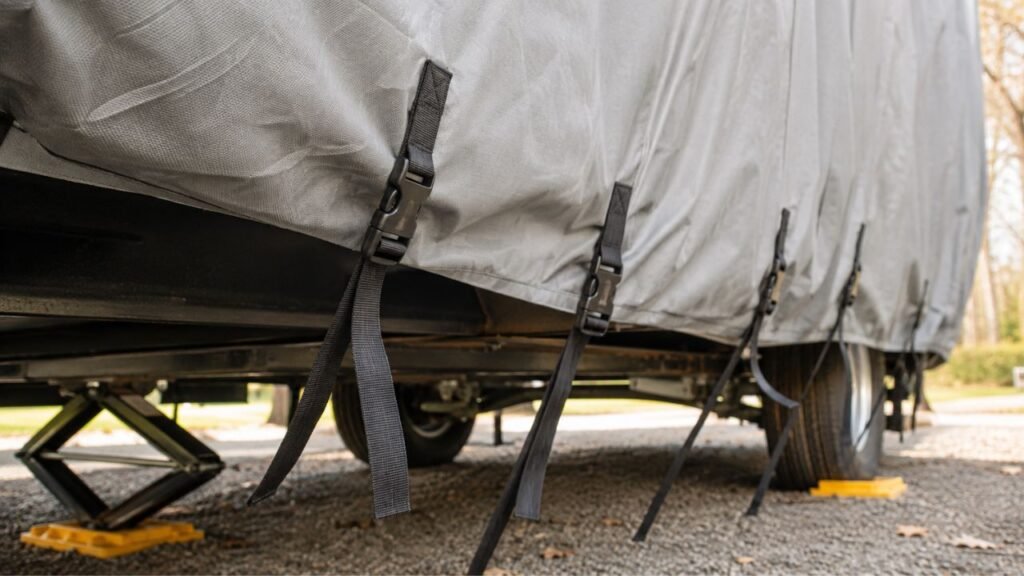
RV cover straps usually keep coming loose because wind repeatedly moves the cover and webbing, allowing slack to work through the adjustment buckles. Incorrect buckle threading, loose cover fit, unsecured strap tails, worn hardware, and changing strap tension can make the problem worse.
The good news is that you usually do not need to keep pulling every strap tighter. I’ll help you identify what is actually creating the slack, fix it correctly, and keep your RV cover secure without overstressing the fabric or hardware.
Key Takeaways
- Wind movement is one of the main reasons RV cover straps loosen.
- A poorly fitted cover can keep creating new strap slack.
- Incorrectly threaded buckles may let webbing slip backward.
- Straps should be snug rather than pulled extremely tight.
- Loose strap tails should be secured so they cannot flap.
- Worn buckles and damaged webbing may need replacement.
- Check strap tension periodically during long-term RV storage.
- Only use extra restraints approved for your specific RV cover.
Why Do RV Cover Straps Keep Coming Loose?
A loose RV cover strap does not always mean the strap needs more tension. In many cases, something else keeps creating slack and transferring it back into the strap.
Wind Keeps Moving the Cover and Cycling the Straps
Wind is often the biggest reason RV cover straps refuse to stay tight.
When wind reaches a loose section of your cover, the material balloons outward. The fabric then falls back against the RV when the gust passes.
That process can happen hundreds or thousands of times during windy weather.
Every movement loads and unloads the straps slightly. Over time, the webbing can gradually move through an adjustable buckle.
You may tighten everything perfectly in the morning and find noticeable slack later.
This becomes especially common when large sections of fabric hang loosely along the RV sides.
The important point is that the buckle may not actually be opening. Repeated vibration can slowly let the strap creep through the adjuster.
That is why simply pulling the strap tighter often provides only temporary relief.
The Strap Is Threaded Through the Buckle Incorrectly
Adjustable RV cover straps rely heavily on friction.
The webbing normally passes around specific sections of the buckle. When tension is applied, that routing helps the buckle grip the strap.
If the webbing is threaded backward, skipped around one bar, or routed incorrectly, there may not be enough friction.
The strap can then slide backward whenever wind loads the cover.
Take a close look at another strap that stays tight. Compare its webbing path with the troublesome strap.
You can also check your RV cover installation instructions for the proper routing.
After tightening, gently pull against the loaded side of the strap. The webbing should resist slipping through the adjuster.
If it slides easily, investigate the buckle before tightening anything further.
The Cover Has Too Much Loose Fabric
Your straps cannot compensate for a badly fitted cover.
An oversized RV cover leaves more fabric available for wind to grab. That movement continuously transfers force to the straps and buckles.
The cover may be loose because:
- It is too long for your RV.
- It was designed for a different RV profile.
- The cover is not centered properly.
- Front or rear cinches were not adjusted.
- Elastic corners are sitting in the wrong position.
- Slide-outs, bumpers, or ladders affect how the cover sits.
If several straps keep loosening together, I would check overall cover fit first.
One slipping strap may indicate a buckle problem. Several loose straps usually point toward a bigger fit or movement issue.
The Buckle or Webbing Has Become Worn
RV covers spend months exposed to sun, moisture, heat, and wind.
Eventually, plastic buckles and fabric webbing can deteriorate.
Look closely at the buckle that keeps slipping. Check for cracks, distortion, rounded gripping surfaces, or damaged adjustment bars.
Then inspect the webbing itself.
Older webbing may become frayed, unusually smooth, polished, stretched, or thinner in certain areas.
A smooth worn strap may slide through a buckle that previously held it securely.
Also inspect the stitching where the strap attaches to the cover.
If the stitching is pulling away, tightening harder could make the damage worse.
The Webbing Changes Tension With Weather and Load
Strap materials do not all behave exactly the same outdoors.
Some nylon webbing can stretch more under load and may change slightly when exposed to moisture. Polyester generally stretches less and remains more stable in wet conditions.
The exact behavior also depends on the weave, thickness, and strap construction.
This means a strap that felt perfectly snug during installation may feel slightly different after rain, temperature changes, or extended loading.
You should not assume the buckle failed simply because a small amount of slack appeared.
Check the entire system before deciding what needs replacement.
The Loose Strap Tail Is Flapping in the Wind
Do not ignore the excess strap hanging beyond the buckle.
A long loose tail can whip around continuously during windy conditions.
That movement can shake the buckle and increase strap vibration. It may also slap against your RV paint or cover material.
Securing the excess webbing helps keep the entire strap system calmer.
It also prevents the tail from becoming tangled around steps, axles, suspension parts, or other objects underneath the RV.
Quick Diagnosis: Why Is My RV Cover Strap Loosening?
You can often identify the cause by looking at when and where the slack appears. Use this quick table before making major adjustments.
| What You Notice | Most Likely Cause | What to Check First | Best First Fix |
| Strap loosens mainly during wind | Cover billowing or strap vibration | Loose nearby fabric | Recenter and retension the cover |
| Strap slips soon after tightening | Wrong threading or worn buckle | Webbing path | Rethread and test the buckle |
| Several straps loosen together | Poor overall cover fit | Cover size and position | Refit the entire cover |
| Only one strap keeps loosening | Local buckle or webbing damage | That specific strap | Inspect or replace damaged parts |
| Strap feels different after rain | Webbing tension changed | Strap material and fit | Retension if needed |
| Strap tail constantly flaps | Excess webbing is unsecured | Loose strap end | Secure the remaining tail |
| Cover balloons despite tight straps | Too much loose material | Cover sizing and cinches | Remove excess fabric first |
| Buckles or seams look distorted | Excessive tension | Strap tightness | Reduce tension |
How to Keep RV Cover Straps From Coming Loose
The best fix depends on what is creating the slack. Work through these steps in order instead of immediately tightening every strap harder.
1. Center the Cover Before Tightening Anything
Start by checking whether the cover sits evenly over your RV.
Look at the front, rear, roofline, and both sides.
You should not have a large amount of extra fabric hanging from one side while the opposite side feels stretched.
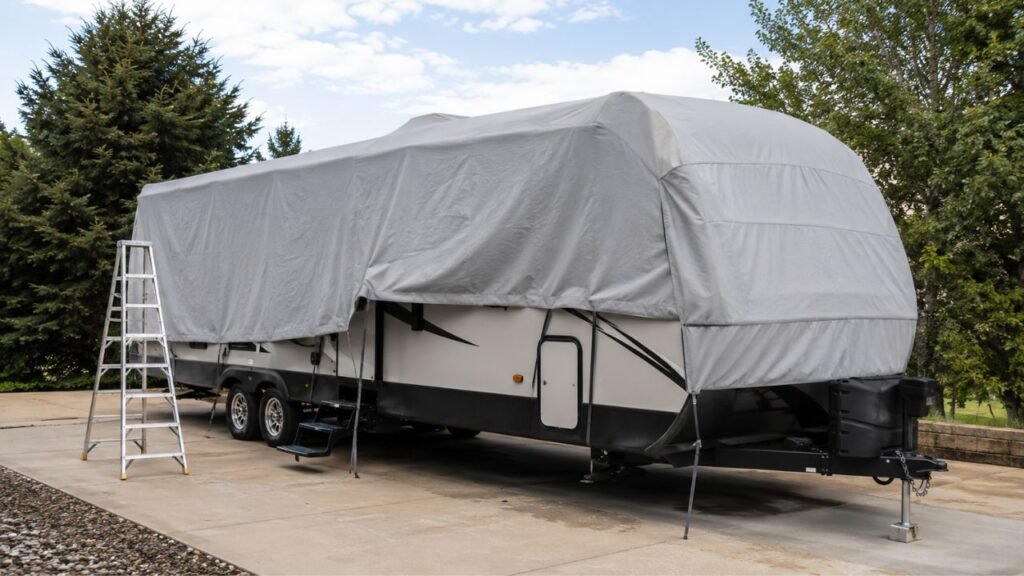
Position the corners correctly and make sure the cover follows the RV’s basic shape.
If your cover has front and rear markings, confirm they are positioned correctly.
A centered cover spreads tension much more evenly across the straps.
Once positioning looks right, begin working with the built-in cinches.
2. Remove Loose Fabric With the Built-In Cinches
Many RV covers have adjustment systems around the front or rear sections.
These are designed to reduce extra fabric before you rely on the underbody straps.
Use those adjustments first.
Try to remove large loose pockets while keeping the fabric comfortably fitted around the RV.
Do not try to make the cover look like shrink-wrap.
You mainly want to prevent large areas from catching and holding wind.
The straps underneath should secure the cover, not perform the entire fitting job.
3. Check How Every Adjustable Buckle Is Threaded
Inspect the webbing where it passes through each adjustable buckle.
If one strap always loosens, compare its routing with another strap that works properly.
You are looking for obvious differences.
Webbing that takes the wrong path through the buckle may not create enough friction.
If you previously removed a strap completely, this is particularly worth checking.
Do not assume every ladder lock or side-release buckle threads identically.
Follow the routing intended for your particular cover whenever possible.
4. Tighten the Straps Snug, Not Drum-Tight
More tension is not always better.
Your straps should normally feel snug enough to reduce excessive movement without pulling the cover unnaturally tight.
Look for these signs:
- The cover follows the RV’s general shape.
- Large panels are not hanging freely.
- Underbody straps remain firm.
- Buckles remain straight.
- Seams are not being pulled sharply.
- Fabric is not stretched tightly across corners.
If the material resembles a tightly stretched tarp, you may have gone too far.
Excessive tension can damage fabric, seams, buckles, and strap attachment points.
It may also increase rubbing around sharp corners.
5. Secure the Excess Strap Tail
Once the strap is adjusted, deal with the remaining loose end.
If your cover includes a built-in strap keeper, use it.
You can also use a reusable hook-and-loop wrap or another soft keeper that does not damage the webbing.
Some buckle designs allow excess webbing to be fed back through a keeper.
The main goal is simple: do not leave several feet of strap whipping underneath the RV.
Avoid attaching the loose tail somewhere that changes the intended direction of tension.
6. Consider a Half-Twist on a Long Exposed Strap
A single half-twist can sometimes reduce wind-induced strap flutter.
Instead of presenting a flat surface directly to the airflow, the twisted strap changes its orientation along the span.
That can help stop certain straps from vibrating continuously.
However, I would treat this as a secondary fix.
Do not twist the section passing through the adjustment buckle.
You also should not use twisting as a substitute for correcting an oversized cover or badly positioned fabric.
If your cover manufacturer provides specific strap instructions, follow those first.
7. Recheck the Cover After It Settles
A freshly installed cover may settle after several hours or days.
Fabric moves slightly, corners reposition themselves, and straps can equalize tension.
Check your work again after installation.
I would also inspect the cover after the first noticeably windy period.
If you find a little slack, adjust it before the cover starts billowing heavily.
Small corrections are much easier than dealing with torn fabric later.
How Tight Should RV Cover Straps Be?
RV cover straps should generally be snug or moderately tight rather than pulled as tightly as possible.
You want enough tension to reduce billowing and excessive cover movement. At the same time, the straps should not distort buckles, strain seams, or stretch the cover aggressively across the RV.
A loose strap lets the cover move and rub against surfaces. A severely overtightened strap can create concentrated pressure around corners and attachment points.
Think of the straps as restraints rather than cargo tie-downs.
They keep the cover positioned properly. They are not meant to compress the cover against the RV.
There is also no universal strap tension measured in pounds that applies to every RV cover.
Cover designs, materials, buckles, and attachment systems vary.
If your manufacturer gives specific adjustment instructions, those instructions should always take priority.
Should I Tie a Knot Behind the RV Cover Buckle?
A simple backup knot can sometimes help prevent loose webbing from feeding backward, but it should not be your first solution.
Start by checking whether the buckle is threaded correctly and still grips properly.
Also make sure the cover fits correctly.
If the strap repeatedly slips because the buckle is cracked or worn, tying a knot only hides the actual problem.
Some strap arrangements may allow a simple half-hitch behind the adjuster. Others are not designed for additional knots.
Never place a bulky knot where it can rub against the RV body.
If you use any backup method, make sure it does not interfere with the buckle’s normal operation.
Can I Add Bungee Cords or Extra Straps to an RV Cover?
Extra straps or bungee cords can help some RV cover systems, but you should not automatically add them to every cover.
Some manufacturers provide separate wind straps specifically for their products.
Those systems are designed around the cover’s reinforced attachment areas.
Random ropes, ratchet straps, or bungee cords can create entirely different problems.
They may rub against painted surfaces, concentrate force on one section, damage the cover, or place unwanted pressure across an RV roof.
Ratchet straps are especially easy to overtighten.
If you want more wind protection, first check whether your particular cover has an approved supplemental restraint kit.
Using the restraint system designed for the cover is much safer than improvising.
How Cover Size and Fit Affect Strap Tension
Even high-quality straps will struggle if the cover itself does not fit properly. Before blaming your hardware, look closely at how the fabric sits around the entire RV.
An Oversized Cover Creates Constant Slack
A cover that is substantially too large gives wind plenty of material to move.
The fabric can balloon between contact points and repeatedly tug on every strap.
You may tighten the straps today and find them loose tomorrow because the underlying problem never disappeared.
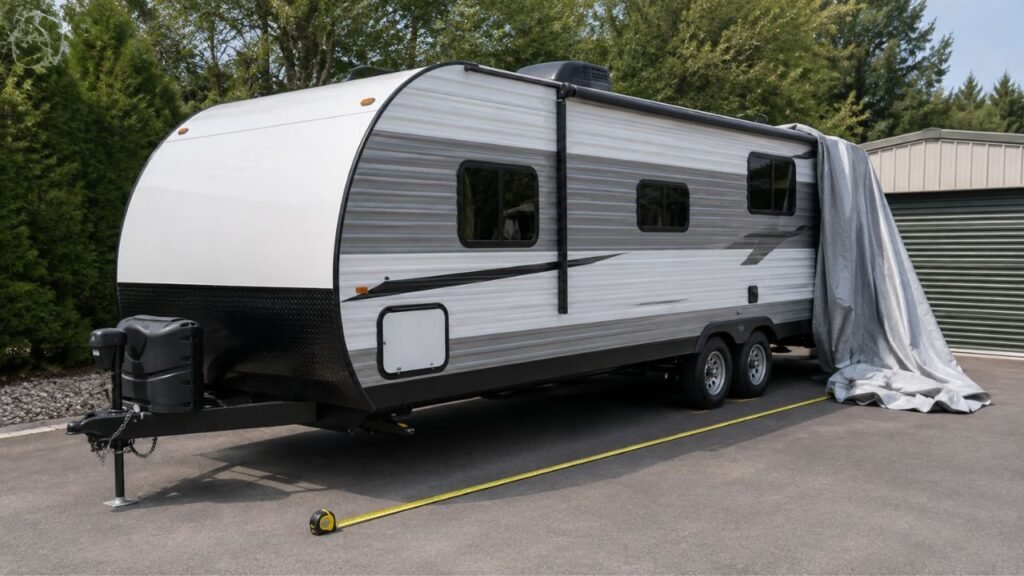
Measure your RV carefully and compare those dimensions with the cover’s recommended fit range.
Do not rely only on the RV’s advertised model length.
Rear ladders, spare tires, bumpers, and other equipment can change the actual dimensions.
A Cover Can Be the Right Length but Still Fit Poorly
RV length is only one part of proper sizing.
A tall fifth wheel has a different shape from a travel trailer.
Likewise, Class A, Class B, and Class C motorhomes have very different profiles.
A cover may technically match the overall length but still contain too much fabric around certain sections.
That excess fabric creates pockets where wind can collect.
Choosing a cover designed for your RV type usually gives better results.
A Miscentered Cover Can Make One Side Constantly Loose
Sometimes the cover itself is correctly sized but positioned incorrectly.
For example, too much material may hang down the passenger side while the driver’s side sits high and tight.
Tightening the passenger-side straps harder does not actually solve the problem.
Instead, reposition the cover so the material is distributed evenly.
Then adjust your cinches and straps again.
Front and Rear Cinches Need to Remove Excess Material
The front and rear of an RV often create large areas of loose fabric.
That is why many covers include separate adjustment systems in these locations.
Use those cinches to gather unnecessary material before final strap tensioning.
If you skip that step, your underbody straps may constantly fight against large billowing panels.
Correcting the cover shape first makes every strap work more effectively.
When Should I Replace a Strap or Buckle Instead of Retightening It?
Repeated adjustment cannot fix damaged hardware forever. If a particular strap refuses to stay tight, inspect the entire assembly closely before pulling harder.
Consider replacement when you find:
- A cracked or badly deformed buckle
- An adjustment bar that no longer grips properly
- Webbing that slips after correct threading
- Frayed, cut, or severely worn straps
- Heavy UV deterioration
- Melted or heat-damaged webbing
- Loose stitching around the strap anchor
- Permanent stretching or distortion
- A buckle that does not properly match the strap width
Whenever possible, use manufacturer-approved replacement parts.
Buckles and webbing are designed to work together.
A random buckle that appears to fit may have different internal dimensions or gripping characteristics.
If the strap is damaged where it attaches directly to the cover, contact the manufacturer or consider professional repair.
Continuing to tighten a damaged anchor can enlarge the tear.
How to Stop Your RV Cover From Flapping in the Wind
A flapping cover creates noise, wear, and repeated loads on your straps. Reducing that movement is often the most effective way to stop straps from loosening.
Remove Large Pockets of Loose Fabric
Walk around your RV and look for areas where the fabric hangs several inches away from the body.
Pay particular attention to large sidewalls, the front cap, and rear sections.
Use the cover’s built-in adjustment points to reduce those loose areas.
Do not eliminate every wrinkle.
Your goal is preventing large sections from acting like sails.
Make Sure Every Underbody Strap Is Connected
Missing one strap can affect the tension on several others.
The cover may lift more around the unsupported area, placing additional movement on nearby buckles.
Check that every intended underbody connection is being used.
Also confirm the straps are not accidentally wrapped around suspension parts, exhaust components, or sharp edges.
Each strap should follow the routing intended by the manufacturer.
Keep Cover Vents Unobstructed
Many RV covers include vents that allow trapped air to escape.
Do not block these areas with extra material or improvised straps.
Proper airflow can help reduce pressure building underneath the cover during gusty conditions.
However, vents do not make a cover windproof.
The cover still needs the correct fit and proper strap tension.
Protect Corners Where the Cover Moves
Wind movement becomes especially damaging around sharp RV features.
Inspect areas near:
- Rain gutter spouts
- Ladder corners
- Bumpers
- Steps
- Awning hardware
- Roof accessories
- Antenna bases
- Spare tire carriers
Use appropriate padding where the cover manufacturer recommends it.
Reducing abrasion also lets you maintain normal strap tension without worrying about the fabric rubbing through.
Know When Wind Exposure Is Too Severe for a Fabric Cover
There is no single wind-speed limit that applies to every RV cover.
Cover design, RV size, installation quality, age, and storage location all matter.
An RV stored between buildings experiences very different wind loads than one sitting in an open desert lot.
If your storage site receives severe wind regularly, continuously tightening straps may not be enough.
A sheltered location, carport, or rigid RV storage structure may provide better long-term protection.
How Often Should You Check RV Cover Straps?
RV cover straps should not be treated as a set-it-and-forget-it system. Periodic checks help you catch small problems before they damage the cover.
- After installation: Check the straps again after the cover settles.
- After the first windy day: Look for loose fabric or slipping buckles.
- After strong storms: Inspect straps, seams, buckles, and anchor points.
- During long-term storage: Recheck tension periodically, roughly monthly when practical.
- After major weather changes: Inspect the cover after heavy rain or large temperature swings.
- Whenever you notice billowing: Correct the problem instead of waiting for your next inspection.
- Before long storage periods: Replace obviously damaged hardware before leaving the RV unattended.
Regular checks take only a few minutes and can prevent expensive cover damage.
RV Cover Strap Mistakes That Can Make the Problem Worse
Several common fixes actually create more trouble than the original loose strap.
- Pulling every strap as tight as physically possible
- Trying to compensate for an oversized cover with tension
- Ignoring incorrect buckle threading
- Leaving long strap tails loose
- Adding ratchet straps without manufacturer approval
- Running straps across sharp RV corners
- Allowing buckles to rub directly against painted surfaces
- Continuing to use cracked plastic hardware
- Ignoring stretched or damaged webbing
- Skipping inspections after strong winds
- Adjusting a large cover during dangerously windy conditions
- Assuming every RV cover uses the same restraint system
The safest approach is usually the simplest one.
Correct the fit, check the hardware, remove unnecessary slack, and use moderate tension.
A Simple 5-Minute Check When Your Straps Keep Loosening
You do not need to completely reinstall your cover every time a strap develops slack. This quick routine can usually tell you where the real problem starts.
- Find the strap or straps that became loose.
- Look for billowing fabric around those areas.
- Check whether the cover remains centered.
- Inspect how the webbing passes through each buckle.
- Pull-test the adjustment buckle gently.
- Check the buckle for cracks or distortion.
- Inspect the strap for fraying or unusual smoothness.
- Remove excess fabric using built-in cinches.
- Retighten the strap until comfortably snug.
- Secure the remaining strap tail.
- Walk around the RV and check overall tension.
- Inspect everything again after the next windy period.
If the same strap loosens again while every other strap remains secure, I would seriously consider replacing that buckle or strap assembly.
Final Words
If your RV cover straps keep coming loose, resist the temptation to solve everything by pulling them tighter.
Start by finding where the slack originates.
Wind movement, incorrect cover positioning, bad buckle routing, loose strap tails, and worn hardware can all produce the same frustrating result.
Once the cover fits properly and the buckle grips correctly, you should only need moderate strap tension.
Keep the excess webbing secured and inspect the system periodically during storage.
A few minutes of checking can prevent months of rubbing, tearing, and repeated strap adjustments.
Related FAQs
Here are quick answers to several common questions RV owners have about loose cover straps and windy storage conditions.
Why Do My RV Cover Straps Loosen Every Time It Gets Windy?
Wind repeatedly inflates and relaxes loose cover sections, creating small tension cycles in the straps. Those movements can gradually feed webbing through adjustable buckles, especially when the cover has excess fabric or the buckle is incorrectly threaded.
Why Does My RV Cover Keep Billowing Even With Tight Straps?
Your cover may be oversized, poorly centered, or improperly adjusted around the front and rear. Tight underbody straps alone cannot remove large pockets of loose fabric, so use the cover’s built-in cinches before increasing strap tension.
Should RV Cover Straps Be Extremely Tight?
No. RV cover straps should normally be snug enough to reduce movement without excessively stretching the fabric or stressing seams and buckles. Pulling them extremely tight can damage the cover and increase pressure around sharp RV features.
Can I Tie RV Cover Straps in a Knot?
You may be able to use a simple backup hitch on certain strap designs, but first make sure the buckle is correctly threaded and undamaged. Avoid knots that interfere with adjustment or sit against the RV finish.
Can I Use Ratchet Straps Over My RV Cover?
I would not use ratchet straps unless your cover manufacturer specifically approves them. Ratchet straps can create excessive tension, rub against RV surfaces, and place concentrated loads on areas not designed to handle them.
Do RV Cover Straps Stretch When They Get Wet?
Some webbing materials can change slightly when exposed to moisture and load. Nylon generally stretches more than polyester, while polyester tends to remain more dimensionally stable outdoors. The exact behavior depends on the strap construction.
How Do I Know if My RV Cover Is Too Big?
Your cover may be oversized if large sections hang loosely even after proper centering and adjustment. Frequent billowing, excess fabric around the front or rear, and straps that constantly regain slack are also common clues.
How Often Should I Retighten My RV Cover?
Check the cover shortly after installation, after severe wind, and periodically during storage. During extended storage, a monthly inspection is a practical habit, although your manufacturer’s maintenance guidance should take priority.
Should I Add Bungee Cords to My RV Cover in High Winds?
Only add supplemental bungee cords or wind straps if your cover manufacturer allows them. Improvised restraints can create rubbing, uneven loading, or damage, while manufacturer-designed wind straps use appropriate attachment locations.
Why Does Only One RV Cover Strap Keep Coming Loose?
When only one strap repeatedly loosens, inspect that buckle and section of webbing closely. Incorrect routing, worn webbing, cracked hardware, or damaged stitching are more likely than an overall cover-fit problem.

Jack Collins specializes in RV routes, trail access, and travel logistics. His how-to articles help RV and trailer owners plan smoother trips and avoid common mistakes. Every review focuses on performance, safety, and value.