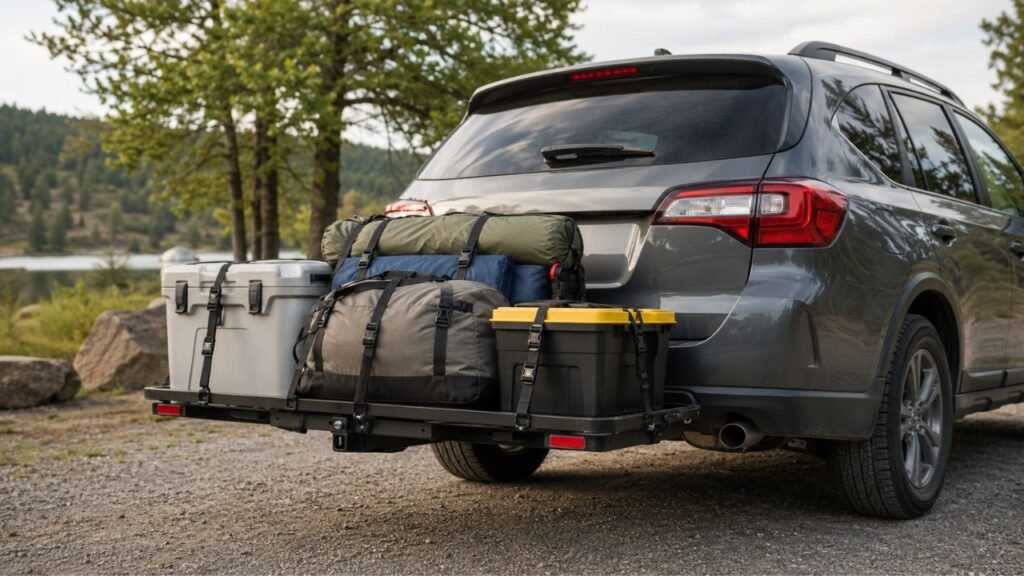
You should never carry people, pets, overweight loads, loose cargo, leaking fuel containers, or items exposed directly to hot exhaust on a rear hitch carrier. You should also avoid loads that block your brake lights, turn signals, license plate, or extend dangerously beyond the carrier.
Some items, such as generators, propane cylinders, coolers, and fuel cans, are not automatically unsafe. Their safety depends on weight, securement, heat exposure, carrier compatibility, and local laws. Below, I’ll help you figure out what belongs on your carrier and what should stay somewhere else.
Key Takeaways
- Never exceed the lowest weight rating in your complete hitch setup.
- People and pets should never ride on a hitch cargo carrier.
- Loose boxes, tools, firewood, and luggage can become dangerous road debris.
- Never put flammable or heat-sensitive cargo directly behind hot exhaust.
- Keep your brake lights, turn signals, and license plate clearly visible.
- A standard cargo basket is not a replacement for a motorcycle carrier.
- Propane tanks and fuel cans require secure, leak-free transportation.
- RV and travel-trailer carriers need specific compatibility checks.
- Hitch extenders and adapters may reduce how much weight you can safely carry.
- Recheck your cargo after driving because straps and loads can settle.
Quick Answer: What Should Never Go on a Rear Hitch Carrier?
Some cargo simply does not belong on a rear hitch carrier. Other items become unsafe only when they are overloaded, poorly secured, exposed to exhaust heat, or carried on the wrong type of platform.
| Item or Situation | Why You Should Avoid It | Better Option |
| People or pets | No passenger protection or restraints | Carry them safely inside the vehicle |
| Overweight cargo | Can overload the hitch, suspension, or carrier | Reduce the load or use a trailer |
| Loose boxes or gear | Can shift, fall, or become road debris | Use strong tie-downs or enclosed storage |
| Leaking fuel containers | Creates serious fire and vapor hazards | Repair or replace the container first |
| Damaged propane cylinders | May leak flammable gas | Do not transport until professionally checked |
| Heat-sensitive cargo near exhaust | Can melt, weaken, or catch fire | Move it away from the exhaust path |
| Loads blocking rear lights | Makes your vehicle harder to see | Reposition cargo or add compliant lighting |
| Cargo hiding the license plate | May violate state laws | Relocate or reconfigure where permitted |
| Long or sharp protruding items | Can create impact and roadway hazards | Use a suitable roof rack or trailer |
| Motorcycle on a basic cargo basket | Basket may lack structural support | Use a purpose-built motorcycle carrier |
| Gear on an incompatible RV carrier | Rear forces may exceed its design | Use an RV-approved carrier |
The safest rule is simple. If you cannot control the item’s weight, movement, heat exposure, and visibility impact, do not put it on the carrier.
Never Carry People or Pets on a Hitch Cargo Carrier
A rear hitch carrier is designed for cargo, not passengers. There are no seat belts, protective structures, suspension systems, or crash protections built into a normal cargo platform.
That means nobody should ever sit, stand, or ride on the carrier while your vehicle is moving. This applies even during short drives around a campground.
Pets should not ride there either, even inside a crate.
A crate attached to the rear carrier exposes an animal to exhaust, road debris, rain, heat, wind, and rear-end collisions. The carrier also bounces much more than the passenger compartment.
Keep people and animals inside the vehicle using proper restraints.
Never Carry More Weight Than Your Entire Setup Allows
A carrier might advertise an impressive weight capacity, but that number does not automatically tell you how much cargo your vehicle can handle. Your real limit depends on every part of the setup.
The Carrier’s Weight Counts Too
The carrier itself puts weight on your hitch before you load anything.
Suppose your vehicle allows 350 pounds of vertical hitch load and your empty carrier weighs 60 pounds. You cannot simply add another 350 pounds of cargo.
The carrier has already used part of that available capacity.
You should consider:
- Vehicle hitch or accessory-load limit
- Receiver or hitch rating
- Carrier weight rating
- Empty carrier weight
- Hitch adapters or extenders
- Vehicle payload limits
- Rear axle limits when applicable
Always follow the lowest applicable rating.
The Lowest Rating Controls Your Setup
Let’s say you have:
- A carrier rated for 500 pounds
- A receiver rated for 350 pounds
- A carrier weighing 60 pounds
The 500-pound label does not mean you can load 500 pounds.
Your vehicle and receiver still determine what the overall system can safely handle.
This is why I recommend checking your owner’s manual and hitch documentation before loading heavy gear.
Hitch Extenders Can Reduce Capacity
Hitch extenders seem convenient when you need extra bumper clearance. However, they move the load farther behind the receiver.
That extra distance creates more leverage on the hitch.
Many extenders reduce the usable tongue-weight rating, sometimes substantially. The exact reduction depends on the extender and manufacturer.
Never assume your original hitch rating stays unchanged after adding an extender.
Check the extender’s instructions before calculating your load.
Never Carry Loose or Poorly Secured Cargo
Cargo that feels stable while parked may behave completely differently at highway speed. Wind, potholes, braking, vibration, and sharp turns can move almost anything.
Avoid carrying loose items such as:
- Unsecured coolers
- Cardboard boxes
- Folding chairs
- Toolboxes
- Firewood
- Camping stoves
- Plastic storage bins
- Duffel bags
- Tent bags
- Loose sports equipment
- Tools
- Small appliances
I would not rely on a single elastic bungee cord for a heavy item.
Use strong tie-down straps attached to solid points on the carrier. Secure the load against movement in every direction, not just upward.
After tightening everything, grab the cargo and try moving it.
If you can easily slide, lift, or twist it by hand, it needs more restraint.
You should also secure loose strap ends. Long webbing tails can flap against the vehicle, drag on the road, or get caught around moving parts.
Never Load Cargo That Blocks Required Rear Lighting or Your License Plate
A rear hitch carrier sits directly behind the vehicle, so tall cargo can easily interfere with visibility. This can become both a safety concern and a legal problem.
Brake Lights and Turn Signals Must Remain Visible
Another driver needs to see when you’re stopping or turning.
Tall coolers, stacked totes, large cargo bags, generators, and oversized boxes can block your rear lamps.
Walk behind the loaded vehicle before leaving.
Check whether both brake lights and turn signals remain clearly visible from normal driving angles.
If your cargo blocks required lighting, simply saying, “You can still see part of the light,” is not a good safety standard.
Lower the load or use an appropriate auxiliary lighting solution.
Do Not Assume License Plate Rules Are the Same Everywhere
License plate visibility laws vary by state.
A setup that seems acceptable where you live may cause problems while traveling elsewhere.
For a road trip across several states, I recommend checking the plate-display requirements along your route.
If your carrier constantly hides the plate, consider an approved relocation solution where legally permitted.
Backup Cameras and Parking Sensors Matter Too
Your backup camera or parking sensors may become partially or completely blocked.
That does not automatically make the carrier illegal, but it changes how you need to drive.
Remember that the carrier also makes your vehicle longer.
Allow extra room while backing into campsites, parking spaces, gas stations, and driveways.
Never Put Heat-Sensitive Cargo Directly in the Exhaust Stream
One of the easiest hitch-carrier hazards to overlook is exhaust heat.
Your carrier may sit only a short distance from the tailpipe. Hot exhaust gases can damage cargo even when nothing physically touches the pipe.
Plastic Bins, Cargo Bags, and Nylon Straps
Heat can damage common carrier materials such as:
- Plastic storage bins
- Vinyl cargo bags
- Nylon tie-down straps
- Rubber components
- Cooler plastics
- Foam equipment
- Plastic handles
- Waterproof covers
A plastic tote may look perfectly safe while you’re loading it.
After several hours of highway driving, constant exhaust exposure can soften or deform the plastic.
Heat can also weaken straps holding heavier cargo.
Before leaving, check exactly where your exhaust exits compared with the carrier.
Flammable Cargo Near Exhaust Is a Bigger Risk
You need even more caution with flammable materials.
Examples include:
- Gasoline containers
- Propane cylinders
- Fuel-soaked equipment
- Certain aerosols
- Flammable chemicals
- Containers holding volatile liquids
These items should never sit in the direct path of hot exhaust.
If you cannot create a safe configuration, carry them somewhere else using an approved transportation method.
Never Guess at a Universal Exhaust Clearance
You may see people online recommending a specific number of inches between the exhaust and cargo.
I would not treat one number as universal.
Different vehicles have different exhaust locations, temperatures, tip angles, and airflow patterns.
Follow your vehicle and carrier manufacturer’s guidance instead.
Also inspect your setup after shorter trips. Heat marks, softened plastic, discoloration, or damaged straps are warning signs.
Never Transport a Leaking or Damaged Propane Cylinder or Fuel Container
Propane cylinders and fuel cans need more attention than ordinary camping gear. The problem is not simply that they contain fuel. The real danger comes from leaks, heat, poor securement, and damaged containers.
Never transport:
- A propane cylinder that smells like gas
- A cylinder with visible valve damage
- A badly rusted or damaged cylinder
- A leaking gasoline container
- A fuel can with a damaged cap
- Any container that cannot remain securely positioned
- Fuel near excessive heat or ignition sources
Make sure valves and caps are properly closed.
Secure the container so it cannot slide, fall over, bounce, or roll.
For propane cylinders, follow the required transportation position for that specific cylinder.
If you suspect a leak, do not load it onto the carrier and hope airflow will make it safe.
Deal with the leak before transportation.
What About Generators, Gas Cans, Propane Tanks, and Coolers?
Many popular camping items can go on a hitch carrier under the right conditions. The important part is recognizing that “possible” does not mean “throw it on and strap it down.”
| Item | Can It Go on a Hitch Carrier? | Main Conditions |
| Generator | Sometimes | Weight within limits, cooled, secured, leak-free |
| Propane cylinder | Sometimes | Leak-free, upright where required, secured, away from heat |
| Approved gasoline can | Sometimes | Closed, undamaged, secure, away from exhaust |
| Cooler | Usually | Lid secured and cooler firmly restrained |
| Firewood | Usually | Fully contained and strapped down |
| Plastic storage tote | Usually | Strong lid, good straps, safe exhaust clearance |
| Luggage | Usually | Weather-protected and securely tied |
| Motorcycle | Not on a normal basket | Use a purpose-built motorcycle carrier |
| Heavy mobility scooter | Needs special equipment | Use a properly rated mobility carrier |
A generator is a good example.
The unit may physically fit on the tray, but you still need to consider its weight, fuel, exhaust clearance, tie-down points, and whether the carrier is designed for that type of concentrated load.
The same thinking applies to propane tanks and gas cans.
Never Use an Ordinary Cargo Basket for Equipment That Needs a Specialized Carrier
A general-purpose cargo basket is designed for normal cargo. It should not be treated as a universal platform for every heavy object you can physically fit onto it.
Motorcycles, Dirt Bikes, and Heavy Scooters
A motorcycle needs more than enough square footage.
A proper motorcycle carrier usually provides features such as:
- Wheel channels
- Wheel stops or chocks
- Suitable tie-down locations
- Structural reinforcement
- Loading ramps
- Vehicle-specific capacity ratings
A flat cargo basket may not provide any of these.
Even if the motorcycle weighs less than the carrier’s printed capacity, the load may be concentrated in places the basket was not designed to support.
Use a purpose-built carrier instead.
E-Bikes Need Extra Attention
E-bikes can be much heavier than traditional bicycles.
Two heavy e-bikes can quickly push a lightweight rack or carrier beyond its rating.
If you carry e-bikes, use a rack specifically rated for their actual weight.
You should also follow the bike manufacturer’s instructions regarding battery transportation, especially during extreme heat.
Mobility Equipment Should Use a Proper Carrier
Powered wheelchairs and mobility scooters can be extremely heavy.
They also need secure wheel positioning and strong restraint points.
A dedicated mobility carrier with the correct capacity and loading system is normally a much better choice than improvising with a luggage basket.
Avoid Fragile, Expensive, or Weather-Sensitive Items on an Open Carrier
Not everything on this list is strictly forbidden.
Some items are simply poor choices for an open rear carrier.
I would think twice before putting laptops, cameras, delicate electronics, important documents, musical equipment, glass items, or other fragile valuables on an exposed tray.
The rear of your vehicle receives plenty of:
- Rain
- Dust
- Road spray
- Mud
- Salt
- Gravel
- Vibration
- Heat
- Exhaust residue
Items there are also more exposed to theft and rear-end collisions.
If you absolutely need to carry sensitive gear outside, use properly sealed and secured storage designed for the environment.
Never Carry Sharp, Dangling, or Excessively Protruding Loads
Oversized cargo creates another set of hazards.
Be especially careful with:
- Long lumber
- Metal tubing
- Poles
- Sharp tools
- Loose fishing rods
- Unprotected metal edges
- Cargo wider than your vehicle
- Items extending far behind the platform
- Hanging ropes
- Dangling straps
- Gear hanging below the carrier
Long items can create problems when turning, parking, or passing close to other vehicles.
Sharp edges should never be left exposed where someone could walk into them.
Overhang requirements can also vary between states. Some loads may require flags, lights, or other markings.
If the item is significantly longer than your carrier, a roof rack, pickup bed, or utility trailer is usually the better solution.
Rear Hitch Carrier Rules Are More Complicated on RVs and Trailers
RV owners need to be particularly careful because the back of a motorhome or trailer can behave differently from the back of an SUV. A carrier that works perfectly on one vehicle may not be approved for another.
A Motorhome Is Not the Same as a Passenger SUV
Many RVs have significant distance between the rear axle and hitch.
That longer rear overhang can produce more up-and-down movement at the carrier when the vehicle hits dips or bumps.
This means a carrier rated for normal passenger vehicles should not automatically be considered motorhome-compatible.
Check the carrier’s approved vehicle types.
Travel Trailers and Fifth Wheels Need Explicit Carrier Approval
The rear of a travel trailer can subject hitch-mounted equipment to significant movement.
That is why some manufacturers specifically prohibit their carriers or racks from being used behind travel trailers or fifth wheels.
Other models are specifically built and tested for RV use.
Do not assume compatibility based only on the receiver size.
Look for an explicit statement saying your carrier is approved for your type of RV or trailer.
A 2-Inch RV Receiver Does Not Guarantee Safe Capacity
This is an easy mistake to make.
A 2-inch receiver tells you the physical size of the opening.
It does not automatically tell you:
- How much weight the receiver supports
- Whether the bumper supports the receiver
- Whether the RV frame supports the load
- Whether the carrier is approved
- Whether an extender is acceptable
- How much dynamic movement the system can tolerate
Always check the actual ratings.
A carrier fitting into the receiver does not prove the setup is safe.
How Can You Tell Whether an Item Is Safe for Your Hitch Carrier?
Before loading unfamiliar or heavy cargo, run through a simple safety check. If you cannot answer one of these questions confidently, verify the information before driving.
Ask yourself:
- Is this carrier designed for this type of cargo?
- Is the carrier approved for my vehicle or RV?
- Am I within the vehicle’s allowable hitch load?
- Am I within the receiver’s rating?
- Am I within the carrier’s rating?
- Have I included the carrier’s own weight?
- Does an adapter or extender reduce capacity?
- Can I secure the item in every direction?
- Is the cargo clear of exhaust heat?
- Are brake lights and turn signals visible?
- Is the license plate visible as required?
- Does the cargo stick out dangerously?
- Could rain or road spray damage it?
- Does the item have its own transportation rules?
- Will the load stay stable after several hours of vibration?
If the answer to an important safety question is no, change the setup.
A few minutes spent rearranging cargo is much easier than dealing with a damaged carrier, lost gear, traffic stop, or roadside emergency.
Rear Hitch Carrier Pre-Trip Safety Checklist
I recommend doing one final walk-around after the carrier is completely loaded. This catches problems that are difficult to notice while standing directly beside the rack.
- Confirm your vehicle’s hitch-load limits.
- Check the receiver rating.
- Confirm the carrier’s maximum capacity.
- Include the empty carrier weight.
- Check any adapter or extender rating.
- Inspect welds, bolts, hitch pins, and hardware.
- Put heavier items closer to the vehicle.
- Center the load from side to side.
- Secure cargo with suitable tie-down straps.
- Secure all loose strap ends.
- Make sure containers cannot tip or roll.
- Check for fuel or propane leaks.
- Confirm adequate exhaust clearance.
- Verify brake-light visibility.
- Verify turn-signal visibility.
- Check license plate visibility.
- Make sure nothing hangs below the carrier.
- Check ground clearance.
- Confirm the carrier is not excessively wobbling.
- Recheck the load after the first part of your trip.
Cargo can settle once you start driving.
I like to check straps again at the first fuel, food, or rest stop. It only takes a minute and gives you a chance to catch something before it becomes a bigger problem.
Final Words
A rear hitch carrier is a great place for stable, weather-tolerant gear that stays within your vehicle’s weight limits. The trouble starts when we treat that extra platform as unlimited storage space.
Never use it for people, pets, leaking fuel containers, overloaded equipment, dangerously loose cargo, or anything exposed to excessive exhaust heat. You should also avoid loads that interfere with rear lighting, license plates, or safe vehicle dimensions.
For items such as generators, propane tanks, coolers, and fuel cans, think in terms of conditions rather than simple yes-or-no answers.
Check the weight. Check the straps. And also, check the heat. Check the visibility.
When all four look right, your rear hitch carrier becomes much easier and safer to use.
Related FAQs
Can I Carry a Propane Tank on a Hitch Cargo Carrier?
Yes, a propane cylinder may be transported on a suitable hitch carrier when it is undamaged, leak-free, properly positioned, securely restrained, and kept away from excessive heat and ignition sources. Follow the cylinder manufacturer’s transportation instructions.
Can I Carry Gas Cans on a Hitch Cargo Carrier?
An approved gasoline container may be carried when it is in good condition, completely closed, securely restrained, and positioned away from the exhaust and other heat sources. Never transport a leaking or damaged fuel container.
Can I Carry a Generator on a Rear Hitch Carrier?
You can carry a generator if the complete setup remains within its weight limits and the unit can be firmly secured. Keep the generator away from exhaust heat, make sure fuel cannot leak, and never run the generator while it is being transported.
Can I Carry Firewood on a Hitch Cargo Carrier?
Firewood can usually be carried if the carrier has enough capacity and the wood is completely secured. Loose pieces should not be able to bounce, roll, or fall through openings in the carrier while you drive.
Is It Safe to Put a Cooler on a Hitch Carrier?
A cooler is normally suitable for a hitch carrier when its loaded weight stays within capacity and the entire cooler is strapped down securely. Do not rely only on the lid handle or place plastic coolers directly in a hot exhaust stream.
Can I Carry an E-Bike on a Cargo Carrier?
A heavy e-bike should generally be transported on a rack specifically rated for e-bikes rather than loosely secured to an ordinary cargo basket. Check the weight of each bike and follow the battery manufacturer’s transportation guidance.
Does the Weight of the Hitch Carrier Count Toward Tongue Weight?
Yes. The carrier itself adds vertical load to the hitch before you add any cargo. Its weight must be included when determining whether your complete setup stays within the vehicle and hitch limits.
Can a Hitch Cargo Carrier Block My License Plate?
You should avoid any setup that prevents your license plate from being displayed as required by applicable state law. Requirements differ between states, so check the rules where you live and anywhere you plan to travel.
Can Cargo on a Hitch Carrier Block My Taillights?
Cargo should not block required brake lights or turn signals. If your loaded carrier hides them, rearrange the cargo or use an appropriate auxiliary lighting setup that meets applicable requirements.
Can I Use a Hitch Cargo Carrier With a Hitch Extender?
Sometimes, but check the extender’s rating carefully. Moving the load farther behind the receiver increases leverage, and many hitch extenders reduce the amount of vertical weight the hitch can safely support.
Can I Put a Rear Hitch Carrier on a Travel Trailer or Fifth Wheel?
Only use a carrier that is specifically approved for that application. Some carriers are not designed for the stronger movement found at the rear of travel trailers or fifth wheels, even when they physically fit the receiver.
How Far Can Cargo Stick Out From the Back of a Vehicle?
There is no single nationwide answer that applies to every situation. Rear-overhang rules and marking requirements vary by state, so check applicable laws before carrying long items that extend significantly behind the vehicle.

Jack Collins specializes in RV routes, trail access, and travel logistics. His how-to articles help RV and trailer owners plan smoother trips and avoid common mistakes. Every review focuses on performance, safety, and value.