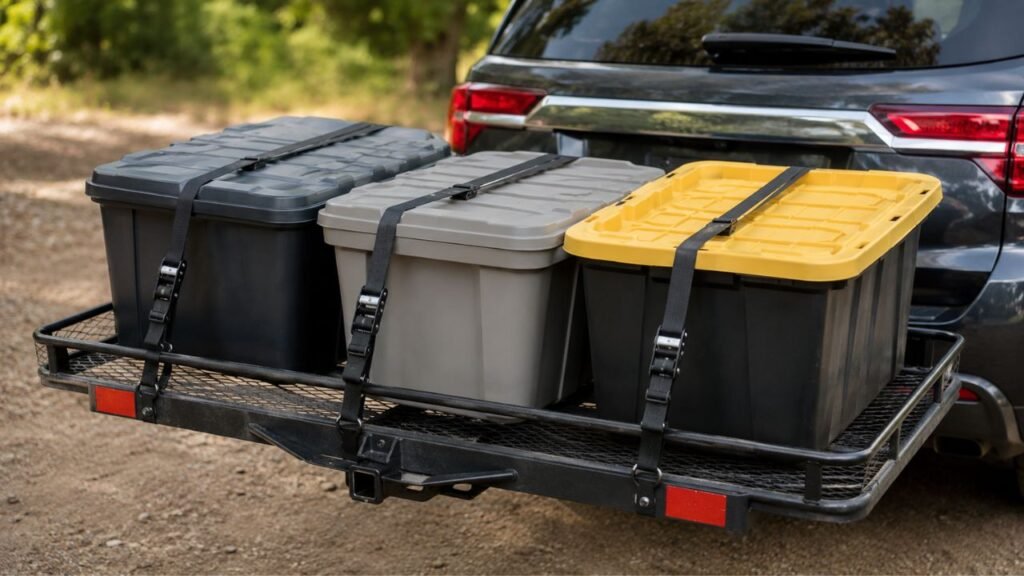
You can stop storage bins from sliding on a hitch carrier by combining ratchet straps with a non-slip rubber mat, proper bin placement, and secure anchor points. The goal is to prevent movement in every direction, not just hold the bins downward.
In this guide, I’ll show you how to stabilize plastic storage bins, choose the right restraint method, and keep your cargo from shifting during highway driving.
Key Takeaways
- Place a non-slip rubber mat underneath smooth plastic bins.
- Use properly rated ratchet straps instead of relying on bungee cords.
- Restrain bins from moving sideways and front-to-back.
- Keep heavier bins low and near the center of the carrier.
- Avoid leaving empty gaps between multiple containers.
- Attach straps to strong structural carrier points.
- Recheck the load shortly after you begin driving.
- Add blocking or dividers when straps alone cannot stop movement.
Why Do Storage Bins Slide on a Hitch Carrier?
Storage bins can move even when they look securely strapped while parked. Several forces act on a hitch-mounted carrier once your vehicle starts moving.
Smooth Plastic Has Very Little Grip
Most storage totes have smooth plastic bottoms.
Put one on painted steel or metal mesh, and there may not be much friction between the two surfaces.
During braking, acceleration, or cornering, the bin can slide before the straps fully resist the movement.
Once the container changes position, your straps may also become loose.
The Hitch Carrier Moves Over Bumps
A hitch-mounted carrier sits behind your vehicle and can experience considerable movement.
Potholes, uneven pavement, bridge joints, and driveway entrances can make the platform bounce.
A bin that feels perfectly stable in your driveway may experience repeated vertical and sideways movement on the road.
This is why securing the bin only against downward movement is not enough.
The Straps Pull Down but Not Sideways
This is a very common problem.
You run one strap straight across the top and tighten it hard.
The bin certainly feels pressed against the carrier.
However, it may still have room to move left, right, forward, or backward.
A good cargo setup controls movement in several directions.
Empty Space Lets Bins Build Momentum
Multiple containers can cause another problem.
If you leave several inches between them, one bin can slide before hitting the next.
That short movement creates momentum.
It may then push other bins, change strap tension, or shift the entire load.
A tighter, better-arranged group usually stays more stable.
Flexible Plastic Bins Can Compress
Storage bins are not rigid cargo boxes.
If a ratchet strap presses heavily against a thin lid, the plastic may bow downward.
As the bin flexes while driving, the strap can lose some tension.
That makes the container easier to move.
Best Ways to Stop Storage Bins From Sliding on a Hitch Carrier
You will usually get the best results by combining several methods. Friction, good positioning, and mechanical restraint work much better together than any single solution.
Put a Non-Slip Mat Under the Bins
This is one of the easiest improvements you can make.
Place a rubber cargo mat underneath the storage containers before loading them.
The extra friction makes it harder for smooth plastic bottoms to slide across metal.
You can use:
- Heavy-duty rubber cargo matting
- Outdoor non-slip rubber material
- Suitable truck-bed-style matting
- Durable high-friction shelf liner for lighter applications
I would avoid thin material that can blow away, tear easily, or bunch underneath the load.
The mat should stay flat across the carrier floor.
Also remember that a non-slip mat is only supplemental restraint. You still need straps.
Use At Least Two Appropriate Tie-Down Straps
One strap may hold a single small bin under ideal conditions.
For larger loads or several containers, two independent straps usually offer much better control.
One strap can apply downward restraint while another helps control front-to-back or sideways movement.
Ratchet straps are useful because you can adjust their tension precisely.
Choose straps with a clearly marked Working Load Limit suitable for the load.
Do not select straps only because the packaging shows a very high breaking-strength number.
Strap the Bins in More Than One Direction
Instead of thinking only about tightening downward, think about where the bins could move.
Your restraint system should address:
- Left-to-right movement
- Front-to-back movement
- Upward bouncing
For example, you may run one strap across the bins while using another at an opposing angle.
The exact arrangement depends on your carrier’s tie-down locations.
Just make sure the straps remain clear of sharp edges and moving vehicle components.
Place Heavy Bins Near the Center
Load placement affects stability.
Put the heaviest containers low and reasonably close to the center of the carrier.
Avoid concentrating all the weight along one outer corner.
Balanced cargo is easier to restrain and creates less tendency for individual bins to move.
Always stay within the weight ratings of:
- Your vehicle
- Hitch
- Receiver
- Hitch adapter, if used
- Cargo carrier
Straps do not increase any of those capacities.
Keep Multiple Bins Close Together
If you carry several storage bins, arrange them so large empty spaces do not remain between them.
The goal is to create a stable group.
Two bins sitting firmly next to each other have less room to accelerate sideways than two containers separated by several inches.
However, don’t simply squeeze everything together so tightly that containers sit crooked.
The bottoms should remain flat and stable.
Use Blocking When Necessary
Sometimes the carrier is much wider than the bins.
Even well-positioned straps may not completely prevent sideways sliding.
In that situation, physical blocking can help.
You might use properly secured:
- Wood blocks
- Metal stops
- Carrier dividers
- Purpose-built cargo guides
The blocking should prevent horizontal movement without damaging the bins.
Never place loose pieces of wood around the cargo. They need to be secured so they cannot become road debris.
How Should You Strap Storage Bins to a Hitch Carrier?
The best strap layout depends on the number and shape of your containers. Here are the setups I would consider first.
One Large Storage Bin
Place the bin on a non-slip mat and center it on the carrier when practical.
Run rated straps over structurally strong portions of the container.
Avoid pulling extremely hard through the center of a flexible lid.
Ideally, arrange the straps so the container cannot move forward, backward, or sideways.
After tightening, grab the bin and try moving it firmly.
If it slides, improve the setup before driving.
Two Storage Bins
Position the containers closely together.
Use at least two suitable straps where the carrier design allows it.
A single strap across both bins can press them downward, but another independent restraint may be necessary to prevent the entire pair from shifting sideways.
Check that neither bin can move independently.
Three or More Storage Bins
With several bins, arrangement becomes even more important.
Put larger and heavier containers low and near the center.
Try to fill usable carrier space without creating unstable stacks.
Secure the group so individual containers cannot migrate toward an empty area.
For complicated loads, individually restraining certain bins may work better than treating the entire group as one object.
Stacked Storage Bins
I recommend avoiding tall stacks whenever you can.
The higher the cargo rises, the more leverage road movement can create.
If stacking is unavoidable, place heavier bins on the bottom.
Make sure the upper container cannot slide independently.
The lower bin’s lid must also be strong enough to support the load above it.
Storage Bin Securement Methods Compared
Different restraint methods solve different problems. This table can help you decide what to use.
| Securement Method | What It Helps With | Best Use | Main Limitation |
| Ratchet straps | Overall cargo restraint | Heavy bins and highway travel | Must be routed correctly |
| Non-slip rubber mat | Reduces sliding | Smooth plastic bins | Not a primary tie-down |
| Cargo net | Contains smaller items | Light secondary restraint | Usually not ideal for heavy bins |
| Wood or metal blocking | Stops horizontal movement | Loose-fitting carrier layouts | Must be securely installed |
| Carrier side rails | Limits sideways movement | Most hitch carriers | Does not replace straps |
| Bungee cords | Light secondary containment | Very light items | Too elastic for many heavy loads |
Should You Use a Rubber Mat Under Storage Bins?
Yes, a rubber mat is one of the easiest ways to reduce storage-bin movement.
The mat increases friction between the bin and the carrier floor.
That means the straps do not have to fight sliding as easily.
This is especially useful when your carrier has:
- Smooth metal flooring
- Powder-coated steel
- Large flat surfaces
- Painted rails
A mat can also reduce rattling and minor abrasion.
Just make sure the mat itself cannot slide or blow out from underneath the cargo.
Can You Use a Cargo Net Over Storage Bins?
A cargo net can be helpful, but I would usually treat it as secondary restraint.
Elastic nets are excellent for keeping lightweight pieces together.
They can also help prevent loose lids or small objects from lifting in the airflow.
However, an elastic net can stretch considerably.
For heavy storage totes, properly rated straps generally provide more dependable primary restraint.
You can use both.
Secure the heavy bins with straps first, then add the net for extra containment where useful.
Can You Use Bungee Cords Instead of Ratchet Straps?
Bungee cords are convenient, but they are highly elastic.
That makes them useful for lightweight secondary tasks rather than primary restraint of heavy cargo bins.
When your vehicle hits a large bump, a bungee can stretch and allow the container to move.
The bin may then rebound in another direction.
For substantial storage bins on a highway trip, I would choose properly rated cargo straps instead.
How Tight Should Straps Be Around Plastic Storage Bins?
Make the straps tight enough that the containers cannot move significantly when pushed by hand.
You do not need to crush the bins.
Watch the lid and walls as you apply tension.
If the container begins deforming heavily, stop tightening.
Move the strap to a stronger area or change the arrangement.
Overtightening a flexible bin may actually make the system worse because the container can later spring, compress, or change shape.
You want stable tension rather than maximum tension.
Should You Strap Through Storage Bin Handles?
I would avoid using normal plastic carrying handles as primary cargo anchor points.
Those handles may be strong enough to lift the container manually.
That does not automatically mean they were designed to withstand repeated highway forces.
A handle can crack, flex, or pull away from the bin.
Run the restraint around the container and connect it to proper carrier anchor points instead.
If your container has manufacturer-designed tie-down points, follow those instructions.
How Do You Keep Storage Bin Lids From Opening?
Stopping the bin from sliding is only part of the job.
Make sure the lid cannot open while driving.
Use the container’s locking latches whenever available.
Some heavy-duty bins also accept:
- Small padlocks
- Locking pins
- Suitable reusable ties
- Manufacturer-approved lid clips
Do not depend on the top cargo strap alone to hold a badly fitting lid closed.
A loose lid can catch highway airflow quickly.
Does Hitch-Carrier Wobble Make Bins Slide?
Yes, carrier wobble can contribute to movement.
A small amount of play between the hitch receiver and carrier shank can create repeated movement behind the vehicle.
Over many miles, that movement can encourage smooth containers to migrate.
A compatible anti-rattle device may reduce unnecessary hitch movement.
However, do not mistake carrier stabilization for cargo securement.
Even a completely stable carrier still requires properly restrained bins.
What Should You Avoid When Securing Storage Bins?
A few shortcuts can make a cargo setup less secure.
- Do not rely only on the weight of the bins.
- Do not use broken or frayed straps.
- Do not attach primary straps to weak plastic handles.
- Do not leave large spaces between loosely restrained containers.
- Do not let webbing rub continuously against sharp metal.
- Do not overtighten thin plastic lids.
- Do not use an elastic cargo net as the only restraint for heavy bins.
- Do not leave loose strap tails flapping.
- Do not exceed carrier or hitch capacity.
- Do not ignore a container that moves during your pre-trip test.
How Often Should You Check the Storage Bins While Driving?
Inspect the setup before leaving your driveway.
Then stop somewhere safe after the first several miles or roughly 10 to 15 minutes of driving.
This early inspection is important because the bins and straps may settle once they experience real road movement.
Check for:
- Loose straps
- Shifted bins
- Rotated hooks
- Compressed lids
- Damaged webbing
- Sliding rubber mats
- Loose lids
After that, inspect the cargo during normal fuel, food, and rest stops.
Stop sooner if you hear new rattling or notice unusual movement.
Quick Pre-Trip Hitch-Carrier Checklist
Run through this simple check before getting on the highway.
- Carrier is properly attached to the receiver.
- Hitch and carrier weight ratings are respected.
- Heavy bins are positioned low and stable.
- Storage-bin lids are securely latched.
- Rubber mat is flat underneath the bins.
- Containers cannot slide easily.
- Ratchet straps are correctly threaded.
- Hooks are fully seated.
- Anchor points are strong.
- Webbing is free from serious damage.
- Straps do not rub sharp edges.
- Ratchets are fully closed.
- Loose webbing tails are secured.
- Bins cannot move sideways.
- Bins cannot move front-to-back.
- Nothing is close to the tires or exhaust.
- A safe early-trip inspection is planned.
Final Words
The best way to stop storage bins from sliding on a hitch carrier is to make the entire load stable before you start tightening straps.
A rubber non-slip mat provides friction. Properly positioned ratchet straps provide mechanical restraint. Good bin placement reduces empty space and unnecessary movement.
Use all three together.
And remember, you should be able to push and pull each container firmly without seeing significant movement before leaving.
If a bin slides in your driveway, it will probably move even more once highway bumps, braking, and turns start working against it.
Related FAQs
What Is the Best Way to Stop Plastic Bins From Sliding on a Cargo Carrier?
Place a durable non-slip rubber mat underneath the bins and secure them with properly rated straps. Arrange the straps so they prevent sideways and front-to-back movement as well as bouncing.
How Many Ratchet Straps Do I Need for Storage Bins?
The number depends on the load, carrier, bin size, and strap ratings. Larger bins and groups of containers often benefit from two or more independent restraints controlling different directions.
Can I Put Shelf Liner Under Storage Bins?
Heavy-duty non-slip shelf liner may help with lightweight loads, but durable rubber cargo matting is generally more suitable for repeated outdoor and highway use.
Should Storage Bins Touch Each Other on a Hitch Carrier?
Placing bins reasonably close together can reduce room for movement. Keep them stable and flat rather than forcing them tightly together at awkward angles.
Can I Stack Storage Bins on a Hitch Carrier?
You can stack suitable bins when the carrier’s limits and container design allow it, but lower arrangements are generally easier to stabilize. Put heavier containers underneath and secure upper bins independently from sliding.
Can a Rubber Mat Replace Ratchet Straps?
No. A rubber mat increases friction but does not provide dependable mechanical restraint. Use it together with properly rated tie-down straps.
Can I Use Rope to Secure Storage Bins?
Suitable cargo rope can work when used correctly, but ratchet straps are often easier to tension consistently. Whatever you use should be strong enough, properly secured, and appropriate for the load.
Are Storage Bin Handles Strong Enough for Tie-Down Straps?
Ordinary plastic carrying handles should not automatically be treated as structural tie-down points. Secure the container itself and attach straps to appropriate carrier anchor points.
Why Do My Bins Keep Moving Even With Tight Straps?
Your straps may be applying mostly downward pressure while allowing sideways movement. Smooth carrier surfaces, carrier bounce, empty gaps, and flexible bin walls can also contribute.
Should I Use an Anti-Rattle Hitch Device?
A compatible anti-rattle device can reduce carrier movement at the receiver connection. It may help stabilize the overall setup, but it does not replace proper cargo straps.
How Do I Stop Storage Bin Lids From Blowing Open?
Close every factory latch and use additional manufacturer-approved locking points when available. Make sure the lid fits properly before relying on cargo straps for additional containment.
Should I Check the Bins During a Long Trip?
Yes. Inspect the load before departure, after the first portion of the trip, and during regular stops. Recheck sooner after rough roads or whenever you hear unusual movement.

Jack Collins specializes in RV routes, trail access, and travel logistics. His how-to articles help RV and trailer owners plan smoother trips and avoid common mistakes. Every review focuses on performance, safety, and value.