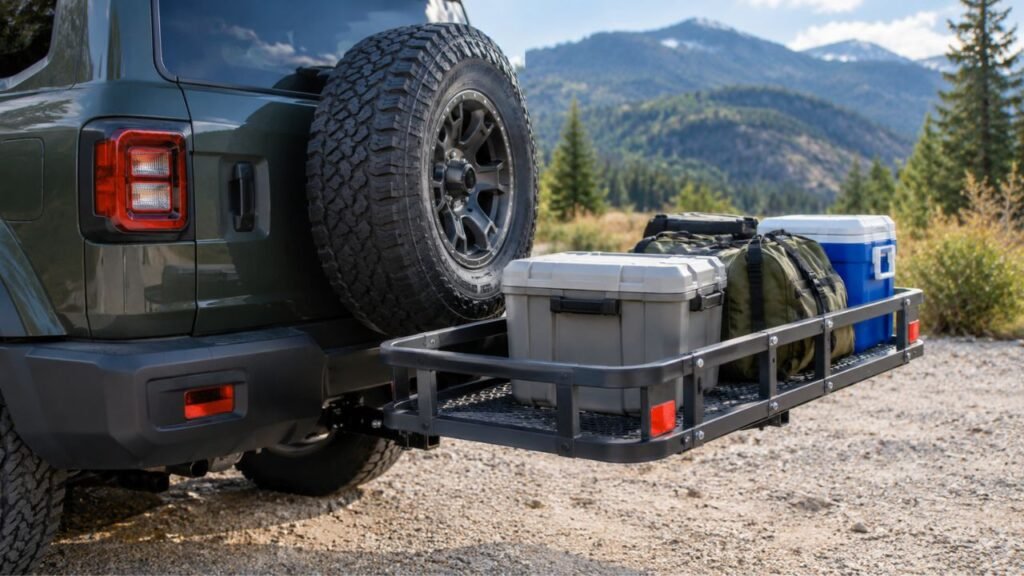
Yes, a rear-mounted spare tire can interfere with a hitch cargo carrier. It may block installation, prevent folding, contact loaded cargo, or limit rear-door access.
The good news is that most clearance problems are predictable. I’ll show you what to measure, where interference happens, and which fixes usually work best.
Key Takeaways
- A rear spare tire can block both fixed and folding carriers.
- Always measure from the hitch pin hole to the tire.
- Check clearance with the carrier deployed and folded.
- Loaded cargo may hit the tire even when the tray clears.
- Larger aftermarket spare tires can reduce available clearance.
- Hitch extenders can help, but they may reduce capacity.
- Swing-away carriers work well when rear-door access matters.
Can a Rear Spare Tire Really Block a Hitch Cargo Carrier?
A spare tire does not need to completely block installation to cause trouble.
Sometimes the carrier slides into the receiver without any problem. However, the platform may sit extremely close to the tire.
In other cases, the carrier fits perfectly while horizontal. The problem only appears when you try folding it upward.
You can also have enough clearance for the empty carrier. Then a cooler, storage tote, or generator touches the spare.
Rear-door access creates another common problem.
A carrier may clear the tire while driving. However, the rear door may still strike the carrier when opened.
That is why I would never judge compatibility from one measurement alone.
You need to think about the complete setup.
That includes the tire, carrier, cargo, rear door, and receiver.
Where Can the Spare Tire Interfere With the Carrier?
A rear spare can create problems in several different places. Identifying the exact interference point makes choosing a solution much easier.
| Interference Area | What Usually Happens | What You Should Check | Possible Solution |
| Carrier shank | Carrier cannot slide far enough inward | Hitch pin hole to tire distance | Longer-shank carrier |
| Carrier platform | Tray touches the spare tire | Clearance while carrier is horizontal | Different carrier design |
| Folding position | Carrier hits tire when raised | Folded carrier clearance | Fixed or longer-shank carrier |
| Loaded cargo | Boxes or gear touch the tire | Cargo height and placement | Reposition cargo |
| Rear door | Door hits carrier or cargo | Full door opening path | Swing-away system |
| Cargo box lid | Lid cannot fully open | Lid movement toward vehicle | Increase rearward clearance |
The important thing here is separating these problems.
For example, an extender may fix tire clearance. It might not fix rear-door access.
Likewise, choosing a fixed carrier can solve folding interference. It may still block your rear door.
Why Rear-Mounted Spare Tires Cause Clearance Problems
Rear-mounted spares extend beyond the vehicle’s normal rear profile. That reduces the usable space between the receiver and your carrier.
The Spare Tire Extends Past the Rear Bumper
Most vehicles without rear-mounted spares have open space above the receiver.
A rear spare occupies part of that space.
The outer edge of the tire can sit several inches beyond the bumper. That extra distance is what creates many carrier fitment problems.
This is particularly common on off-road vehicles and SUVs.
Examples include Jeep Wranglers, Ford Broncos, and older Toyota FJ Cruisers.
The exact clearance can vary even between similar vehicles.
Different tire sizes, wheels, bumpers, and spare mounts change everything.
Folding Carriers Move Toward the Vehicle
Folding cargo carriers are useful when you are not carrying gear.
You can raise the platform vertically and shorten your vehicle’s overall length.
Unfortunately, the folding motion usually brings the carrier closer to the vehicle.
That is where the spare tire becomes a problem.
Your carrier may have several inches of clearance while horizontal. Once folded, the upper frame can contact the tire.
This is why deployed clearance and folded clearance must be measured separately.
Never assume that one measurement covers both positions.
Loaded Cargo Can Extend Into the Spare Tire
The carrier itself may clear the spare without difficulty.
Your cargo might not.
Tall storage bins, coolers, generators, and cargo bags often extend upward. They can occupy space directly behind the spare tire.
Road vibration can make this problem worse.
A bin that barely clears while parked may shift forward during driving.
That can allow the container to rub against the tire.
Secure everything firmly and leave some usable breathing room.
Rear Doors Need More Space Than the Tire Alone
Rear-door clearance can be more complicated than tire clearance.
This is especially true with side-hinged rear doors.
On many vehicles, the spare tire is attached directly to the door. When you open the door, the tire swings outward with it.
The door therefore needs a large sweeping area behind the vehicle.
A fixed cargo carrier can block that path.
The same problem happens when tall cargo sits near the vehicle.
Even liftgates can contact gear stacked too high.
Oversized Spare Tires Make the Problem Worse
Upgrading your spare tire can change a previously compatible setup.
A larger tire may extend farther outward from the vehicle.
A wider tire can also move the outer edge rearward.
Aftermarket wheels may change the tire position even more.
An aftermarket spare carrier can also relocate the tire.
So, if you install a larger spare, measure everything again.
Do not rely on measurements taken with factory tires.
How to Measure Spare Tire Clearance for a Hitch Cargo Carrier
Measuring correctly can save you from buying the wrong carrier. You only need a tape measure, straightedge, and a few minutes.
Step 1: Find the Center of the Hitch Pin Hole
Look at the side of your receiver tube.
You will see the hole where the hitch pin passes through.
Measure from the center of that hole.
Do not start from the bumper or receiver opening.
Carrier manufacturers commonly use the hitch pin hole as the reference point.
That gives you a consistent measurement for comparison.
Step 2: Mark the Outermost Edge of the Spare Tire
Next, identify the part of the spare extending farthest rearward.
This may be the tire tread or tire cover.
Place a straightedge vertically against that outermost point.
A long level, board, or similar straight object works well.
Keep the straightedge vertical.
Then measure horizontally from the hitch pin hole center.
That number represents your basic spare-tire clearance requirement.
Step 3: Compare the Carrier’s Driving-Position Clearance
Now check the carrier specifications.
Look for the distance from the hitch pin hole to the closest part of the platform.
That carrier distance must exceed your vehicle measurement.
For example, imagine your spare needs nine inches of clearance.
A carrier offering only eight inches will likely interfere.
A carrier providing twelve inches gives you more usable space.
I prefer avoiding setups that barely clear.
Vehicle movement and cargo shifting can reduce tiny gaps.
Step 4: Measure the Folded Position Separately
If the carrier folds upward, check the folded measurement too.
This is where many buyers get caught out.
A folding carrier can provide plenty of horizontal clearance.
Its vertical frame may still move close to the tire.
Look for a manufacturer-provided folded clearance specification.
If one is unavailable, measure the carrier yourself when possible.
Never force the carrier upward against the spare.
That can damage the tire, carrier, or vehicle.
Step 5: Check the Rear Door’s Full Movement
Next, slowly open the rear door.
Watch how the tire and door move around the carrier.
Do not stop after opening it only a few inches.
Check the full range you normally need.
If you have a side-swing door, pay extra attention.
The spare may sweep across a surprisingly large area.
With a liftgate, check whether tall cargo blocks upward movement.
Step 6: Leave Some Extra Clearance
A setup should not depend on nearly zero clearance.
Road movement introduces vibration and small amounts of flex.
Cargo can also shift slightly after several miles.
Leave additional space whenever possible.
There is no single clearance number for every carrier.
Follow your carrier manufacturer’s specific recommendation first.
How to Fix Spare Tire and Hitch Cargo Carrier Interference
The right fix depends on where the interference occurs. I usually recommend solving the problem with the simplest compatible hardware first.
Choose a Carrier With a Longer Shank
If you have not purchased a carrier yet, start here.
Look for a carrier providing greater hitch-pin-to-platform clearance.
A longer integrated shank moves the tray farther from the tire.
This keeps the setup relatively simple.
You avoid adding another connection between the carrier and receiver.
A purpose-built carrier is usually cleaner than stacking adapters.
However, greater distance also increases leverage on the hitch.
Your weight limits still matter.
Use a Hitch Extender When Allowed
A hitch extender moves the carrier farther behind the vehicle.
That can create enough space to clear the spare.
However, I would not treat an extender as an automatic solution.
Moving weight farther from the receiver increases leverage.
Many extenders therefore reduce allowable tongue weight.
The amount of reduction depends on the specific product.
You must check the extender manufacturer’s instructions.
Also check whether your carrier allows extender use.
Some accessory manufacturers restrict certain adapter combinations.
An extender can also introduce more hitch movement.
Using suitable anti-rattle hardware may help reduce unwanted play.
Consider a Swing-Away Carrier or Adapter
A swing-away system is useful when rear access matters frequently.
Instead of remaining directly behind the vehicle, the carrier pivots sideways.
That gives you better access to the rear door.
This design can be especially helpful with side-swing doors.
You may be able to move the carrier completely away.
However, swing-away hardware adds weight and complexity.
The adapter itself counts toward your hitch load.
It also adds another pivot and connection point.
Make sure every component is rated for your complete load.
Use a Fixed Carrier if Folding Is the Only Problem
Sometimes the only issue is the folding mechanism.
The carrier works fine while horizontal.
It only touches the spare when folded upward.
In that situation, you may not need an extender.
A fixed carrier can be a simpler alternative.
You lose the ability to fold it vertically.
However, you also eliminate the folding clearance problem.
This can work well when the carrier stays installed during trips.
Change Cargo Placement Before Changing Hardware
Not every clearance issue requires new equipment.
Sometimes only your cargo contacts the spare.
Move taller boxes farther toward the rear of the platform.
Lower-profile items can sit closer to the vehicle.
Keep the load balanced across the carrier.
Do not move all heavy items to one extreme side.
Secure everything with properly rated straps.
Then check the clearance again before driving.
Does a Hitch Extender Reduce Cargo Carrier Capacity?
A hitch extender can reduce the amount of weight your setup safely carries.
The reason is leverage.
Moving the carrier farther from the receiver increases the force applied there.
Think about holding a weight close to your chest.
It feels easier than holding the same weight at arm’s length.
Your hitch experiences a similar mechanical effect.
Before using an extender, check several ratings.
You need to know:
- Your vehicle’s tongue-weight limit.
- Your hitch receiver’s rated capacity.
- Your hitch extender’s rated capacity.
- Your cargo carrier’s maximum capacity.
- The empty weight of the cargo carrier.
- The empty weight of the extender or swing adapter.
- The actual weight of everything you plan to carry.
Your usable capacity is controlled by the weakest applicable rating.
The carrier’s advertised capacity alone does not determine safety.
For example, a carrier may advertise a 500-pound capacity.
That does not mean your vehicle can carry 500 pounds.
Your hitch, extender, or vehicle may have a lower limit.
Always follow the lowest permitted rating.
Which Cargo Carrier Type Works Best With a Rear Spare Tire?
Different carrier designs solve different problems. The best option depends on your clearance, cargo, and rear-door needs.
- Fixed cargo carrier: Usually the simplest option when deployed clearance is sufficient.
- Folding cargo carrier: Convenient when empty, but requires separate folded-clearance measurements.
- Swing-away carrier: Excellent for frequent rear-door access, though heavier and more expensive.
- Enclosed cargo box: Protects cargo well but requires tire, lid, and door clearance.
- Long-shank carrier: Helpful when the spare projects far beyond the bumper.
- Low-profile carrier: Useful when liftgate access matters more than folding capability.
I would choose based on your actual interference problem.
Do not buy a swing-away model simply because it sounds more capable.
If a simple fixed carrier already clears everything, use that advantage.
How Rear Door Design Changes Carrier Clearance
Rear-door design changes how much working space you need. The spare tire is only one part of the clearance equation.
Side-Swing Rear Doors
Side-swing doors often create the hardest carrier-access problem.
The door swings horizontally behind the vehicle.
If the spare is door-mounted, it moves with the door.
That creates a large arc around the carrier.
Jeep Wranglers are a common example.
Ford Broncos can present a similar challenge.
A standard fixed carrier may prevent the door from opening fully.
A swing-away design often works better for frequent access.
Liftgates and Hatchbacks
Liftgates move upward instead of sideways.
That can make low cargo carriers easier to live with.
However, tall cargo creates another problem.
A large storage bin may contact the liftgate while opening.
The platform itself can also block a very low-opening hatch.
Test your actual cargo height before a long trip.
Split or Barn-Style Rear Doors
Some vans and utility vehicles use split rear doors.
Each side needs its own opening path.
One door may clear while the other does not.
Check both sides separately.
Do this with the carrier loaded, not only when empty.
Do Oversized Spare Tires Change Cargo Carrier Fit?
Yes, oversized spare tires can change hitch cargo carrier clearance.
A larger spare often moves the tire farther rearward.
That decreases the available gap between the tire and carrier.
Tire width matters too.
A wider tire mounted on a different wheel can change offset.
Aftermarket bumpers and spare mounts also affect positioning.
This means a carrier that fit your factory setup may stop fitting.
You should remeasure whenever the rear tire setup changes.
Pay particular attention after installing oversized off-road tires.
Also check whether a thicker tire cover adds noticeable clearance requirements.
Never assume a one-inch tire-size change creates exactly one inch of interference.
Wheel offset and mounting position can change the final result.
How to Test the Setup Before Driving
Once everything fits, perform a complete test before driving. This catches problems that basic measurements sometimes miss.
- Install the cargo carrier while it is completely empty.
- Confirm the hitch pin passes fully through the receiver.
- Make sure the carrier shank seats correctly.
- Check clearance around the spare while horizontal.
- Fold the carrier slowly if it has that feature.
- Confirm no frame section contacts the spare.
- Open the rear door through its usable range.
- Load your normal cargo onto the carrier.
- Recheck tire clearance with the carrier fully loaded.
- Confirm containers cannot slide forward into the spare.
- Tighten all straps and securing hardware.
- Verify the carrier does not block important vehicle lighting.
- Check whether the license plate remains appropriately visible.
- Inspect hitch pins and anti-rattle hardware again.
- Recheck the setup after driving a short distance.
I especially recommend that last step.
Loads can settle after the first few miles.
Straps can also lose tension as cargo shifts slightly.
When You Should Not Use the Setup
Do not use the carrier if the spare tire physically touches it.
I would also stop if the hitch pin cannot seat properly.
A carrier should never be forced into an incomplete mounting position.
Do not exceed the vehicle, hitch, extender, or carrier rating.
Also avoid combinations prohibited by the equipment manufacturer.
If the carrier continuously strikes the vehicle during normal movement, fix it first.
Small hitch movement can be normal.
Actual contact between the carrier and vehicle is not.
When you cannot verify the capacity, do not guess.
Reducing cargo weight or changing hardware is safer than assuming.
Final Words
A rear spare tire can definitely interfere with a hitch cargo carrier. However, that does not mean you cannot use one safely.
The key is measuring the complete setup before choosing your carrier. Check deployed clearance, folded clearance, cargo position, and door movement.
If interference occurs, start with the simplest compatible solution. A longer-shank carrier may be enough without adding extra hardware.
Use extenders and swing-away systems only after checking every weight rating.
Related FAQs
How Much Clearance Does a Hitch Cargo Carrier Need From a Spare Tire?
Your carrier needs more hitch-pin-to-platform clearance than the measured distance between the hitch pin hole and the spare tire. Leave additional space whenever possible and follow the manufacturer’s fitment requirements.
Can I Use a Hitch Extender With a Cargo Carrier?
You can use a hitch extender when your vehicle, receiver, extender, and carrier manufacturers allow the combination. Always account for any reduced tongue-weight capacity caused by the extender.
Will a Folding Cargo Carrier Clear a Jeep Wrangler Spare Tire?
Some folding carriers will clear a Jeep Wrangler spare, while others will not. Measure both horizontal and folded clearance because tire size, bumper design, and carrier geometry vary.
Can I Open My Rear Door With a Hitch Cargo Carrier Installed?
That depends on the carrier design and your rear door. Side-swing doors often need swing-away hardware, while liftgates may work with low-profile carriers and shorter cargo.
Does a Larger Spare Tire Require a Hitch Extender?
Not necessarily. A larger spare may reduce clearance, but you should remeasure before adding an extender. A longer-shank carrier may solve the problem without extra hardware.
Is a Swing-Away Cargo Carrier Better for a Rear-Mounted Spare?
A swing-away carrier is often better when frequent rear-door access matters. However, it adds weight, cost, and mechanical complexity, so verify all component ratings first.
Can Cargo Touch the Spare Tire While Driving?
Cargo should not rest against or repeatedly rub the spare tire. Road vibration can cause wear, damage containers, and loosen the load, so leave clearance and secure everything properly.
Do I Need to Measure Again After Changing Tire Size?
Yes. A larger or wider spare tire can change rearward clearance significantly. Remeasure the hitch-pin-to-tire distance before using the same cargo carrier again.

Jack Collins specializes in RV routes, trail access, and travel logistics. His how-to articles help RV and trailer owners plan smoother trips and avoid common mistakes. Every review focuses on performance, safety, and value.