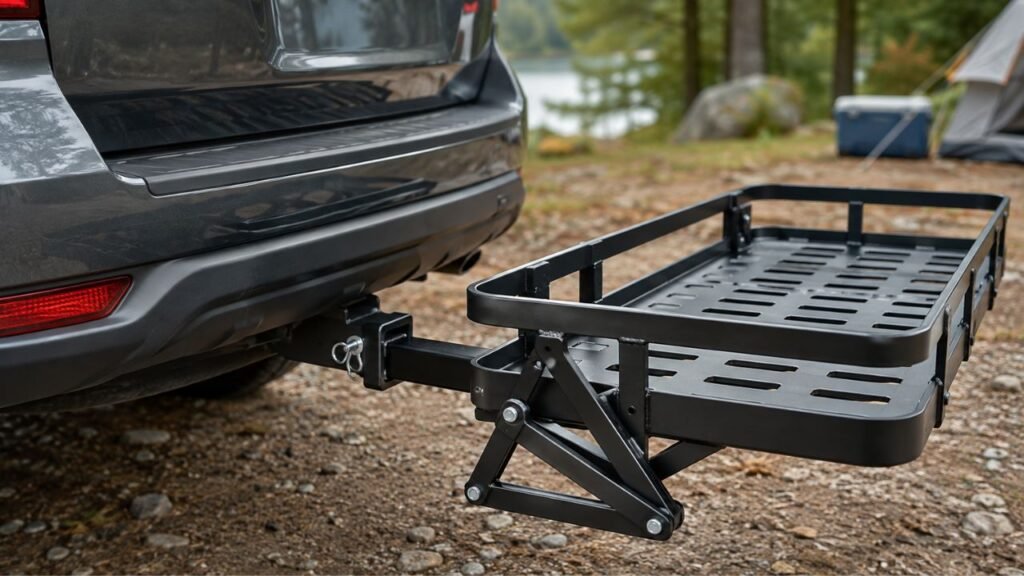
You can prevent rust around hitch-carrier welds and pins by keeping them clean and dry, repairing damaged coatings quickly, and protecting moving metal parts with the correct lubricant or corrosion inhibitor. Pay extra attention after rain, winter road salt, coastal driving, or long periods of outdoor exposure.
In this guide, I’ll show you how to protect welds, pins, folding joints, and exposed steel. I’ll also explain how to handle existing rust and when corrosion becomes serious enough to stop using the carrier.
Key Takeaways
- Rinse road salt, mud, and grime from the carrier promptly.
- Dry welds, pin holes, hinges, and overlapping joints thoroughly.
- Repair chipped paint or powder coating before bare steel rusts.
- Clean and protect hitch pins and folding pins regularly.
- Follow the manufacturer’s instructions before lubricating threaded hardware.
- Remove the carrier during long periods when you do not need it.
- Stop using the carrier if you find cracked welds or deep structural corrosion.
Why Does Rust Start Around Hitch-Carrier Welds and Pins?
Welds and pins are some of the hardest-working areas on a hitch carrier. They collect road spray, experience vibration, and often lose protective coating sooner than flat frame sections.
Weld Seams Can Hold Water and Road Grime
A weld is rarely as smooth as the surrounding tubing. Small edges, corners, and depressions around the weld can hold dirty water.
That becomes a bigger problem after driving through rain, mud, or winter road salt. Moisture may remain around the weld even when the rest of the carrier looks dry.
Once paint or powder coating chips, the exposed steel can begin rusting underneath the damaged finish.
Pins and Pin Holes Experience Constant Friction
Every time you remove or install a hitch pin, two metal surfaces rub together.
That repeated contact can scrape away protective coatings. Dirt trapped between the pin and hole can make the wear even faster.
The same thing happens on folding-carrier pins and pivot points. Once bare steel becomes exposed, moisture has an easy place to start corrosion.
Folding Joints Can Trap Moisture
A folding hitch carrier usually has overlapping brackets, washers, pins, and pivot surfaces.
Water can enter these areas and remain there longer than you expect. If the carrier stays folded for weeks, the moisture may sit between metal surfaces with little airflow.
That is why folding joints deserve their own maintenance routine.
Road Salt Accelerates Corrosion
Winter road salt is especially aggressive around steel components.
Your carrier sits directly behind the vehicle where salty road spray can hit the frame, shank, pins, and welds continuously.
If you drive regularly in snow-belt states, washing the carrier after salted-road exposure is one of the most effective rust-prevention habits you can develop.
What Do You Need to Prevent Hitch-Carrier Rust?
You do not need an elaborate workshop for basic rust prevention. A few simple cleaning and maintenance supplies are usually enough.
- Mild automotive soap
- Fresh water
- Soft or medium cleaning brush
- Clean towels or microfiber cloths
- Wire brush for minor loose rust
- Degreaser for paint preparation
- Rust-inhibiting primer
- Exterior metal paint compatible with the existing finish
- Manufacturer-approved lubricant or corrosion inhibitor
- Gloves and eye protection
Always check whether a coating, lubricant, or cleaner is compatible with your carrier before applying it.
How Do You Prevent Rust Around Hitch-Carrier Welds?
Weld protection is mostly about keeping contamination away and restoring the protective coating whenever it becomes damaged.
Step 1: Inspect Every Weld Before Cleaning
Start with a careful visual inspection.
Look at the basket corners, support braces, shank connection, gussets, folding brackets, and anywhere tubing has been welded together.
You are looking for more than orange discoloration.
Check for cracked paint, flaking coating, separation around the weld, unusual gaps, or an actual crack in the metal.
If the weld itself appears cracked, stop there. Painting over it will not solve a structural problem.
Step 2: Wash Away Salt, Mud, and Road Film
Use fresh water and mild soap to remove contamination.
Spend extra time around weld seams because dirt tends to collect along their edges. A brush helps reach corners that a normal rinse may miss.
After winter driving, this step becomes especially important. Salt left on steel keeps attracting moisture and encourages corrosion.
Step 3: Dry the Weld Completely
Do not assume the carrier is dry because the flat surfaces look dry.
Water often remains around tubing intersections, brackets, mesh connections, and weld edges.
Wipe these areas carefully and allow the carrier to air-dry before applying primer, paint, or protective treatment.
Step 4: Remove Minor Surface Rust
If you find a small amount of surface rust, address it before it spreads.
Use a suitable wire brush, abrasive pad, or sandpaper to remove loose oxidation and failing paint around the area.
You do not need to grind deeply into a structural weld.
The goal is to remove loose rust and prepare a stable surface for coating.
Step 5: Prime Exposed Steel
Bare steel should not remain exposed after you finish cleaning.
Apply a rust-inhibiting primer that is suitable for exterior steel. Cover the affected area and slightly overlap the intact surrounding finish.
Allow the primer to dry according to its instructions.
Step 6: Touch Up the Protective Finish
Finish the repair with a compatible exterior metal paint or coating.
A small paint chip may not seem important, but it gives moisture direct access to the steel underneath.
Touching up these areas early is much easier than removing spreading rust later.
Step 7: Add Extra Protection Where Appropriate
Once the coating has cured, you can use a suitable corrosion inhibitor on vulnerable exterior areas if the product and carrier manufacturer allow it.
Do not use a greasy coating on surfaces you may need to repaint soon.
Also, never use corrosion treatment simply to hide a questionable weld. Structural damage needs inspection, not camouflage.
How Do You Keep Hitch Pins and Folding Pins From Rusting?
Hitch pins and folding pins need a slightly different approach because they move, rub, and frequently contact bare metal surfaces.
Remove the Pins Periodically
A pin that stays installed for months can collect moisture, dirt, and corrosion inside the hole.
Remove it occasionally and inspect the entire surface.
Do the same with folding pins and removable pivot hardware when your carrier design allows it.
Clean the Pin and Pin Hole
Wipe away dirt, old lubricant, and rust particles from the pin.
Clean around the pin hole as well. Road grit inside the opening can work like sandpaper every time the pin moves.
If you see only minor surface oxidation, clean it before applying fresh protection.
Apply a Thin Protective Film
Use the lubricant or corrosion inhibitor recommended for that component.
You usually need only a light coating.
Packing a pin with thick grease can attract dust and road grit, which may create additional wear.
A thin, maintained protective layer is often more useful than a large amount of neglected lubricant.
Work Folding Pins Through Their Full Range
If you have a folding carrier, move the joint after cleaning and lubricating it.
This helps distribute the lubricant around the contact surfaces rather than leaving protection only on the exposed end of the pin.
Make sure the mechanism still locks securely afterward.
Replace Severely Corroded Pins
Do not try to save every rusty pin.
Replace a pin if you see deep pitting, major metal loss, bending, damaged retaining grooves, or a clip that no longer holds securely.
A heavily weakened pin is not worth risking simply because it can still slide into the hole.
What Should You Lubricate on a Hitch Carrier?
Different carrier components need different types of protection. This is where following the manufacturer’s instructions becomes especially important.
| Hitch-Carrier Area | Typical Maintenance | Why It Helps | Important Caution |
| Removable hitch pin | Clean and apply suitable corrosion protection | Reduces rust and seizure | Follow pin or lock instructions |
| Folding or pivot pin | Clean and lubricate if permitted | Reduces binding and corrosion | Avoid excessive grease buildup |
| Receiver contact area | Keep clean and protect if recommended | Helps prevent sticking and surface corrosion | Dirt can cling to heavy lubricant |
| Chipped bare steel | Prime and repaint | Restores the moisture barrier | Clean thoroughly before painting |
| Welded structural joint | Keep clean, dry, and coated | Protects exposed steel | Do not cover cracks with paint |
| Threaded anti-rattle hardware | Follow manufacturer instructions | Proper tension depends on design | Do not automatically grease threads |
| Hitch lock | Use lock-specific lubricant if needed | Helps prevent sticking and corrosion | Heavy grease may attract dirt |
The main point here is simple: do not assume every metal component should receive the same lubricant.
Some fasteners are designed to be installed dry. Lubricating threads can change how much clamping force is produced at a given torque.
When the manual gives specific instructions, follow them instead of generic advice.
Is WD-40 Enough to Prevent Rust on Hitch Pins?
WD-40 can help displace moisture and provide short-term protection, but it should not be treated as a permanent rust-prevention system.
It can be useful after cleaning or exposure to moisture, depending on the component. However, exposed structural steel still needs proper primer and paint.
Moving pins may also benefit from a longer-lasting lubricant or corrosion inhibitor if the manufacturer recommends one.
Think of WD-40 as one possible maintenance product rather than the only product your carrier will ever need.
Should You Use Grease or Anti-Seize on a Hitch Pin?
Grease and anti-seize serve different purposes.
Grease provides lubrication while also helping repel moisture. It can work well on moving metal contact points when the carrier manufacturer allows it.
Anti-seize is commonly used where metal parts might seize together, especially in certain threaded or fitted applications.
However, you should not apply anti-seize to every threaded hitch component automatically.
Lubricating threads can affect tightening behavior. That matters on bolts or anti-rattle hardware where the manufacturer specifies a particular installation method.
For hitch pins, pivots, and threaded hardware, the safest approach is to use the treatment recommended for that specific component.
How Often Should You Protect Hitch-Carrier Welds and Pins?
There is no single maintenance interval that fits every carrier and every climate. I recommend adjusting your checks based on how harsh the carrier’s environment has been.
- Before each trip: Check welds, pins, fasteners, and visible coating damage.
- After salted-road driving: Rinse and dry the carrier as soon as practical.
- After muddy or coastal trips: Remove contamination from joints and pin areas.
- During regular use: Check paint chips, pivot movement, and pin condition periodically.
- Before storage: Clean, dry, touch up exposed steel, and protect suitable hardware.
- After storage: Inspect the carrier carefully before loading it again.
If you use your carrier frequently in winter, you will need more attention than someone who uses one a few times each summer.
How Do You Fix Rust That Has Already Started?
Rust does not automatically mean the carrier is ruined. The key is identifying whether you are dealing with light surface corrosion or structural deterioration.
Light Surface Rust on the Carrier Frame
For small surface spots, remove loose rust and failed coating.
Clean the area, allow it to dry, then apply rust-inhibiting primer and compatible paint.
Do not simply brush paint over loose rust and expect it to stop spreading.
Surface Rust Around a Weld
Treat rust near a weld more carefully.
Before sanding or repainting, inspect the weld for cracking, separation, deep pitting, or significant metal loss.
If everything looks structurally sound and the rust is clearly superficial, you can clean and refinish the area.
If you cannot tell how deep the corrosion goes, have it inspected.
Rust on a Hitch or Folding Pin
Minor surface rust can often be cleaned off.
Afterward, apply appropriate protection and confirm that the pin still fits correctly.
A badly pitted pin should be replaced.
A Pin That Has Rusted in Place
If a pin will not move, unload the carrier first.
Support the carrier so the pin is not under tension. Clean the exposed area and use an appropriate penetrating product if the manufacturer allows it.
Give the product time to work and gently move the pin.
Avoid beating aggressively on structural parts or using heat around the hitch without understanding what you may damage.
If the pin remains completely seized, professional removal may be safer.
Rust Under Bubbling or Peeling Powder Coat
Bubbling paint or powder coating usually means corrosion has started underneath the finish.
The visible rusty spot may not show the full size of the affected area.
Remove loose coating until you reach stable material, clean the rust, then prime and repaint the exposed steel.
When Is Hitch-Carrier Rust Unsafe?
Most small surface rust spots are maintenance issues. Deep corrosion around structural areas is different and deserves much more caution.
Stop using the carrier and inspect it further if you notice:
- Cracks through or beside a weld
- Weld separation
- Deep rust pits
- Thick scaling or flaking steel
- Noticeable thinning of structural tubing
- Rust holes
- Bent structural members
- Elongated or distorted pin holes
- A severely corroded hitch shank
- A pin that has lost significant material
- A folding mechanism that no longer locks securely
If you think corrosion has reduced the strength of a structural part, unload the carrier.
Do not keep using it simply because it has not failed yet.
Contact the manufacturer or a qualified hitch or fabrication professional to determine whether the carrier should be repaired or replaced.
Can You Re-Weld a Rusted Hitch Cargo Carrier?
Re-welding a rusted load-bearing carrier is not a repair I would recommend doing casually.
A damaged weld may be only part of the problem. The surrounding steel may also be thin, pitted, or weakened.
Grinding and welding can affect alignment and protective coatings. Some carriers may also have manufacturer restrictions against welding or modifying the frame.
If a structural weld is cracked or heavily corroded, contact the manufacturer first.
In many cases, replacing a badly compromised carrier is the safer choice.
How Does Winter Road Salt Change Your Maintenance Routine?
Winter driving should make you more aggressive about cleaning.
A hitch carrier sits directly in the spray zone behind your vehicle. Snow, water, grime, and deicing chemicals can constantly hit the basket and shank.
If you live in the Midwest, Northeast, Mountain West, or another snow-prone area, rinse the carrier after salty trips whenever practical.
Do not wait until spring if salt is visibly building up around the frame.
Coastal driving can create a similar problem because salty air and road spray increase corrosion exposure.
Should You Remove a Hitch Carrier When You Are Not Using It?
Yes, removing the carrier during extended periods of non-use can significantly reduce its exposure.
A carrier left installed all year experiences rain, snow, road spray, humidity, and sunlight even when you are not carrying anything.
Removing it also gives you a chance to inspect the receiver, shank, hitch pin, and areas that normally stay hidden.
Before storage, wash the carrier and let it dry completely.
Do not put a wet, salty carrier straight into a garage and expect the corrosion process to stop.
How Should You Store a Hitch Carrier to Prevent Rust?
Good storage starts before you put the carrier away.
- Wash off dirt, salt, and road film.
- Dry welds and tubing connections thoroughly.
- Repair chipped coating and exposed steel.
- Clean removable pins.
- Apply suitable protection to approved metal contact points.
- Store the carrier in a dry garage or shed when possible.
- Avoid trapping moisture beneath a wet, airtight cover.
- Inspect everything again before reinstalling it.
A few minutes of preparation before storage can prevent months of hidden corrosion.
Are Aluminum Hitch Carriers Rust-Proof?
Aluminum hitch carriers do not develop red iron rust the way carbon-steel carriers do.
That gives them an advantage in wet or salty environments.
However, an aluminum carrier is not completely maintenance-free.
It may still use steel hardware such as bolts, folding pins, hitch pins, clips, locks, or shank components.
Mixed-metal contact can also develop corrosion under certain conditions.
So even with an aluminum basket, you should continue inspecting the hardware and connection points.
A Simple Five-Minute Hitch-Carrier Rust Prevention Routine
You can catch most rust problems early with a short routine after harsh trips.
- Inspect the welds, pins, pin holes, and folding joints.
- Rinse away salt, mud, or road grime.
- Dry the carrier, especially around joints and crevices.
- Touch up any exposed steel or coating chips.
- Clean and protect moving pins as recommended.
If you see deep pitting, cracked welds, or major structural corrosion, skip the quick maintenance routine and investigate the damage properly.
Final Words
Preventing rust around hitch-carrier welds and pins comes down to keeping moisture, salt, and exposed steel from staying together for long periods.
Protect welded areas by keeping the coating intact. Protect pins by cleaning them and using the correct corrosion treatment or lubricant.
Small rust spots are much easier to manage when you catch them early. Regular inspections can also help you find more serious damage before you load the carrier for another trip.
Related FAQs
Can I Spray WD-40 on a Hitch Carrier Pin?
Yes, WD-40 can help displace moisture and offer temporary rust protection on some hitch pins. However, it may not provide the same long-lasting protection as a dedicated corrosion inhibitor or manufacturer-approved lubricant.
Should a Hitch Pin Be Greased?
A hitch pin can often benefit from a light coating of suitable grease or corrosion protection, especially where metal surfaces rub together. Check the pin or carrier instructions before choosing a lubricant.
Can I Put Anti-Seize on a Hitch Pin?
Anti-seize may be appropriate for some metal connections, but it should not be used automatically on every hitch component. Follow the carrier or hardware manufacturer’s recommendations, especially around threaded fasteners.
How Often Should I Inspect Hitch-Carrier Welds for Rust?
Inspect the welds before trips and after heavy exposure to rain, salt, mud, or coastal conditions. Frequent winter use may require checks and cleaning much more often.
Is Surface Rust on a Hitch-Carrier Weld Dangerous?
A small amount of surface rust is not automatically dangerous, but it deserves inspection. Deep pitting, cracking, weld separation, or significant metal loss can indicate a structural concern.
Can I Paint Over Rust on a Hitch Cargo Carrier?
You should remove loose rust and failed coating before repainting. Clean and prepare the metal first, then apply a rust-inhibiting primer and compatible protective paint.
Does Powder Coating Completely Stop a Hitch Carrier From Rusting?
No. Powder coating protects steel well while intact, but scratches and chips can expose bare metal. Rust may also spread underneath loose or damaged coating if moisture gets inside.
Why Does My Folding Hitch-Carrier Pin Keep Rusting?
Folding pins experience friction and often trap moisture between overlapping metal parts. Cleaning the joint, drying it thoroughly, and using approved corrosion protection can help slow recurring rust.
Can Road Salt Ruin a Hitch Cargo Carrier?
Yes, repeated road-salt exposure can accelerate corrosion, particularly where coatings are chipped. Rinsing the carrier with fresh water after winter driving helps reduce salt buildup.
Should I Remove My Hitch Carrier During Winter?
If you are not using the carrier regularly, removing it during winter can reduce exposure to salty road spray and moisture. Clean and dry it thoroughly before storage.
Can a Rusted Hitch Pin Break?
A lightly rusted pin may still be serviceable after cleaning, but a deeply pitted or thinned pin may have lost strength. Replace seriously corroded pins rather than relying on appearance alone.
Is an Aluminum Hitch Carrier Better for Preventing Rust?
Aluminum does not develop red iron rust like steel, so it generally requires less rust maintenance. However, steel pins, bolts, locks, and other hardware can still corrode.

Jack Collins specializes in RV routes, trail access, and travel logistics. His how-to articles help RV and trailer owners plan smoother trips and avoid common mistakes. Every review focuses on performance, safety, and value.