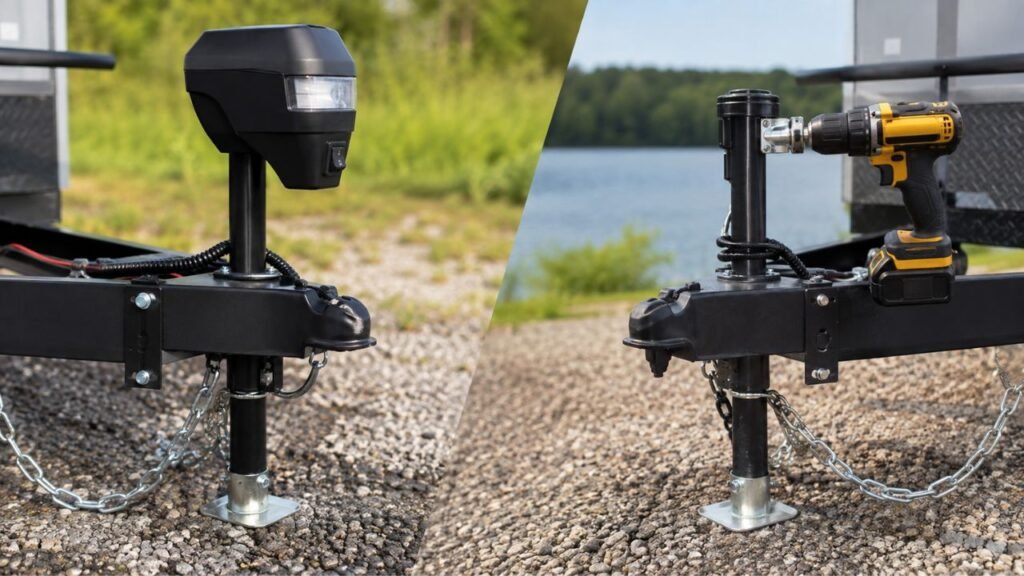
An electric trailer jack is usually better for frequent RV towing and maximum convenience, while a drill-powered trailer jack is better for lower-cost, wiring-free operation. However, the better choice ultimately depends on tongue weight, lifting capacity, towing frequency, and how much setup effort you want.
In this guide, I’ll compare both options in real-world terms. We’ll look at lifting power, speed, installation, battery use, reliability, maintenance, costs, and which jack makes the most sense for different trailers.
Key Takeaways
- Electric trailer jacks offer the easiest push-button operation.
- Drill-powered jacks provide powered lifting without permanent trailer wiring.
- Choose a jack using actual loaded tongue weight, not trailer weight alone.
- Lift capacity matters more than whether the jack is electric.
- Some drill-powered jacks have lower ratings when operated by a drill.
- Electric jacks work especially well for frequent hitching and unhitching.
- Drill-powered jacks are attractive for occasional or off-grid trailer use.
- Many electric jacks include a manual override for power failures.
- Never assume every manual trailer jack can safely use a drill.
- Always follow the jack manufacturer’s approved operating method and capacity.
Electric Trailer Jack vs Drill-Powered Trailer Jack: Quick Comparison
Both systems eliminate most of the hand-cranking associated with traditional jacks. The real differences involve convenience, power source, installation, and operating limits.
| Feature | Electric Trailer Jack | Drill-Powered Trailer Jack |
| Power source | Trailer’s 12V electrical system | Cordless drill battery |
| Operation | Push-button switch | Attach drill and operate drive |
| Permanent wiring | Usually required | Usually unnecessary |
| Physical effort | Very low | Low |
| Setup before operation | Almost none | Drill must be attached |
| Lifting capacity | Depends on model | Depends on model and drill rating |
| Speed | Consistent and convenient | Depends on drill and gearing |
| Power failure backup | Often manual override | Usually manual crank available |
| Frequent hitching | Excellent | Good |
| Weight distribution hitch use | Usually very convenient | Depends heavily on lifting rating |
| Off-grid simplicity | Good | Excellent |
| Installation complexity | Moderate | Usually simpler |
| Electrical maintenance | Higher | Lower |
| Upfront cost | Usually higher | Often lower |
| Best for | Frequent RV and trailer users | Occasional and wiring-free setups |
Neither choice is automatically stronger. Always compare the jack’s actual lifting rating with your trailer’s loaded tongue weight.
What Is the Difference Between Electric and Drill-Powered Trailer Jacks?
Both types raise and lower the front of your trailer. The main difference is how that lifting force gets generated.
How an Electric Trailer Jack Works
An electric trailer jack has a permanently installed electric motor. Most RV tongue jacks connect to the trailer’s 12V system.
You normally operate the jack using an extend-and-retract switch. Press one direction, and the jack raises the trailer. Press the other direction, and the jack lowers it.
Many electric jacks also include useful convenience features, such as:
- Built-in LED work lights
- Weather-resistant switches
- Manual crank overrides
- Automatic stopping systems
- Height memory on certain models
- Remotely controlled operation on some premium models
Once installed, there is very little setup involved. Walk to the tongue, press the switch, and start adjusting.
That simplicity becomes especially valuable when you hitch frequently.
How a Drill-Powered Trailer Jack Works
A drill-powered trailer jack uses a mechanical gearbox instead of a built-in motor. A cordless drill connects to the jack’s drive mechanism through an approved adapter.
The drill then replaces much of the hand-cranking effort.
You still get powered lifting, but the power source travels separately. Your cordless drill and its battery essentially become the motor.
That setup offers several advantages.
There is usually no permanent electrical wiring to install. The jack can often still be operated manually if necessary.
The tradeoff is an extra setup step every time.
You need to retrieve your drill, attach it correctly, choose the proper direction, and operate the jack at the recommended speed.
Do Not Confuse a Drill-Powered Tongue Jack With Stabilizer Jacks
A drill-powered tongue jack and drill-operated RV stabilizers serve different purposes.
The tongue jack raises and lowers the front of your trailer. It supports significant tongue weight while hitching and unhitching.
RV stabilizer jacks have a different job. They reduce rocking and movement after the trailer is already parked.
You may have seen inexpensive drill sockets designed for stabilizer jacks. Those accessories can make campsite setup much faster.
However, that does not mean stabilizer jacks should lift the trailer.
Likewise, attaching a random drill socket to a manual tongue jack does not automatically make it safe for powered operation.
Use a drill only when the jack manufacturer specifically allows it.
Lift Capacity Matters More Than the Power Source
This is where trailer jack comparisons often become misleading. An impressive number printed on the jack does not always represent what it can actually lift.
Tongue Weight Is Not the Same as Trailer Weight
Your jack normally supports the trailer’s tongue, not its entire weight.
Suppose your travel trailer weighs 7,000 pounds loaded. That does not automatically mean you need a 7,000-pound lifting jack.
The jack handles the tongue portion of that weight.
Conventional trailers commonly place roughly 10% to 15% of their loaded weight on the tongue. Your actual percentage can vary.
For example, a 7,000-pound loaded trailer might have around 700 to 1,050 pounds of tongue weight.
But don’t rely only on estimates.
Cargo location, batteries, propane tanks, water, storage, and accessories can all change tongue weight.
Measure or verify your loaded tongue weight whenever possible.
Lift Capacity vs Support Capacity
Another important distinction is lift capacity versus support capacity.
Lift capacity tells you how much weight the jack can raise while moving.
Support capacity tells you how much weight it can hold while stationary.
Those numbers may be very different.
For example, a jack might support several thousand pounds while stationary but safely lift much less.
When selecting your jack, pay closest attention to the lifting capacity.
That is the number doing the real work during hitching.
Drill-Powered Capacity Can Be Different
Drill-powered jacks add another important specification.
Some models have one lifting capacity when hand-cranked and another when powered by a drill.
The drill-powered rating can be significantly lower.
Imagine a jack advertised with a 5,000-pound static capacity. That sounds extremely strong.
However, it might lift only 1,600 pounds manually and 800 pounds with a drill.
That changes the buying decision considerably.
Whenever you consider drill operation, check these specifications separately:
- Static or support capacity
- Manual lifting capacity
- Drill-powered lifting capacity
- Recommended drill specifications
Never assume the largest advertised number applies to every operating method.
How Much Trailer Jack Capacity Do You Need?
Start with your trailer’s actual loaded tongue weight.
Then compare that number against the jack’s moving lift capacity.
I also recommend leaving some working margin. Running any mechanical system constantly near its maximum rating can create unnecessary strain.
Your basic process should look like this:
- Determine your loaded tongue weight.
- Check the jack’s actual lift rating.
- Check its drill-powered rating when applicable.
- Consider extra loading from your hitching procedure.
- Choose reasonable capacity above normal operating demand.
- Follow trailer and jack manufacturer recommendations.
This approach is much safer than shopping by trailer GVWR alone.
Electric vs Drill-Powered Jack Performance in Everyday Use
Specifications matter, but everyday convenience matters too. The difference becomes obvious after several campsite setups.
Which Trailer Jack Is Easier to Use?
The electric jack wins this category.
There is almost nothing to prepare.
You walk to the trailer tongue and press a switch.
A drill-powered jack still saves substantial physical effort. However, there are more steps involved.
You normally need to:
- Find the cordless drill
- Confirm the battery is charged
- Attach the correct adapter
- Select the proper direction
- Operate the jack
- Remove and store the drill afterward
That process isn’t difficult.
If you camp twice each year, you may barely notice it.
If you move every few days, the electric jack becomes much more appealing.
Which Trailer Jack Is Faster?
There is no universal winner based purely on lifting speed.
Actual speed depends on:
- Gear ratio
- Jack design
- Tongue weight
- Jack travel distance
- Electric motor speed
- Drill speed
- Drill torque
- Battery condition
A powerful cordless drill can operate some jacks surprisingly quickly.
However, electric jacks usually feel faster in practice because there is no tool setup before operation.
The switch is already there.
For regular RV travel, that convenience matters more than saving a few seconds during the actual lift.
Which Is Better for Frequent Hitching?
Electric is generally better for repeated hitching and unhitching.
This is especially true for:
- Full-time RVers
- Frequent weekend campers
- Contractors
- Mobile work trailers
- People changing campsites regularly
- Anyone wanting minimal setup effort
A drill-powered system still works.
It simply asks you to handle an extra tool each time.
Which Jack Is Better With a Weight Distribution Hitch?
An electric jack generally makes weight distribution hitch setup easier.
Many weight distribution systems require you to raise the coupled trailer and rear of the tow vehicle slightly before connecting or releasing the spring bars.
That can require more lifting effort than simply raising an uncoupled trailer tongue.
You may also raise and lower the jack several times during the process.
A properly sized electric jack makes these repeated movements much easier.
A drill-powered jack can also work well, but capacity becomes especially important.
Do not assume that a jack handling your normal tongue weight automatically has enough drill-powered capacity for every weight distribution procedure.
Check the jack manufacturer’s limits before depending on it.
Power Requirements: Trailer Battery vs Cordless Drill Battery
Both systems depend on electricity during powered operation. They simply get that electricity from different places.
Electric Trailer Jack Power Requirements
Most electric tongue jacks connect to a 12V trailer battery.
Installation may involve:
- Battery wiring
- Proper grounding
- Fuse or circuit protection
- Correct wire size
- Weather-protected connections
A healthy battery provides predictable operation.
A weak battery can make the jack move slowly or stop under load.
Electrical connections also matter.
Corrosion, loose grounds, damaged wiring, or blown fuses can create problems that look like a failing jack motor.
Some systems may also receive approved power through the tow vehicle connection.
However, never assume every electric jack supports the same wiring arrangement.
Follow the installation instructions for your specific model.
Drill-Powered Trailer Jack Requirements
The drill becomes part of the lifting system.
That means drill compatibility matters just as much as jack compatibility.
A manufacturer may specify:
- Minimum drill voltage
- Maximum recommended voltage
- Required chuck size
- Non-impact operation
- Low-speed operation
- Torque recommendations
- Approved drive adapters
A larger, faster drill is not automatically better.
Too much speed or improper impact operation can put unnecessary stress on the jack’s gearing.
Use the recommended drill type rather than whatever tool happens to fit.
Can You Use an Impact Driver on a Drill-Powered Trailer Jack?
Do not assume an impact driver is safe for your trailer jack.
Impact drivers deliver repeated hammering force through the drivetrain. That is useful for fasteners but may not be appropriate for a jack gearbox.
Some purpose-built drill-powered jacks specifically require a standard non-impact cordless drill.
Even if an impact driver physically fits the adapter, that does not mean the manufacturer approves it.
The safer rule is simple.
Use the tool type listed in the jack’s instructions.
If the manufacturer specifies a cordless drill, use a cordless drill.
That protects the gearbox and keeps operation more controlled.
What Happens If the Battery Dies?
Battery failure is often presented as an electric-jack weakness. In reality, both systems can have straightforward backup options.
Electric Jack With a Dead Trailer Battery
A dead trailer battery does not always leave you stranded.
Many electric tongue jacks include a manual override.
You remove the appropriate cover, insert the supplied crank, and operate the jack manually.
Some trailer electrical systems may also allow another approved 12V power source.
Depending on your setup, possible backup options include:
- Manual override crank
- Tow-vehicle electrical power
- Approved portable 12V power source
- Replacement or charged trailer battery
Still, confirm your backup procedure before you actually need it.
Trying to figure it out during a rainy roadside stop is frustrating.
Drill-Powered Jack With a Dead Drill Battery
The solution is usually straightforward.
Install another charged drill battery.
Many RVers already carry multiple batteries for cordless tools.
If every battery is dead, many purpose-built drill-powered jacks can still be operated with a manual crank.
That gives drill-powered systems a useful simplicity advantage.
The jack itself does not depend on the trailer’s electrical system.
Installation: Which One Is Easier to Add to a Trailer?
Installation varies between models, but drill-powered jacks usually require less electrical work. Both still need proper mechanical fit.
Installing an Electric Trailer Jack
Replacing an existing A-frame jack can be fairly straightforward.
However, you still need to check:
- Mounting bolt pattern
- Jack tube diameter
- Available A-frame opening
- Retracted height
- Extension range
- Tailgate clearance
- Propane tank clearance
- Ground clearance
- Electrical wiring route
- Battery location
- Fuse requirements
Physical fit matters just as much as capacity.
A powerful jack that blocks your tailgate or hangs too low creates another problem.
Installing a Drill-Powered Trailer Jack
The biggest advantage is usually the lack of permanent electrical wiring.
You still need to verify:
- Mounting configuration
- Tube diameter
- Bolt pattern
- Jack travel
- Retracted clearance
- Drive location
- Space around propane tanks
- Room to attach the drill
That last point is easy to overlook.
If the drill must connect from the side or top, make sure nearby equipment doesn’t block access.
Can You Convert Your Existing Manual Jack?
Sometimes.
But this is an area where improvising can damage equipment.
Some manual jacks are specifically designed for drill-powered operation. Others accept approved conversion accessories.
Some are intended only for hand cranking.
Do not simply attach a socket and cordless drill because the drive happens to fit.
The jack’s gears, shaft, bearings, and internal components may not be designed for powered operation.
Check the manufacturer’s instructions first.
If drill operation is not approved, replace the jack with one designed for it.
Electric vs Drill-Powered Trailer Jack Cost
The drill-powered option is often cheaper, but your existing tools influence the real cost.
Consider the complete ownership cost, including:
- Jack purchase price
- Wiring supplies
- Professional installation
- Cordless drill purchase
- Drill batteries
- Approved adapters or sockets
- Replacement switches
- Replacement motors
- Electrical repairs
- Gear lubrication
- Manual backup equipment
Electric jacks usually cost more initially.
You are paying for the built-in motor, switches, wiring, and added convenience.
A drill-powered jack can be an excellent value if you already own the correct drill and batteries.
If you must buy a high-quality drill only for the jack, the price difference becomes smaller.
Reliability and Maintenance
Both jack types can last for years when properly sized and maintained. Their failure points are simply different.
Electric Trailer Jack Maintenance
Electric jacks combine mechanical and electrical components.
Periodically inspect:
- Battery condition
- Power cables
- Grounds
- Fuse
- Switches
- Motor housing
- Gear mechanism
- Mounting bolts
- Jack tube
- Corrosion
- Weather seals
Keep electrical connections clean and protected.
Lubricate mechanical components only according to manufacturer instructions.
Avoid assuming every jack uses the same grease or lubrication points.
Drill-Powered Trailer Jack Maintenance
A drill-powered jack has fewer permanently installed electrical components.
That removes motors, switches, and trailer wiring from the jack itself.
However, it still needs attention.
Inspect:
- Drive adapter
- Gears
- Crank mechanism
- Mounting bolts
- Jack tube
- Corrosion
- Drill chuck
- Drill batteries
Store the cordless drill somewhere dry and secure.
A perfectly maintained jack won’t help if your drill battery has been sitting dead for six months.
Which Has Fewer Failure Points?
A simple drill-powered mechanical jack generally has fewer installed electrical failure points.
However, fewer parts do not guarantee better reliability.
Overall durability depends on:
- Build quality
- Gear design
- Proper sizing
- Corrosion resistance
- Maintenance
- Weather exposure
- How heavily the jack gets used
A quality electric jack can easily outperform a poorly built mechanical one.
Buy based on specifications and construction rather than power source alone.
Which Handles Rain, Dirt, and Outdoor Storage Better?
Neither jack style automatically wins in bad weather.
An electric jack permanently exposes its motor housing, switches, wiring, and mechanical components to outdoor conditions.
That makes weather sealing important.
A drill-powered jack leaves fewer electrical components outside, but its mechanical parts still face rain, dust, mud, and corrosion.
The drill itself should normally be stored indoors or inside your tow vehicle.
When comparing models, look at:
- Protective coatings
- Weather-resistant housings
- Sealed switches
- Corrosion-resistant hardware
- Protected electrical connections
- Manufacturer lubrication instructions
Boat trailer owners should pay particular attention to corrosion protection.
Saltwater exposure can shorten the life of poorly protected hardware quickly.
Electric vs Drill-Powered Jack for Different Trailer Types
The right jack often depends more on how you use your trailer than the trailer category itself.
Travel Trailers
For most frequently used travel trailers, I prefer electric.
Regular campground setup means repeated hitching, leveling adjustments, and sometimes weight distribution hitch operation.
Push-button control reduces effort every time.
The larger your travel trailer becomes, the more valuable that convenience feels.
Utility and Cargo Trailers
Either system can work well.
A drill-powered jack is particularly attractive when the trailer has no dedicated battery.
You get powered lifting without installing an electrical system just for the jack.
For commercial trailers used constantly throughout the workday, electric operation may still be worth the added cost.
Boat Trailers
Both styles can work, but corrosion protection deserves extra attention.
A drill-powered system keeps the drill itself away from constant outdoor exposure because you store it separately.
An electric jack can still work very well if designed for the environment.
Avoid choosing solely by power method.
Construction quality matters more around water.
Car Haulers and Equipment Trailers
Capacity should make the decision first.
Heavy tongue loads can exceed what some lighter drill-powered systems can safely raise.
That does not mean every drill-powered jack is unsuitable.
Heavy-duty drill-compatible jacks exist.
Compare your real tongue weight against the specific powered lifting rating.
Small Campers and Occasional-Use Trailers
Drill-powered operation often makes excellent sense here.
You can avoid permanent wiring and still eliminate most hand cranking.
If you tow only several weekends yearly, attaching a drill takes very little extra effort.
The lower complexity may be worth more than one-button convenience.
Who Should Choose an Electric Trailer Jack?
An electric jack makes the most sense when convenience matters every time you tow.
Consider electric if you:
- Hitch and unhitch frequently.
- Travel regularly with your RV.
- Use a weight distribution hitch.
- Want immediate push-button operation.
- Already have a healthy 12V trailer battery.
- Prefer integrated lighting or convenience features.
- Have difficulty with repetitive hand or shoulder movement.
- Want fewer tools involved during setup.
- Frequently set up after dark or in poor weather.
For many regular travel-trailer owners, this becomes the easiest long-term choice.
Who Should Choose a Drill-Powered Trailer Jack?
A drill-powered jack offers an appealing balance between manual simplicity and powered operation.
Consider drill-powered if you:
- Want to avoid permanent trailer wiring.
- Already carry a compatible cordless drill.
- Tow only occasionally.
- Want an easy mechanical backup.
- Own a small camper, utility, boat, or cargo trailer.
- Frequently camp away from trailer electrical power.
- Prefer fewer permanently installed electrical components.
- Have confirmed the drill-powered lift rating meets your needs.
It can be a very practical solution when your towing routine stays simple.
When Should You Avoid a Drill-Powered Jack?
Drill-powered operation is convenient, but it is not right for every setup.
Avoid or reconsider it when:
- Drill-powered capacity is below your loaded tongue weight.
- The jack manufacturer does not approve drill operation.
- Your available drill does not meet required specifications.
- You hitch and unhitch multiple times daily.
- Your weight distribution procedure creates heavier lifting demands.
- You dislike retrieving and attaching tools during every setup.
- Controlling a high-torque cordless drill feels uncomfortable.
- You want completely hands-off push-button operation.
The biggest mistake is forcing drill operation onto an unsuitable jack.
When Is an Electric Trailer Jack Probably Overkill?
Not everyone needs an electric jack.
If you tow a very light trailer only a few times yearly, a drill-powered or even manual jack may already be convenient enough.
Electric may also be unnecessary when your trailer has no onboard 12V battery.
Installing wiring solely for occasional jack use adds cost and complexity.
Likewise, if your current drill-powered jack raises the trailer comfortably and quickly, upgrading may not improve your experience enough to justify the expense.
Buy the convenience you will actually use.
Electric Trailer Jack vs Drill-Powered Trailer Jack: Which Is Better for You?
Your towing routine should decide the winner more than marketing claims. Here’s a practical way to narrow the choice.
| Your Situation | Better Choice |
| Frequent travel-trailer camping | Electric |
| Regular weight distribution hitch use | Electric |
| Maximum everyday convenience | Electric |
| Limited physical effort preferred | Electric |
| No trailer battery available | Drill-powered |
| Already own compatible cordless drill | Drill-powered |
| Occasional trailer use | Drill-powered |
| Want fewer installed electrical parts | Drill-powered |
| Heavy tongue weight | Compare lift ratings first |
| Commercial trailer use | Depends on capacity and frequency |
| Remote/off-grid use | Drill-powered has an advantage |
| Frequent nighttime setup | Electric often feels more convenient |
| Want immediate operation | Electric |
| Prefer simple manual backup | Drill-powered |
If you’re still undecided, focus on four questions.
How heavy is the loaded tongue?
How often do you hitch?
Do you already have reliable trailer power?
How important is push-button convenience?
Those answers usually make the choice fairly obvious.
Final Verdict
For the typical U.S. travel-trailer owner who camps regularly, an electric trailer jack is the better all-around choice.
You press a switch and the jack works. There is no drill to retrieve, adapter to install, or tool battery to check first.
That convenience becomes especially useful with larger travel trailers and weight distribution hitches.
A drill-powered trailer jack is the better value when you tow occasionally, already own a suitable cordless drill, or want powered operation without permanent trailer wiring.
It also gives you a simple path back to manual operation when necessary.
Most importantly, don’t choose either system using the largest capacity number printed on the product page.
Check the actual lifting capacity.
If you’re considering drill operation, check the drill-powered lifting rating separately.
Match that rating to your loaded tongue weight, allow reasonable working capacity, and use the power method approved by the manufacturer.
Do that, and either jack style can make hitching far easier.
Related FAQs
Is an Electric Trailer Jack Better Than a Drill-Powered Jack?
An electric trailer jack is usually better for frequent towing because operation requires only a button. A drill-powered jack makes more sense when you want lower complexity, no permanent wiring, and occasional powered lifting.
Are Drill-Powered Trailer Jacks Safe?
Yes, purpose-built drill-powered trailer jacks are safe when operated within their rated capacity. Use the manufacturer-approved drill, adapter, speed, and operating method rather than modifying an unsupported manual jack.
How Much Weight Can a Drill-Powered Trailer Jack Lift?
Capacity varies widely between models. Some manufacturers also specify a lower drill-powered capacity than manual lift capacity, so always check the rating specifically listed for drill operation.
Can I Use Any Cordless Drill With a Trailer Jack?
No. Drill voltage, torque, chuck size, operating speed, and impact capability can matter. Use a drill that meets the exact requirements provided by the trailer jack manufacturer.
Can I Use an Impact Driver on a Trailer Jack?
Only if the jack manufacturer specifically approves impact operation. Many drill-powered jacks require a standard non-impact cordless drill because repeated impacts can stress gears and other internal components.
Can I Convert a Manual Trailer Jack to Drill Power?
Some manual jacks can accept manufacturer-approved drill adapters, while others cannot. Do not convert a jack simply because a socket fits its crank shaft. Confirm drill operation is officially supported.
How Big of an Electric Trailer Jack Do I Need?
Choose capacity based mainly on your actual loaded tongue weight and required lifting load. Compare that figure against the jack’s lift rating rather than choosing solely from the trailer’s gross weight.
Does Trailer Jack Capacity Refer to Trailer Weight or Tongue Weight?
A tongue jack primarily handles the load placed on the trailer tongue. However, product ratings can describe lifting or static capacity differently, so verify what each capacity figure actually represents.
What Is the Difference Between Lift Capacity and Support Capacity?
Lift capacity describes how much weight a jack can raise while moving. Support capacity describes how much weight it can hold while stationary. The support rating is often higher.
Will an Electric Trailer Jack Work if the RV Battery Is Dead?
Powered operation may stop with a dead trailer battery, but many electric jacks include manual overrides. Some setups may also accept another approved 12V source or tow-vehicle power.
Can a Drill-Powered Jack Be Used With a Weight Distribution Hitch?
It can, provided its powered lifting capacity safely handles the load created during your hitch procedure. Check both the jack manufacturer’s rating and your weight distribution hitch instructions.
Are Drill-Powered Trailer Jacks Good for Travel Trailers?
Yes, especially for smaller or occasionally used travel trailers. Frequent campers may still prefer electric because it eliminates the need to retrieve and attach a cordless drill during every setup.
Which Trailer Jack Is Better for Off-Grid Camping?
A drill-powered jack has an advantage because it does not depend on the trailer’s 12V system. Carry charged drill batteries and retain the manual crank for additional backup.
Does an Electric Trailer Jack Drain the RV Battery?
An electric jack draws battery power only while operating, so normal use should not heavily drain a healthy battery. Repeated operation with a weak battery can still become problematic.
Is a Drill-Powered Tongue Jack the Same as a Drill Adapter for Stabilizer Jacks?
No. A tongue jack lifts the front of the trailer during hitching. Stabilizer jacks primarily reduce movement after parking and are generally not designed to lift significant trailer weight.

Jack Collins specializes in RV routes, trail access, and travel logistics. His how-to articles help RV and trailer owners plan smoother trips and avoid common mistakes. Every review focuses on performance, safety, and value.